
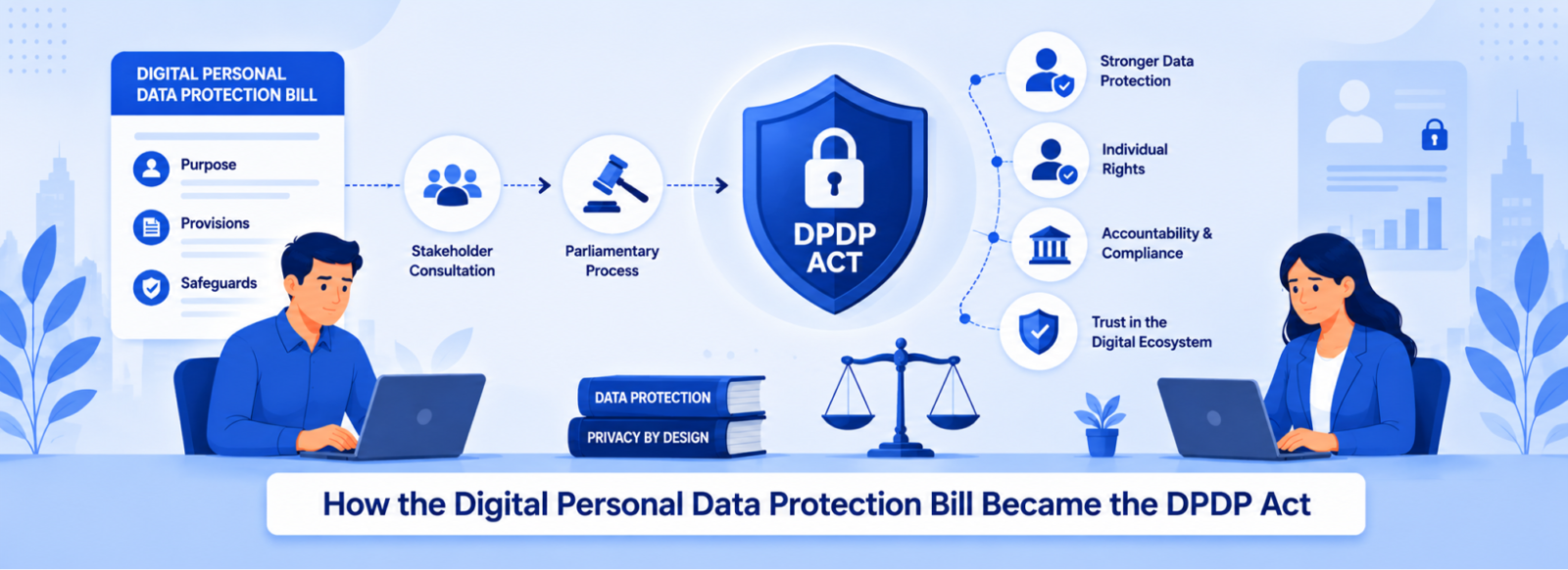
India’s approach to data protection changed shape several times before the Digital Personal Data Protection Act finally arrived in its current form. The long transition from draft bill to enforceable legislation did more than rename a regulatory framework. It altered compliance expectations, narrowed some obligations, expanded others and quietly shifted accountability onto businesses handling personal data at scale.
Many organisations focused on the headline changes. Fewer paid attention to the operational obligations hidden beneath the legal language. That gap is already becoming visible across sectors like healthcare, fintech, SaaS, logistics, manufacturing and retail.
The question of how the digital personal data protection bill became the DPDP Act reflects more than legislative evolution. It is a practical shift in how Indian businesses are expected to collect, process, retain, and secure personal information.
Why the Transition Matters
The earlier versions of the bill carried broader compliance structures that resembled elements of GDPR. Over time, several provisions were simplified or reframed. Some organisations interpreted this simplification as reduced pressure. That assumption may prove expensive.
The DPDP Act focuses heavily on accountability around digital personal data. It also gives the central government significant flexibility in defining rules, exemptions, and enforcement mechanisms. That means compliance is not static. Businesses waiting for “full clarity” before acting may find themselves behind once enforcement tightens.
What changed most was the practical expectation placed on data fiduciaries. Organisations are now expected to demonstrate responsible handling of personal data rather than merely publish privacy policies.
From Bill to Act
The legislative journey moved through multiple drafts, committee reviews, industry consultations, and public criticism. Concerns around surveillance, localisation, cross-border transfers and state exemptions repeatedly shaped revisions.
The final DPDP Act introduced a framework that is narrower than many expected but operationally sharper in key areas. A few major shifts stand out:
| Earlier Focus | DPDP Act Direction |
| Broad personal data regulation | Digital personal data only |
| Heavy localisation concerns | Selective cross-border transfers |
| Large compliance architecture | Simpler but stricter accountability |
| Multiple categories of sensitive data | Unified personal data approach |
| Detailed procedural obligations | Principle-based responsibilities |
This is how the Digital Personal Data Protection Bill became the DPDP act and also quite commercially important. The law no longer rewards checkbox compliance. It expects businesses to understand where personal data exists, why it is processed and what risks surround it.
The Five Obligations Businesses Missed
Several obligations received limited attention during public discussion because the industry focus stayed fixed on penalties and consent banners. In practice, these less discussed areas are likely to create operational friction first.
-
Consent Control
Consent under the DPDP Act is expected to be specific, informed, unconditional and revocable. Many businesses still depend on bundled consent structures buried inside terms of service. That model is unlikely to survive regulatory scrutiny for long.
Consent records also need to be demonstrable. If challenged, organisations may need evidence showing when consent was obtained, how it was presented, and whether withdrawal mechanisms actually worked.
-
Data Mapping
A surprising number of organisations still do not know where all personal data resides internally. Legacy applications, unmanaged cloud storage, third-party vendors, archived databases, and employee-owned systems continue to create blind spots. The DPDP Act indirectly raises pressure on businesses to maintain accurate visibility over data flows.
Without data mapping, deletion requests, retention controls, or breach investigations become difficult very quickly.
-
Vendor Oversight
The law may apply to data processors even when they operate indirectly through outsourcing chains.
Businesses often assume vendor risk ends after signing a contractual clause. Real-world incidents suggest otherwise. Third-party exposure remains one of the fastest ways sensitive information leaks into unauthorised environments.
This issue has become more serious as organisations integrate SaaS tools, AI platforms, analytics services and offshore support providers into daily operations.
-
Breach Reporting
The DPDP Act places major emphasis on reporting personal data breaches to the Data Protection Board and affected individuals. That sounds straightforward on paper. Operationally, it is difficult.
Many organisations still lack:
- Clear breach classification criteria
- Internal escalation timelines
- Forensic readiness
- Communication playbooks
- Evidence preservation processes
This creates hesitation during active incidents. Delayed reporting often worsens regulatory exposure.
-
Data Retention
Businesses frequently collect more information than necessary and keep it indefinitely. The Act changes the risk attached to that behaviour. Retaining unnecessary personal data expands liability during breaches and investigations.
Data minimisation is no longer just a governance concept. It has become a practical security requirement.
Where Security Teams Struggle
One overlooked aspect in how the Digital Personal Data Protection Bill became the DPDP Act is the operational burden placed on security and compliance teams already managing fragmented environments. The challenge is not policy creation. Most enterprises already have policy documents.
The difficulty sits elsewhere:
- Shadow IT environments
- Untracked third-party integrations
- Poor asset inventories
- Weak software supply chain visibility
- Inconsistent logging
- Delayed patching cycles
Modern data protection compliance increasingly overlaps with software supply chain security. If organisations cannot identify which applications process personal data or which third-party components exist inside those systems, risk assessment becomes unreliable.
That problem grows larger in environments using open-source dependencies without formal inventory management.
The Supply Chain Problem
The DPDP Act does not explicitly centre itself around software bills of materials, but the connection is becoming difficult to ignore.
Security incidents increasingly originate through software supply chain weaknesses rather than direct attacks on core infrastructure. A vulnerable third-party library inside a customer-facing application can expose personal data just as effectively as a phishing attack.
Businesses preparing for long-term compliance are starting to combine privacy governance with stronger asset and dependency visibility.
This is especially relevant for organisations operating cloud-native infrastructure, DevSecOps pipelines or outsourced development ecosystems.
Compliance is Becoming Continuous
The earlier mindset around annual audits and static compliance reviews no longer fits current risk conditions.
The DPDP framework pushes organisations toward ongoing governance. Data inventories change constantly. Vendors change. Applications evolve. Employees move information across systems faster than governance teams can track manually.
That reality matters more than legislative wording. The real lesson behind how the Digital Personal Data Protection Bill became the DPDP Act is that privacy obligations are now operational security obligations too.
Businesses treating the Act as a legal documentation exercise are more likely to miss the larger shift happening underneath.
Conclusion
The DPDP Act represents a structural change in how organisations operating in India must approach digital personal data. Compliance now extends beyond legal interpretation into infrastructure visibility, vendor governance, breach readiness, and software supply chain awareness.
Many businesses are still focused on surface-level adjustments like updated privacy notices or consent banners. Those measures matter, but they are only part of the picture. Long-term resilience depends on understanding where data exists, how software components interact with it, and where hidden operational risks remain.
As regulatory expectations continue evolving, stronger visibility across applications and dependencies is becoming increasingly difficult to avoid. CyberNX DPDP Consulting Services can help organisations test their current exposure, strengthen governance practices, identify compliance gaps, and prepare operationally for growing DPDP requirements. As enforcement matures, businesses will need stronger alignment between privacy obligations, cybersecurity controls, and day-to-day data handling practices.
