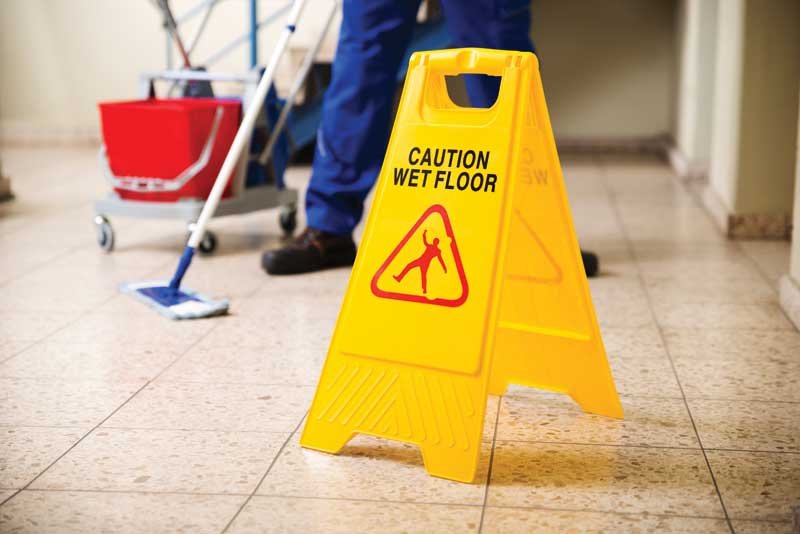
Ensuring floor access covers are safe, watertight, and easy to open are all vital. Then there’s deciding on the level of slip resistance. If you think “the more slip resistance the better” you’re mistaken, overly slip-resistant surfaces can hinder wheeled traffic or require excessive force to open.
Understanding the Testing Methods: PTV vs DCOF
There are two main standards used to measure the slip resistance of floor surfaces, and they actually measure two different things.
The Pendulum Test Value (PTV) regulated by BS EN 13036-4 mimics a heel strike on a wet surface through the use of a standardized rubber slider. PTVs above 36 indicate low slip potential, while under 24 is considered high risk. The PTV is a good, quick measure, and while it is not as simplistic as 1-2-3, it is close. It represents what is often the most effective solution available for controlling slipping, that is, engineering the slip-resistance of the flooring to avoid slips, falls, and their consequences in the majority of expected environmental conditions.
ANSI A326.3 is the standard regulating Dynamic Coefficient of Friction (DCOF) testing in the U.S. context. If the floor is likely to be wet in normal use, level interior walking surfaces (not thresholds) are required by this standard to have a minimum DCOF of 0.42. The DCOF test measures the available friction as something is actually in motion, rather than static, and therefore is most relevant for actual real-world walking surfaces where contamination is a regular condition.
Generally, if a surface is satisfactory for a walking test since traction is provided and the walker does not slip on first contact, the pendulum test is also likely to predict satisfactory performance. It measures the same thing in essence but in a controlled environment rather than actual human kinetics. A surface that passes both is less likely to generate complaints and require costly litigation, and it is therefore recommended.
Structural Deflection as a Slip and Trip Multiplier
Load rating may be a structural consideration, but the safety consequences go straight to slip risk. If an access cover is under-specified for its traffic load, i.e. the class selected is too low, then the frame may warp and the cover deflect under repeated loading.
That deflection has two consequences. First, it creates a trip edge around the perimeter of the cover which is unacceptable in any high-slip-risk location and for which no inclusion of grit in any subsequent coating can compensate. Second, it results in water ponding in the centre of the deflected cover, and this is the area most likely to dry last. The minimum required coefficient of friction will therefore be more likely to be breached for longer after conditions that compromise it, such as dirt or grease, have been present.
When you are looking to specify high-performance access systems in industrial or public applications, ensure you partner with experienced manufacturers like Surespan so that floor covers are designed and supplied with both the structural load capacity and the correct slip-resistant surface treatment for the anticipated application. Specifying the right load class first time around is not just the most elegant solution; it is the safest.
The Transition Hazard Most Specifications Miss
There is a specific risk associated with recessed access covers designed to accept infill materials. The infill must first be a suitable material in compression, but beyond that, it must also meet two important criteria. The slip resistance rating must equal that of the surrounding floor finish, and the surface height must also precisely match the surrounding floor finish.
It’s the most common cause of slips and falls at access covers. A difference of even 2-3mm between the cover surface and the adjacent floor will create a trip edge, with pedestrians most at risk as their feet are following an irregular path, no matter if they’re moving quickly or bearing a heavy load.
More insidious is the traction transition. A person walking from a terrazzo floor that has an R-rating / PTV surface of 42 onto an infill panel that has an R-rating / PTV surface of 28 will generally experience no visual or physical warning of the imminent loss of traction. There is no step up, they don’t see a difference, there is just a sudden loss of grip underfoot.
How Slip-Resistant Finishes Degrade and What to Specify Instead
Coatings on metal covers are factory applied and not designed to last forever. In extreme environments, the anti-slip properties of bead-blasted or grit-coated surfaces can degrade to ineffective levels within just 18 to 24 months of installation. This cover may look perfectly fine to the naked eye, but micro-roughness has diminished to the point where it no longer provides any increased grip in the wet.
Protection against this type of premature performance decline is to not specify it in the first place. Chequer plate and tread plate patterns are embossed into the top surface of the cover during manufacture, creating a far stronger, reliable, and long-lasting mechanical grip. This represents a better strategy when faced with heavy wheeled traffic, cleaning chemicals, or lubricating oils and grease found in industrial applications. If your chosen application includes them, don’t detail a coated flat surface, equivalent to a pristine ex-works bead-blasted or grit-coated finish.
Specifying For Performance, Not Just Compliance
There are minimum compliance thresholds for a reason, but they are a bottom line level that is just about acceptable, not a level that will perform safely over a ten-year-service life.
Engineer slip-resistance as a property, not a checkbox. Test data, infill matching, load classification, and surface finish durability are all interrelated. Consider each variable at specification stage and the access cover becomes part of a safe, consistent floor system rather than a weak point within it.