
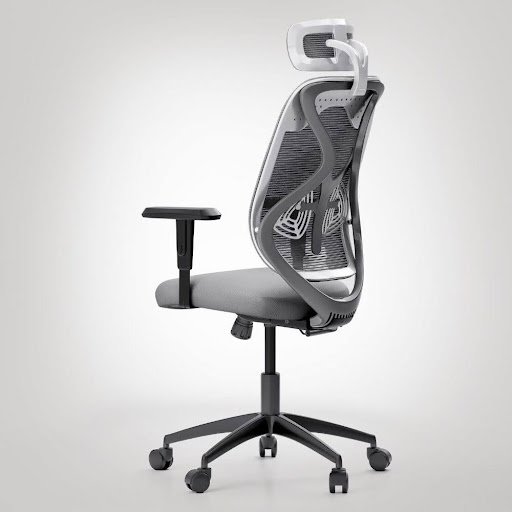
The number on a product page is not what a chair costs you. A Rs 5,000 office chair that fails in fourteen months and contributes to recurring lower back pain has a different true cost than its sticker suggests. Office chair price only makes sense when it’s measured against three things: how many hours per day you use it, what use-case you’re buying for, and how long the chair will actually last under that load. Here is what each price band delivers for the most common Indian buyer profiles – and where the numbers change.
Why does the same office chair price mean different things for different buyers?
A student sitting for two to three hours a day uses a chair very differently from a WFH professional putting in eight-hour focused sessions. The foam compresses at different rates. The mechanism wears differently. The support requirements are different. Treating both buyers as needing the same chair at any price point misses the central question: what is the actual cost per hour of productive, pain-free work?
| Buyer Type | Daily Hours | Use Pattern | Starting Price That Makes Sense |
| Student or light user | 2-3 hours | Occasional, varied posture | Rs 5,000-8,000 (basic spec is sufficient at low hours) |
| Hybrid worker (3-4 days WFH) | 5-6 hours | Moderate sustained sitting | Rs 10,000-15,000 (mesh back and adjustable lumbar minimum) |
| Full-time WFH professional | 7-9 hours | Long uninterrupted sessions | Rs 15,000-25,000 (complete spec required) |
| Corporate bulk buyer (multi-user) | Varies across shifts | Multiple users per chair | Rs 25,000+ (commercial durability justified here) |
What does total cost of ownership actually look like across office chair price tiers?
The honest comparison is cost per session, not the sticker price. A chair used by a full-time WFH professional across 250 working days per year will log around 1,750 to 2,000 sessions over five years. Here is what the numbers look like.
| Chair Price | Lifespan (Full-time WFH) | Total Sessions | Approx. Cost Per Session |
| Rs 5,000 | 14-18 months | ~350 sessions | Rs 14.30 |
| Rs 10,000 | 2.5-3 years | ~700 sessions | Rs 14.30 |
| Rs 15,000 | 4-5 years | ~1,100 sessions | Rs 13.65 |
| Rs 20,000 | 5-7 years | ~1,500 sessions | Rs 13.30 |
| Rs 25,000 | 7+ years | ~1,800 sessions | Rs 13.90 |
The cost per session is nearly flat across all tiers because better chairs last significantly longer. The Rs 5,000 chair doesn’t save money – it replaces itself twice in the time a Rs 20,000 chair runs without issue. The real cost difference is the one that doesn’t appear on any product page: recurring lower back pain, physiotherapy costs, and the productivity loss from chronic discomfort during long sessions.
What does each office chair price band actually deliver in India?
| Price Range | Foam Quality | Mechanism | Adjustability | Realistic Lifespan |
| Under Rs 5,000 | Low density, compresses within a year | Fixed gas lift, no tilt | Seat height only | 12-18 months |
| Rs 5,000-10,000 | Medium density, quality varies by brand | Basic tilt, fixed lumbar | Height + limited recline | 2-3 years |
| Rs 10,000-18,000 | High density foam or quality mesh | Adjustable tilt, lumbar height | Height + lumbar height + 2D arms | 3-5 years |
| Rs 18,000-28,000 | High density + quality mesh combined | Syncro-tilt with resistance settings | Full – lumbar depth, seat depth, 4D arms | 5-7 years |
| Rs 28,000+ | Commercial grade, multi-user rated | Multi-year commercial mechanisms | Full spec + extended warranty | 8-10 years |
The meaningful jump happens between Rs 10,000-18,000 and Rs 18,000-28,000. Below Rs 18,000, you are almost always giving up either seat depth adjustment or lumbar depth control. Above Rs 28,000, the increment is commercial-grade durability designed for multi-user, multi-shift environments – the kind of specification that adds no practical benefit for a single person at one desk.
How do Indian body proportions change which office chair price tier is right?
Most office chairs are built around a Western body dimension range. The average male height in India is approximately 5’5” – shorter than the design target of most international chairs. For users below 5’6”, the most critical feature is seat depth adjustment, which only appears reliably at the Rs 15,000 tier and above in the domestic market. A chair without seat depth control will have a seat pan that’s too long for a shorter user’s leg length, which pushes the user forward and away from the backrest. When you’re sitting away from the backrest, no lumbar support can reach your spine regardless of how it’s positioned.
For users with heavier builds – above 85 kg – foam density becomes the key variable at any price. Low-density foam (standard below Rs 8,000) compresses significantly within six to twelve months under higher loads. The chair then sits 3-4 cm lower than when new, which shifts the entire posture setup that was originally calibrated. Buying into the Rs 12,000+ foam density tier is not optional for heavier users – it’s what preserves the chair’s functional spec over time. An Rs 5,000 chair under a 90 kg user is not a 2-3 year chair. It’s closer to a 12-month chair.
What costs are not visible in the office chair price listed online?
Delivery and assembly are the most common additions. Most office chair listings in India price delivery separately – Rs 400-800 in metro cities – and assembly is often charged at Rs 500-1,500 as an add-on. These costs appear on checkout but not in the product listing price, which means a Rs 12,000 chair can land at Rs 14,000 delivered and assembled. Check what the brand includes before comparing prices across platforms.
Caster replacement is a cost most buyers don’t anticipate. If you buy a chair with nylon casters for a marble or tile floor – the default on most Indian home office chairs – you will need to replace them with rubber or soft-roll casters to prevent floor scratching and unwanted rolling. Replacement caster sets run Rs 500-1,000. Some brands include soft-roll casters or offer them as a variant. Worth checking upfront rather than after delivery.
Floor damage has a time lag. Nylon casters on polished marble tile leave hairline scratches within a few months that only become visible when the floor is cleaned. Marble polishing in an Indian metro costs Rs 8-15 per sq ft. The cost of choosing a chair that ships with the right casters is always lower than repolishing a floor section – but this only shows up six months after purchase, never in the product listing.
At what office chair price does daily WFH use become genuinely sustainable?
For someone working full-time from home – seven to eight hours per day on weekdays – the honest minimum is Rs 14,000-16,000. Below that threshold, at least one of three essential features is consistently absent: seat depth adjustment (required for users below 5’6”), lumbar depth control (required for sessions above five hours), or a breathable mesh back (required in Indian climate conditions where home offices don’t have central air conditioning).
The cost-per-day math is straightforward. A Rs 15,000 chair used across 250 working days per year for five years costs Rs 12 per working day. That’s the price of a chair that actually fits your body and holds up. A Rs 5,000 chair that needs replacing in 18 months and contributes to back discomfort costs more by every measure that matters.
Where does a higher office chair price stop making a difference?
For home users and individual WFH setups, the practical ceiling is Rs 25,000-28,000. At that price from a quality domestic brand, you have full adjustability, quality mesh back, syncro-tilt with resistance settings, and a lifespan of five to seven years under single-user daily use. Chairs above Rs 30,000 are engineered for commercial multi-user environments where the same chair takes different users across multiple shifts over a decade. For one person at home, the ergonomic benefit above a well-built domestic chair at Rs 22,000-25,000 is marginal – you are paying for a use-case that isn’t yours.
In the Rs 15,000-25,000 domestic range, a best office chair for daily WFH use should cover: full mesh back, lumbar adjustable in both height and depth, seat depth slider, and syncro-tilt with resistance settings. Those four features on the spec sheet confirm the chair is built for sustained single-user sessions rather than light or shared use. For anyone comparing options before deciding on a price tier, benchmarking against this spec is a faster shortcut than reading individual product reviews.
