
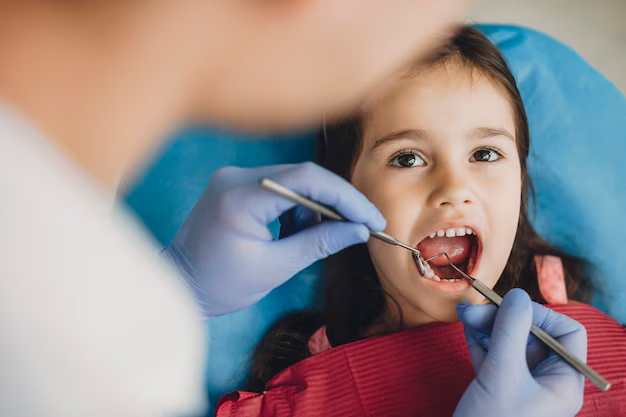
Walk into any forward-thinking dental office today and you’ll notice something that would have looked like science fiction twenty years ago. Cone-beam CT scanners render jaw structures in full three dimensions. Intraoral cameras capture real-time images that hygienists must interpret on the fly. The profession has changed, and the entrance exam for aspiring dental hygienists has quietly kept pace. The Allied Dental Hygiene Test, better known as the ATDH, doesn’t just gate-keep an academic program—it screens for a cognitive trait that separates competent clinicians from exceptional ones: spatial reasoning.
What the Perceptual Ability Test Actually Measures
The PAT section of the ATDH is the portion that catches most applicants off guard. Unlike reading comprehension or biology recall, the PAT asks you to rotate mental objects, judge angles without a protractor, and count cubes hidden inside stacked arrangements. These aren’t party tricks. Angle discrimination, for example, forces candidates to compare two angles and identify the larger one without any numerical reference—a task that mirrors the split-second judgment a hygienist makes when positioning a scaler at the correct angulation against a tooth’s root surface. Cube counting takes that further. When you’re staring at a block diagram and calculating how many cubes touch exactly three other cubes, you’re exercising the same neural pathways you’ll use while reading a periapical radiograph and mentally reconstructing what’s happening beneath the gum line.
From Abstract Shapes to Clinical Chairside Reality
Researchers at the University of Southern California published findings that dental students who scored in the top quartile on perceptual ability assessments made significantly fewer procedural errors during their first year of clinical rotations. The connection isn’t surprising once you think about it. A hygienist using an ultrasonic scaler around the lingual surface of a lower molar is essentially solving a three-dimensional puzzle inside a dark, wet, constantly moving environment. The hand has to go where the eyes can’t. That demands an internal spatial map—the kind of map the PAT is designed to test.
Modern practices have raised the bar even higher. With the rise of digital impressions and 3D treatment planning software, hygienists are now expected to interpret volumetric data that once lived exclusively in the radiologist’s domain. The American Dental Association has acknowledged this shift by updating its competency frameworks to include digital literacy and three-dimensional image interpretation as core skills for graduating hygienists.
Bridging the Gap Between Natural Talent and Trained Skill
As dental offices transition to fully digital 3D scanning, the need for hygienists with superior spatial reasoning has skyrocketed. This is precisely why the American Dental Association’s ATDH exam focuses so heavily on non-verbal visualization. Candidates who struggle with these abstract concepts often find themselves at a disadvantage during the admissions process. To bridge this gap, top applicants use a high-fidelity ATDH Practice test to retrain their brains for spatial recognition, turning a complex cognitive challenge into a repeatable skill.
That last point matters more than it sounds. Neuroscience literature consistently shows that spatial ability isn’t fixed at birth. A 2021 meta-analysis in Psychological Bulletin confirmed that targeted spatial training produces durable gains that transfer to related tasks—meaning the student who drills angle discrimination problems today is genuinely rewiring their perceptual system for clinical work tomorrow.
Why This Matters for the Future of the Profession
Dental hygiene programs have limited seats and growing applicant pools. Admissions committees lean on the ATDH because it captures something that GPA alone cannot: the ability to think in three dimensions under pressure. As the profession continues its shift toward technology-integrated care, that cognitive baseline will only grow in importance. The students who recognize this early—and who invest in sharpening their perceptual toolkit before they sit for the exam—tend to carry that advantage all the way through graduation and into practice.
The ATDH isn’t a bureaucratic hurdle. It’s a remarkably well-calibrated predictor of the kind of mind that thrives in a field where millimeters matter, angles determine outcomes, and the ability to see what isn’t visible separates good care from great care.
