

The way applications are built is changing quickly. What once required separate frontend engineers, backend developers, and DevOps specialists can now often be handled by AI-assisted platforms that combine everything into a single workflow.
Modern full-stack builders are not just coding helpers. Many now generate interfaces, manage databases, configure authentication, and even handle deployment automatically. This shift is allowing teams to move from concept to launch in significantly less time.
For founders, product teams, and developers trying to avoid complex toolchains, choosing the right platform can dramatically affect speed and cost. To make the comparison easier, we looked at several leading platforms based on how complete they are, how quickly you can iterate, how simple deployment is, and whether pricing makes sense for early projects.
Which Platform Fits Different Development Needs
Not every tool tries to solve the same problem. Some focus on design, others on APIs or deployment. Below is a quick overview of where each platform stands:
- MeDo– Best suited for turning ideas into fully working applications using AI
- Figma– Ideal for teams that prioritize UI design before development
- v0 by Vercel – Useful for developers focused on fast frontend generation
- Postman– A strong choice for API creation and testing workflows
- Neon– Designed for modern database management with branching features
- Railway– Focused on simplifying hosting and deployment workflows
Each of these tools targets a different part of the development lifecycle, which is why many teams combine several of them depending on project needs.
6 Platforms Developers Are Using to Accelerate Full-Stack Development
1. MeDo
Pricing: Free usage available with daily credits; paid plans begin at $20 monthly
Best suited for: Builders who want to move from idea to a working product with minimal setup
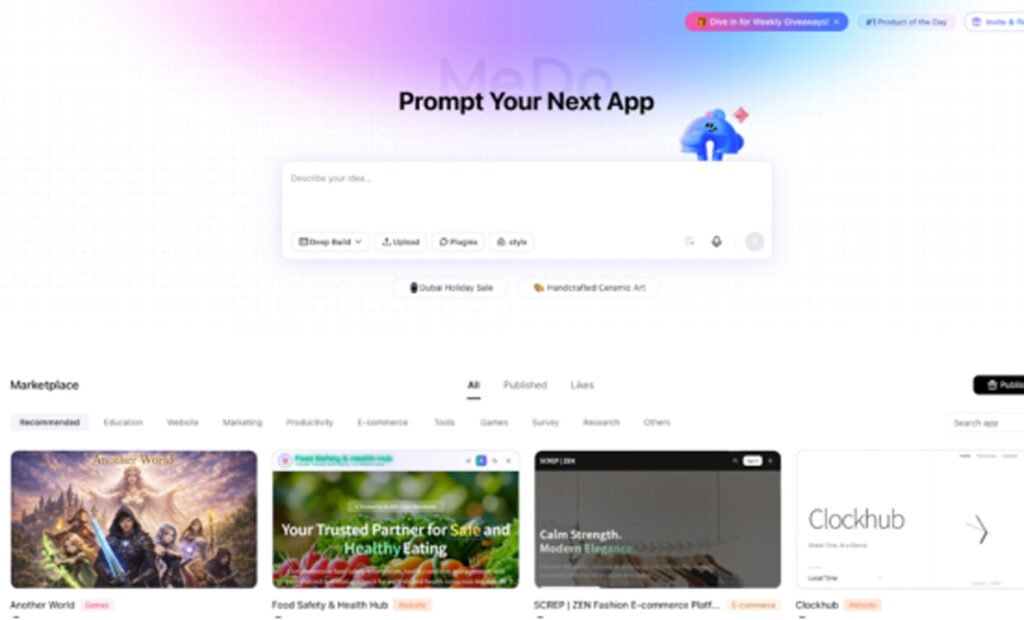
MeDo positions itself as a complete AI development environment rather than a single-purpose tool. Instead of generating only layouts or code fragments, the platform builds entire applications including interface, backend services, database models, authentication logic, and deployment configuration.
This allows users to stay within one environment instead of managing multiple services separately. The result is a product that can be tested and deployed without switching between tools.
Strengths
- Generates full application stacks rather than partial components
- Includes deployment without requiring external infrastructure tools
- Allows iteration through simple text prompts
- Can reduce costs by replacing several separate services
Limitations
- Still less widely known compared with established development platforms
- Does not yet produce fully native mobile apps directly, although mobile deployment options are expected in future updates
2. Railway
Pricing: Free starting credits with usage-based billing
Best suited for: Developers wanting simple deployment workflows
Railway focuses on reducing infrastructure complexity. By connecting a code repository, the platform automatically detects the technology stack and prepares the required environment.
It essentially turns deployment into a simplified process instead of a technical project.
Strengths
- Simple deployment workflow
- Free credits for early experimentation
- Automated updates without downtime
- Centralized dashboard for apps and databases
Limitations
- Pricing may scale unpredictably with high traffic
- Less control compared with enterprise cloud setups
- Does not generate application logic or design
3. Postman
Pricing: Free individual plan; team plans starting at $14 monthly
Best suited for: Backend teams building and managing APIs
Postman has become a standard environment for API testing and collaboration. It allows developers to simulate endpoints, automate testing, document APIs, and coordinate backend development workflows.
For API-driven development, it remains one of the most widely used tools.
Strengths
- Strong developer community
- Automation and testing features
- Simplifies API collaboration
- Supports multiple API standards
Limitations
- Focused only on API workflows
- Can feel complex for simple tasks
- Some collaboration features require paid plans
4. Figma
Pricing: Free entry plan; paid tiers starting at $20 per user monthly
Best suited for: Teams focused on interface design and product planning
Figma has become one of the most widely used design collaboration platforms. Product teams rely on it to map user journeys, test visual concepts, and align design decisions before development begins.
Its biggest value lies in bridging communication between designers and developers through shared visual references.
Strengths
- Real-time collaboration across teams
- Advanced interaction and prototype capabilities
- Large ecosystem of plugins and UI assets
- Strong design documentation capabilities
Limitations
- Does not produce production-ready applications
- May be unnecessary for simple product ideas
- Requires time to learn for non-design users
5. Neon
Pricing: Free entry tier; paid plans beginning around $19 monthly
Best suited for: Teams needing scalable Postgres infrastructure
Neon introduces a modern approach to database management by adding branching capabilities similar to version control systems. Developers can create isolated database environments for testing features without affecting production data.
This approach makes experimentation safer and easier.
Strengths
- Branching improves testing workflows
- Usage-based pricing structure
- Managed infrastructure with automatic updates
- Fast database cloning capabilities
Limitations
- Focused purely on database infrastructure
- Requires additional tools for frontend and backend layers
- Newer ecosystem compared with traditional providers
6. v0 by Vercel
Pricing: Free limited usage; premium tiers starting at $20 monthly
Best suited for: Developers focused on fast UI development
v0 focuses specifically on frontend acceleration. Using text instructions or visual references, it can generate React components styled with Tailwind CSS. This makes it useful for teams building interfaces quickly or testing layout ideas.
Its strength is speed rather than completeness.
Strengths
- Produces clean frontend code ready for production use
- Speeds up UI iteration cycles
- Integrates naturally with Vercel hosting
- Handles complex interface patterns
Limitations
- Limited to front-end generation
- Requires developer knowledge to integrate into full applications
- Credit limits may restrict experimentation
How These Platforms Were Compared
Rather than ranking tools based purely on popularity, the comparison focused on practical development concerns such as:
- how quickly a project can start
- flexibility of workflows
- usefulness of AI assistance
- reliability of deployment
- overall cost efficiency
The goal was to highlight practical strengths rather than brand recognition.
Practical Advice for Moving Faster with Full-Stack Builders
Teams that use these platforms effectively often follow a few consistent habits:
- Define your data model before generating the application
- Include authentication early instead of adding it later
- Test on real devices instead of only local previews
- Use branching workflows when adding major features
- Keep exported code backups to maintain flexibility
These practices help avoid rework and reduce technical debt as projects grow.
Conclusion
Full-stack builders are reducing the need for large development teams by combining multiple technical layers into unified environments. This makes it possible to launch functional applications without hiring specialists for every role.
For teams trying to reduce complexity and avoid managing multiple services, platforms that integrate frontend, backend, database, and deployment offer clear advantages.
MeDo stands out in this category because it focuses on generating complete applications rather than isolated components. By combining AI generation, infrastructure management, and deployment into one workflow, it allows users to move from concept to working software with significantly less friction.
Developers interested in testing this approach can explore MeDo’s free tier and experiment with building a full-stack product within minutes.
