
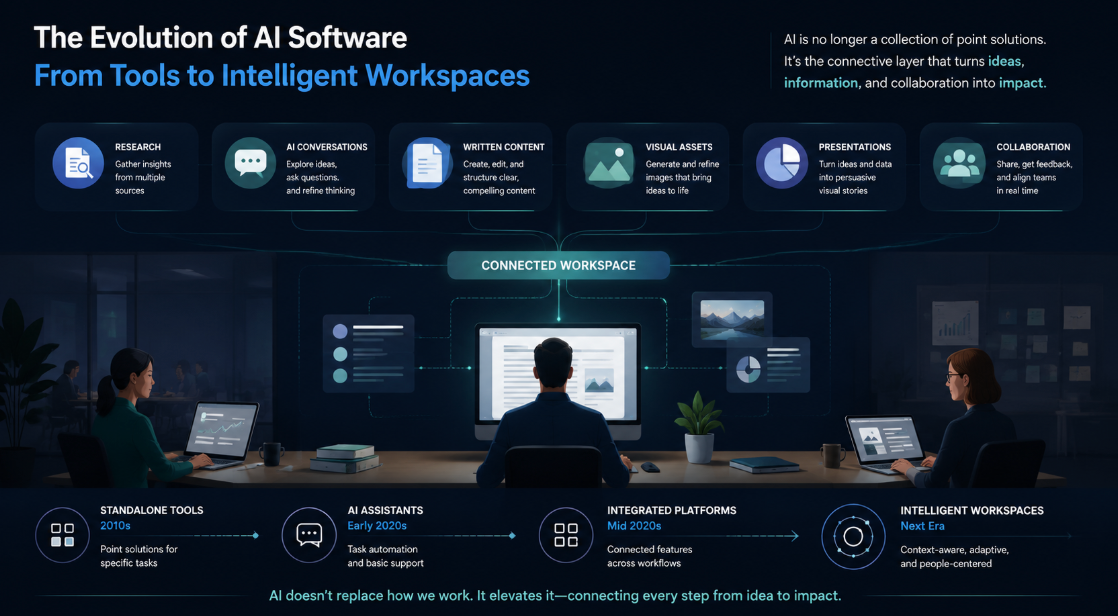
Every major software category eventually reaches a point where individual features become less important than the experience connecting them together.
Early word processors focused on helping people write documents more efficiently. Spreadsheet software transformed how organizations analyzed information. Collaboration platforms changed how teams shared knowledge and worked across locations. Over time, the most successful software products became less about performing one specific task and more about supporting the broader workflows built around that task.
Artificial intelligence is beginning to follow a similar path.
The first generation of AI adoption focused on individual capabilities. Organizations explored how AI could generate text, summarize information, write code, answer questions, and create images. These capabilities introduced a new level of productivity and changed expectations around what software could accomplish.
However, as AI becomes more common across organizations, a new challenge is emerging.
People rarely complete meaningful work through a single task.
A researcher does not simply find information. They gather sources, analyze findings, organize ideas, write summaries, create visuals, and share conclusions.
A product manager does not simply write documentation. They research customer needs, collaborate with teams, prepare presentations, communicate decisions, and update internal knowledge.
A marketer does not simply create content. They develop strategies, produce assets, refine messaging, analyze results, and communicate outcomes.
The work itself is connected.
The software supporting that work is increasingly expected to be connected as well.
This is why AI is beginning to evolve from a collection of individual tools into something closer to a digital workspace.
From AI Tools To AI Environments
When generative AI entered mainstream adoption, most users approached it through individual use cases.
A professional used AI to draft an email.
A developer used AI to generate code.
A student used AI to summarize research.
A marketer used AI to create content ideas.
These experiences demonstrated the value of AI, but they also revealed a limitation.
Most real-world tasks do not end after one interaction.
The first draft needs refinement.
The research needs verification.
The content needs visuals.
The ideas need to become presentations.
The final output needs to be shared with other people.
As a result, many users began building their own informal AI workflows by combining multiple tools together. They moved between applications depending on the stage of work they were completing.
The process worked.
But it was not always efficient.
Every transition required users to carry context from one environment to another. They had to explain the project again, move information manually, and recreate connections that already existed in their own thinking.
This challenge is becoming one of the biggest opportunities in AI software.
The next generation of AI platforms will not simply help users complete individual tasks.
They will help users move through entire workflows.
Why Context Switching Has Become The Hidden Cost Of AI Adoption
One of the unexpected lessons from early AI adoption is that creating content was never the only challenge.
Moving between different stages of work remains a significant source of friction.
A business analyst may use one application to research information, another to organize notes, another to draft a report, and another to prepare a presentation. A creative team may use separate tools for writing, image creation, editing, and publishing. A software team may use different environments for documentation, coding, testing, and collaboration.
Each tool may perform its function well.
The challenge exists between them.
Context switching creates invisible costs. Information must be transferred. Decisions must be explained again. Teams spend time managing workflows instead of progressing through them.
This is why the future of AI software is likely to be shaped less by individual capabilities and more by how effectively those capabilities connect.
The strongest platforms will not necessarily be the ones with the largest number of features.
They will be the ones that reduce the number of interruptions between ideas and outcomes.
The Rise Of Connected AI Workflows
Modern AI workflows increasingly resemble the way people naturally think and work.
An idea may begin as a conversation.
That conversation may become research.
Research may become written content.
Written content may become a presentation.
A presentation may support collaboration and decision-making.
Instead of treating these as separate activities, AI platforms are increasingly bringing them together.
This is already visible across the technology industry.
OpenAI has expanded beyond conversational AI into broader experiences involving research, reasoning, multimodal capabilities, and collaborative workflows.
Microsoft is integrating AI throughout workplace environments where documents, meetings, communication, and productivity already happen.
Google continues embedding AI across its productivity ecosystem.
Notion has connected documentation, knowledge management, collaboration, and AI assistance within a shared workspace.
Canva and Adobe are expanding beyond traditional design workflows by integrating writing, visual creation, presentations, and collaboration.
Perplexity is moving beyond simple search toward research experiences where information discovery and synthesis happen together.
Cursor has demonstrated how AI can become part of a developer’s existing workflow rather than a separate destination.
Although these platforms operate in different categories, they are responding to the same shift.
Users increasingly want AI to fit into their workflow instead of forcing their workflow to adapt around AI.
Communication Is Becoming The Foundation Of AI Workflows
Although AI is expanding into many different areas of work, one theme connects nearly every workflow.
Communication.
Research eventually becomes documentation.
Documentation becomes presentations.
Presentations become discussions.
Discussions become decisions.
Decisions become actions.
This is why communication is increasingly becoming the foundation layer for AI-powered work. The ability to move information between different formats and audiences is becoming just as important as the ability to generate the original content.
Many professionals now begin projects by exploring ideas, organizing information, and structuring their thinking before creating a final deliverable. An AI Chat workflow can support this early stage by helping users brainstorm concepts, analyze information, clarify objectives, and develop stronger communication before moving into drafting and refinement.
The value is not simply faster content creation.
It is helping people arrive at clearer ideas before those ideas become documents, presentations, or published resources.
Visual Creation Is Becoming Part Of Everyday Knowledge Work
Another important shift taking place is the expansion of visual communication.
For decades, visual creation was often separated from other forms of knowledge work. Designers created graphics. Writers created documents. Presentations were developed separately. Each discipline had its own tools and processes.
That separation is becoming less defined.
Today, professionals across industries increasingly create visual assets as part of their everyday responsibilities. Marketers develop campaign visuals. Consultants create diagrams to explain complex recommendations. Educators build visual learning materials. Product teams use illustrations and diagrams to communicate ideas internally and externally.
This change is being driven by a simple reality.
People understand information differently when it is presented through multiple formats.
A written explanation may communicate a concept effectively, but a diagram can reveal relationships more clearly. A presentation may summarize an idea, while visual examples make that idea easier to remember.
As a result, visual creation is becoming another stage of communication rather than a separate creative function.
Many professionals use AI Image Generator to explore concepts, create supporting visuals, and develop communication assets that help explain ideas more effectively. The purpose is not to remove creative judgment from the process. Instead, it allows teams to experiment with visual possibilities earlier and integrate imagery into the way they think, plan, and communicate.
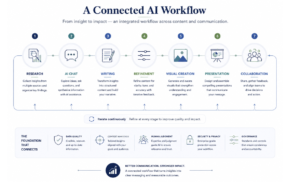
The next generation of AI platforms will compete by connecting workflows rather than adding isolated features
Why Workflow Ownership Matters More Than Feature Ownership
The evolution of AI platforms reflects a broader lesson from software history.
Features can be copied.
Workflows are much harder to replicate.
A successful platform does not simply provide individual capabilities. It understands how those capabilities connect together and how users naturally move between them.
This is why workflow ownership is becoming increasingly valuable in AI.
A platform that understands the relationship between research, writing, refinement, visuals, presentations, and collaboration can create a more meaningful experience than a collection of separate tools, even if those individual tools are technically capable.
The competitive advantage is no longer only about what software can do.
It is about how smoothly people can accomplish what they need to do.
This shift explains why AI companies are expanding into broader environments rather than remaining focused on narrow categories.
The future of AI software is likely to be defined by platforms that reduce friction across the entire journey from idea to outcome.
Quillbot And The Shift Toward Communication Platforms
This broader movement can also be seen in how AI communication platforms are evolving.
Platforms such as Quillbot demonstrate how AI communication systems are evolving from individual productivity tools into broader workplace environments where research, drafting, refinement, and knowledge sharing can happen within a connected process. For enterprises, the value increasingly comes from helping employees maintain context as information moves across teams, departments, and communication channels.
The significance of this shift is not simply the addition of more capabilities.
It is the recognition that modern knowledge work rarely happens through one isolated task.
Professionals do not think in terms of “writing” or “presenting” or “creating visuals” as separate activities. They think about communicating an idea, solving a problem, explaining information, or helping others make decisions.
AI platforms are increasingly being designed around that reality.
What This Means For Enterprises
For enterprise organizations, the move toward AI workspaces represents a significant change in how technology investments are evaluated.
Historically, companies selected software based on specific requirements.
A tool solved a particular problem.
A platform supported a broader business process.
AI is pushing organizations toward a different approach.
Instead of asking which tool can complete a specific task, leaders are increasingly asking how AI can support entire workflows across departments.
How can teams move from research to recommendations faster?
How can knowledge be shared more effectively?
How can employees communicate complex information clearly?
How can organizations reduce repetitive work without reducing quality?
These questions are shaping the next phase of enterprise AI adoption.
The organizations that benefit most will likely not be those that simply deploy the greatest number of AI tools.
They will be those that redesign workflows around how people actually work.
The Future Of AI Software
The next five years of AI development will likely be defined by a shift from assistance toward integration.
AI systems will continue becoming more capable, but capability alone will not determine success. The most valuable platforms will be those that understand context, preserve information, and help people move naturally between different stages of work.
The future of AI will not simply be about generating text, images, or code.
It will be about connecting the processes around them.
Research will connect with writing.
Writing will connect with visuals.
Visuals will connect with presentations.
Presentations will connect with collaboration.
The platforms that reduce friction across this entire communication journey will shape the next generation of software.
AI is becoming less like a tool people open when they need help.
It is becoming the environment where work itself happens.