
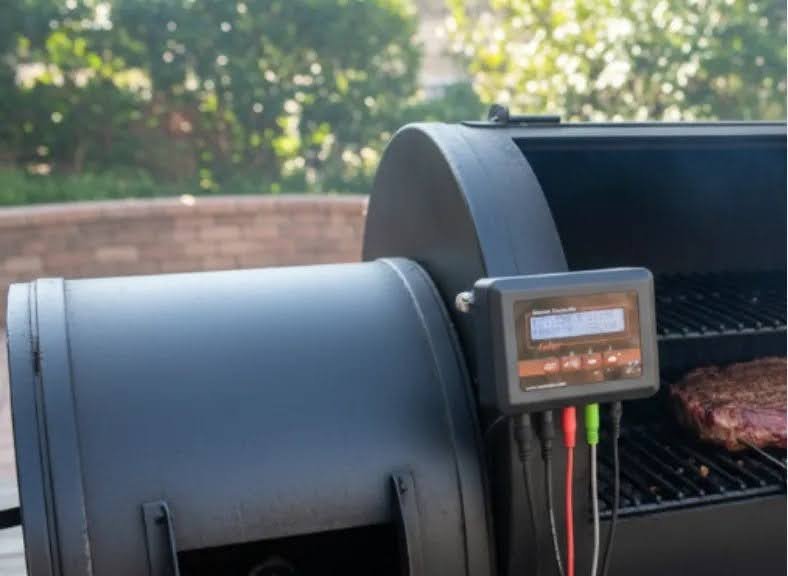
A good barbecue requires consistent heat. Small temperature fluctuations can ruin expensive meat during prolonged cooking. Many pitmasters use Auber Instruments BBQ controllers to automate airflow.
However, routing cables across a hot grill often leads to melted wires. This guide explains PID control. It also reveals how modern wireless tools bypass these wired flaws, letting you track the fire from your phone.
Quick Answer: What Is Auber Instruments and Why Do BBQ Enthusiasts Use It?
Auber Instruments builds commercial-grade digital controllers. Pitmasters use them to block temperature swings caused by wind or cold air. You connect a blower to the vent and run a wired probe to the grate. The controller measures the heat and pulses the fan.
The major flaw? The wired probes tangle easily, and the controller requires an AC outlet nearby. If you can manage the cords, it holds 225°F for hours. You spend less time chasing the fire and more time cooking, resting, or enjoying the day.
What Are Auber Instruments and How Did They Start?
Auber Instruments started by building control panels for breweries and labs. These industries demand exact heat to prevent ruined batches. This made them experts in PID technology.
Backyard cooks quickly discovered that smoking meat with an Auber PID worked very well. Commercial sensors are now packaged in durable, weather-resistant boxes. The user interface is still stubbornly industrial, despite the perfect science.
What Is a PID Temperature Controller?
A standard thermostat turns a fan fully on or off, creating massive heat swings. A PID temperature controller uses smart math to stop these spikes.
- Proportional (P): Reacts to the current gap between actual and target heat.
- Integral (I): Corrects previous mistakes.
- Derivative (D): Forecasts variations in temperature.
To steady the fire, manually reduce your “P” number by half and raise your “I” value, for example, P:10, I:600, if your smoker overshoots the target.
Auber Instruments Smoker Controller Systems Explained Three different components are needed for an Auber Instruments smoker controller:
- Control Box: The digital brain. It requires constant wall power.
- Temperature Probes: Braided steel cables. Warning: They fail instantly upon direct contact with a flame over 550°F.
- Blower Fan: Attaches to the bottom vent.
The box reads the grate probe every few seconds. If the heat drops, the fan powers up. Once the heat stabilizes, the fan slows. The system works, but managing the fragile cables takes constant care.
Understanding Auber Temperature Controller Features
Industrial characteristics are included in every Auber temperature controller. The probes precisely measure heat to within one degree. However, the Open-Lid detection feature often fights with the PID auto-tune algorithm.
When you lift the lid, the unit pauses the fan to prevent ash from blowing out. To avoid system errors, always turn off the auto-tune function before opening the lid frequently during a cook.
Manual Vents vs. Auber BBQ Controller
Managing a smoker by hand takes real practice. You have to move the metal vents in small increments to control the airflow. Sadly, one small mistake can quickly ruin an expensive brisket. In contrast, an Auber BBQ Controller does this hard work for you.
Let’s look at the main differences below:
| Feature | Manual Vent Control | Automated Control |
| Heat Swings | Wide jumps, often 30°F or more. | Tight control, staying within a few degrees. |
| Time Spent | Needs manual checks every 30minutes. | Set your target temp and walk away. |
| Bad Weather | Wind and rain can quickly
extinguish the fire. |
The smart fan speeds up to fight the cold wind. |
| Overnight Cooks | Less sleep and constant worry. | Sleep deeply while the system runs the pit. |
In the end, automation brings peace of mind. You get a perfect, tasty barbecue every single time you light the fire.
Auber Instruments WiFi BBQ Controller and Remote Monitoring Modern Auber Instruments WiFi BBQ controller provides real-time data to your phone. You can watch the fire from indoors. However, substantial external walls can make it difficult for older WiFi models to stay connected. If it stays connected, it provides live heat graphs and safety alarms. This prevents ruined meat if the charcoal runs out.
Green Egg Temperature Regulator Options
Kamado grills trap heat heavily. A green egg temperature regulator prevents fatal heat spikes. Because ceramic retains heat so efficiently, correcting a 50-degree overrun takes hours.
The regulator delivers tiny, gentle puffs of air. Always close your top vent to a tiny sliver (1/8 inch) when using a regulator, or the fan cannot control the draft.
Choosing the Right PID Controller for Your Smoker
A PID controller for temperature control fails if the fan is the wrong size.i
- Match the CFM: Use a 6.5 CFM fan for small ceramics. Use a 10 CFM fan for 55-gallon drums. Demand a 20 CFM fan for large offset smokers.
- Cable Length: Ensure the AC power cord reaches a safe, dry outlet.
- Probe Limits: Stand noard units have a maximum of 2 wired probes.
Modern Alternatives to Traditional PID Controllers
Wireless technology faces one objective constraint: thick steel offset smokers can sometimes weaken Bluetooth signals.
However, if you place the hub nearby, the ProTemp S1 Smart Grill Thermometer completely solves the fatal flaws of wired PID controllers. Instead of dealing with fragile wires that melt, this system uses 100% wireless meat probes.
- Tracks 4 probes at once.
- The digital gauge survives 1000°F ambient heat.
- Connects directly to the Automatic Breezo V2 temperature control fan.
The ProTemp S1 won the 2025 IHA Global Innovation Award because it removes messy cables entirely, offering accurate auto pit-temp control without patio clutter.
Final Thoughts
At the expense of tangled wires and laborious tuning, Auber Instruments delivers extreme industrial precision. Modern ProTemp S1 wireless hubs provide a far better user experience for people who desire perfect heat control without the mess of a patio.
FAQs of Auber Instruments
Q: Can a PID temperature controller work with any smoker?
Yes, any wood or charcoal system can use a PID temperature controller. Over your lower air vent, you install a metal adaptor plate. Next, fresh oxygen is directly pushed into the firebox by the tiny fan. Because of this, ceramic cookers, hefty offset rigs, and drum smokers all benefit greatly from this easy adjustment.
Q: Do I need WiFi for a smoker controller?
To operate your smoker, WiFi is not strictly necessary. The fire can be easily controlled offline with a simple unit. For busy cooks, WiFi is still a major benefit. It provides your phone with real-time heat charts and safety alerts. As a result, while the meat cooks safely, you can unwind indoors or run errands.
Q: What is the advantage of a green egg temperature regulator?
Ceramic grills trap heat extremely well, but they take hours to cool if they get too hot. A green egg temperature regulator stops this problem before it starts. It uses a fan to deliver tiny, gentle puffs of air. This exact pacing keeps the fire from growing too fast and ruining food.
Q: Are wireless grill thermometers replacing traditional PID systems?
Yes, outdated wired equipment is rapidly being replaced by smart wireless thermometers. Clean patios with no tangled cords to trip on are what most cooks prefer. Contemporary hubs now read pit heat via Bluetooth and WiFi. They then immediately transmit signals to an automated fan. With no messy cords, you can precisely adjust the temperature.
Q: How accurate is an Auber PID device during long cooks?
An Auber PID device provides amazing accuracy during all-day cooks. The smart system actually learns how your specific smoker burns fuel. By tracking these unique heat patterns, it stops large temperature swings. Usually, a well-tuned unit holds the heat within 1 to 3 degrees of your exact target temperature.
Q: What does the CFM rating mean to an Auber BBQ controller fan?
Cubic feet per minute is known as CFM. It gauges how much air a fan forces into the fire. A basic Auber BBQ controller has a 6.5 CFM fan, which is adequate for most backyard smokers. However, a stronger 10 CFM blower would be required if you have a large offset rig.
