
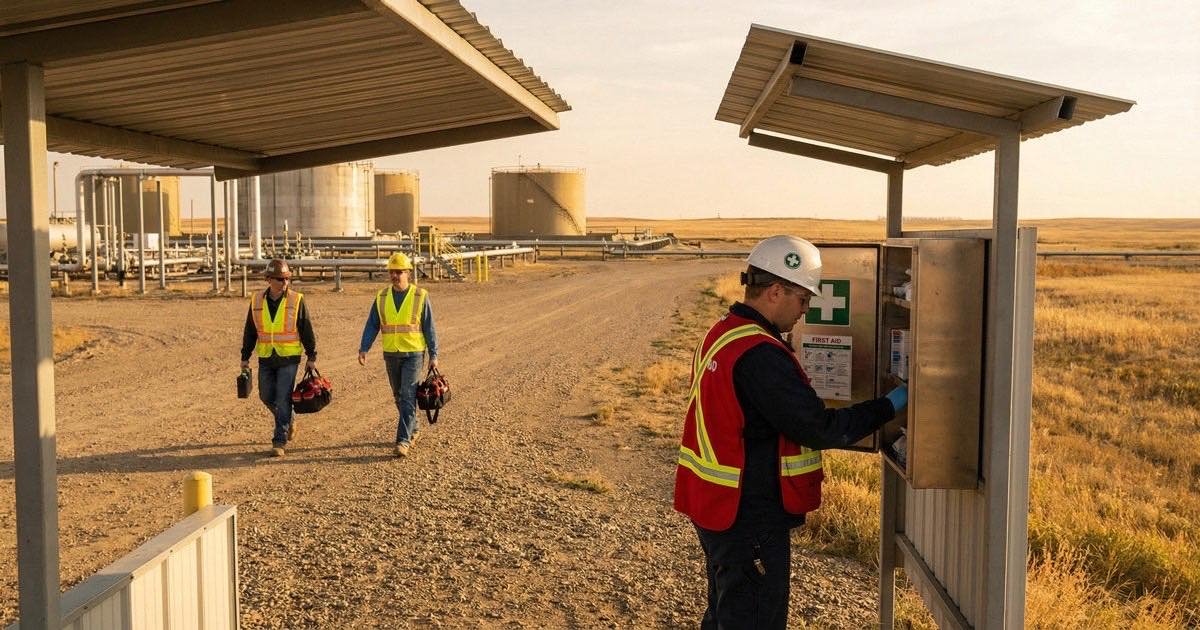
Alberta has one of the most demanding industrial workforces in Canada. Oil and gas extraction, pipeline construction, heavy equipment operation, high-rise builds — these are environments where the difference between a managed incident and a fatality can come down to the person standing closest when something goes wrong.
That’s not a hypothetical. It’s what the Workers’ Compensation Board of Alberta has built its first aid regulations around. If your team hasn’t reviewed those requirements recently, CPR training Calgary is likely overdue — and this article will show you exactly why.
What Does WCB Alberta Require for Workplace First Aid?
The WCB Alberta first aid regulations, established under the Alberta Occupational Health and Safety Act, set minimum requirements based on three variables: the number of workers on site at any given time, the hazard level of the work being performed, and the proximity of the worksite to emergency medical services.
The regulations establish three workplace hazard categories:
Low hazard — office environments, retail, light administrative work. Smaller teams may require only a basic first aider with CPR/AED Level C; larger low-hazard worksites require Standard First Aid certified staff.
Medium hazard — warehousing, light manufacturing, food processing, some service sectors. Standard First Aid certification becomes mandatory at lower workforce thresholds.
High hazard — construction, oil and gas, forestry, mining, heavy industry. These worksites carry the most stringent requirements, including higher ratios of certified first aiders to workers and, in some cases, on-site first aid facilities and transport equipment.
The WCB also specifies requirements for first aid kits, transportation protocols, and record-keeping. Certification alone isn’t compliance — the full program needs to be operational.
Why Do So Many Alberta Employers Fall Short?
The most common gap isn’t ignorance. It’s administrative drift.
A company hires a certified first aider, ticks the compliance box, and moves on. Two years later, that person’s certification has lapsed. Or they’ve transferred to a different department. Or the workforce has grown past a threshold that now requires a higher certification level or a second designated first aider — and no one updated the safety plan.
WCB Alberta audits and incident investigations look at exactly this. When a workplace injury occurs, one of the first questions asked is whether the required first aid was immediately available. An expired certificate, an absent first aider, or a kit that hasn’t been restocked doesn’t just expose an employer to WCB penalties. It affects claims costs, experience ratings, and — in serious incidents — potential liability under the Alberta OHS Act.
The lesson experienced safety managers have learned: compliance isn’t a date you reach. It’s a system you maintain.
What Certification Levels Are Relevant for Alberta Workplaces?
CPR/AED Level C is the foundation. It covers cardiac arrest response for adults, children, and infants, plus AED operation. Required as a standalone in some low-hazard, small-workforce settings — and embedded within all higher certifications as a mandatory component.
Standard First Aid with CPR/AED Level C is the workhorse certification for most Alberta workplaces. It covers a comprehensive range of emergencies: severe bleeding, shock, fractures, head and spinal injuries, burns, poisoning, diabetic emergencies, seizures, stroke, and more. Two-day course in traditional format; single in-person day with blended learning.
Emergency First Aid with CPR/AED Level C is a condensed one-day option covering the most critical life-threatening scenarios. Appropriate for some low-hazard environments with small workforces, but does not satisfy Standard First Aid requirements where those apply.
BLS (Basic Life Support) is a higher-level credential for healthcare providers — nurses, paramedics, and regulated health professionals operating in clinical settings. Most industrial and construction workplaces don’t require BLS, but healthcare-adjacent roles on large industrial sites sometimes do.
Understanding which level your workplace actually requires — not which level is easiest to obtain — is the starting point for building a compliant program.
How Does Blended Learning Change the Training Equation?
One of the most common reasons Alberta employers cite for delayed or deferred first aid training is scheduling. Pulling workers off a job site or out of a facility for two consecutive days creates real operational friction, particularly in industries where shift patterns are tight and absences are costly.
Blended learning addresses this directly. The online theory component — covering physiology, emergency recognition, and decision-making frameworks — is completed independently, on each worker’s own schedule, before the course day. The in-person session then focuses entirely on hands-on skills: compressions on mannequins, AED simulation, scenario walkthroughs with instructor feedback.
The result is a recognized, fully compliant certification — accepted by WCB Alberta — delivered in approximately half the in-person time of a traditional format. For safety managers trying to certify multiple team members without grinding operations to a halt, the logistics difference is significant.
Building a First Aid Program That Stays Compliant
A one-time certification drive gets you to compliant. A system keeps you there. Here’s what that looks like in practice:
Map your requirements by worksite. Hazard level and workforce count may differ across locations — don’t assume one compliance standard covers everything.
Build a renewal calendar. Standard First Aid certifications are valid for three years; CPR components require renewal every two to three years. Schedule renewals before expiry, not after.
Maintain a coverage matrix. Track who is certified, at what level, and which shifts they cover. If your only certified first aider goes on leave, who is the backup?
Log and audit your first aid kits. WCB Alberta specifies kit contents by workplace category. Regular inspection and restocking is part of the regulatory obligation.
Train above the minimum. A buffer of certified staff absorbs turnover, absenteeism, and workforce growth without creating compliance gaps.
Coast2Coast First Aid Inc. is a Canadian Red Cross and Heart & Stroke Authorized Training Partner offering Standard First Aid, CPR/AED Level C, and BLS certifications across Alberta, including blended learning formats suitable for individual workers and corporate group bookings.
If you are looking for first aid or CPR certification near Capitol Hill Crescent NW, 16th Avenue, the SAIT Polytechnic area, or Confederation Park in Calgary, you may reach out to Coast2Coast First Aid Inc. in that area.
FAQs
Q: Does WCB Alberta recognize blended learning first aid certifications? A: Yes. Blended learning programs — online theory combined with mandatory in-person skills practice — are recognized by WCB Alberta provided they are delivered through an approved provider such as the Canadian Red Cross. The certification carries the same compliance standing as a traditional classroom course.
Q: How often must first aid certifications be renewed under Alberta OHS regulations? A: Standard First Aid certifications are valid for three years. CPR components are typically valid for two to three years and must be renewed within those timeframes to maintain WCB Alberta compliance. Employers are responsible for tracking renewal dates and ensuring coverage is maintained continuously.
Q: What happens if an Alberta employer is found non-compliant with first aid requirements during a WCB audit? A: Non-compliance can result in orders to remedy the deficiency, administrative penalties, and increased scrutiny in future audits. If a workplace injury occurs and first aid was not available as required, WCB claims outcomes and the employer’s experience rating can be significantly affected. In serious cases, the Alberta OHS Act provides for prosecution.
Q: Do all workers on a high-hazard site need first aid certification, or just designated first aiders? A: WCB Alberta regulations require a minimum number of certified first aiders based on workforce size and hazard level — not all workers. However, many safety managers choose to certify a higher proportion of their workforce to ensure coverage during shift changes, absences, and workforce fluctuations.
Q: Is there a difference between WCB Alberta first aid requirements and those in other Canadian provinces? A: Yes. Each province administers its own occupational health and safety framework. Alberta operates under WCB Alberta and the Alberta OHS Act. Ontario, for example, operates under WSIB and the Ontario OHSA, with different threshold calculations and documentation requirements. Employers operating across multiple provinces need to confirm compliance in each jurisdiction separately.