
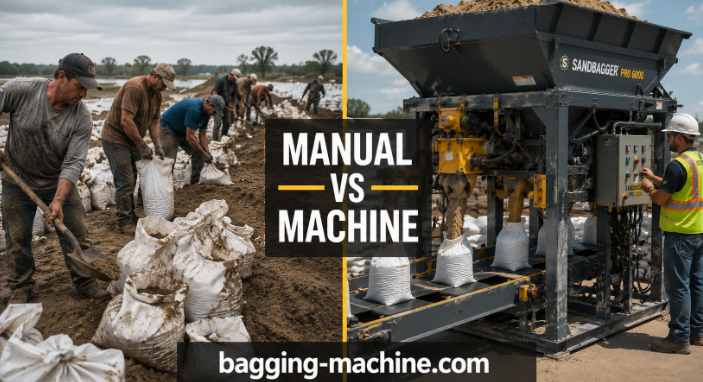
Flooding doesn’t wait. When a storm warning hits, emergency teams, contractors, and municipal workers have hours — sometimes less — to deploy thousands of sandbags along vulnerable perimeters. In those moments, the method you use to fill those bags determines everything: how many you produce, how fast, and at what cost.
For years, manual sandbag filling was the only option. Today, automated sand bag filler machines have become accessible to operations of all sizes — and the financial and operational case for switching has never been stronger.
But is automation always the right call? This article breaks down both approaches across every major factor — speed, cost, consistency, and scalability — so you can make the most informed decision for your operation in 2026.
The True Cost of Manual Sandbag Filling
Manual filling looks cheap on the surface. No equipment purchase, no installation, no training. Just workers, shovels, and bags. But when you dig into the real numbers, the picture changes quickly.
Labor Hours Per 1,000 Bags An experienced two-person team — one holding the bag, one shoveling — can fill roughly 100–150 bags per hour under ideal conditions. That means filling 1,000 bags takes 7–10 labor hours minimum. Add fatigue after the first two hours and output drops further.
Labor Cost Breakdown At an average labor rate of $18/hour with a 6-person crew:
- Hourly cost: $108
- Output: ~600 bags/hour (optimistic)
- Cost per 1,000 bags: ~$180 in labor alone
- Plus: supervision, PPE, breaks, and overtime during emergencies
Physical Strain & Injury Risk Repetitive shoveling of heavy sand causes back injuries, shoulder strain, and fatigue-related accidents. Worker compensation claims, medical costs, and lost workdays add hidden costs that never appear in the initial labor estimate.
Inconsistent Fill Weights Manual filling produces bags that vary significantly in weight — some overfilled, some underfilled. Overfilled bags are harder to stack and handle. Underfilled bags don’t provide adequate flood resistance. Both outcomes waste material and compromise performance.
Weather Dependency Manual crews slow down significantly in rain, extreme heat, or high winds — exactly the conditions present during flood emergencies when output matters most.
How a Sand Bag Filler Machine Works?
A modern sand bag filler machine eliminates most of the variables that make manual filling inefficient. Here’s how the automated process works step by step:
- Step 1 — Material Loading Sand, gravel, or soil is loaded into a large overhead hopper via front-end loader, conveyor, or auger feed system. Hopper capacities typically range from 0.5 to 3 cubic meters depending on the model.
- Step 2 — Bag Positioning The operator slides an empty bag onto the fill spout or bag holder. On semi-automatic models this is done manually; on fully automatic systems, bags are fed from a roll or pre-opened stack automatically.
- Step 3 — Automated Fill Cycle A sensor or foot pedal triggers the fill cycle. The metering gate opens, releasing a pre-set volume or weight of material into the bag. The cycle stops automatically when the target fill is reached — ensuring every bag is consistent.
- Step 4 — Bag Removal & Conveyance The filled bag is removed from the spout — manually on semi-auto units or via conveyor on automated lines — and moves to the tying, sealing, or stacking station.
Types of Sand Bag Filler Machines:
- Gravity-fed semi-automatic — simplest design, operator-triggered, 200–400 bags/hour
- Auger-based fillers — precise metering for consistent weight, ideal for fine sand
- Conveyor-integrated automatic lines — high-volume, 800–2,000+ bags/hour
- Trailer-mounted portable units — field-deployable, diesel or generator powered
Head-to-Head Comparison
Here’s how manual filling stacks up against an automated sand bag filler machine across every operational factor that matters:
| Factor | Manual Filling | Sand Bag Filler Machine |
| Output speed | 100–150 bags/hr | 300–2,000+ bags/hr |
| Workers required | 4–6 per station | 1–2 operators |
| Labor cost per 1,000 bags | $150–$200 | $30–$60 |
| Fill weight consistency | Variable | Uniform (±2–5%) |
| Fatigue impact | High after 2 hrs | Minimal |
| Weather performance | Degrades significantly | Consistent |
| Setup time | Immediate | 15–30 mins |
| Scalability | Add more workers | Upgrade machine model |
| Equipment cost | $0 upfront | $3,000–$80,000+ |
| Long-term ROI | Negative at scale | Strong positive |
The numbers tell a clear story. For any operation filling more than 300–400 bags per week, the machine pays for itself faster than most operators expect.
Real-World Use Cases
- Emergency Flood Response Teams City emergency management agencies that once relied on volunteer crews are increasingly deploying portable sand bag filler machines pre-positioned at flood-prone zones. A single trailer-mounted unit with two operators can out-produce a 20-person manual crew — and do it for hours without fatigue.
- Sand & Gravel Suppliers Aggregate businesses selling pre-filled sandbags to hardware stores, contractors, and government agencies need consistent output at low per-bag cost. Manual filling at commercial scale is simply not viable — automated lines are the industry standard.
- Military & Defense Logistics Forward operating bases require rapid barrier construction. Portable automated fillers allow small teams to produce hundreds of bags per hour in the field, reducing manpower requirements for non-combat tasks.
- Construction Site Contractors Drainage control, slope stabilization, and temporary retaining walls all require sandbags on demand. A mid-range semi-automatic unit on a job site eliminates the need to source pre-filled bags from suppliers — saving both cost and lead time.
- Landscaping & Drainage Contractors Smaller contractors handling residential flood protection or drainage projects benefit from compact semi-automatic units that are easy to transport between sites and require minimal operator training.
ROI Calculation — When Does the Machine Pay Off?
Let’s run a realistic ROI scenario for a mid-size municipal contractor:
Operation Profile:
- Fills 2,000 sandbags per week during flood season (20 weeks/year)
- Currently using 6 manual workers per session
Manual Filling Annual Cost:
- 2,000 bags/week ÷ 600 bags/hr = ~3.3 hours/session
- 6 workers × $18/hr × 3.3 hrs = ~$356/session
- 20 sessions/year = $7,120/year in labor
With Automated Equipment:
- 2,000 bags/week ÷ 800 bags/hr = 2.5 hours/session
- 2 operators × $18/hr × 2.5 hrs = $90/session
- 20 sessions/year = $1,800/year in labor
Annual Labor Saving: $5,320
A quality mid-range bagging machine in this output category typically costs $8,000–$15,000. At $5,320 in annual savings, the equipment pays for itself in 18–34 months — and continues saving money every year after that. Factor in reduced injury claims and the ROI timeline shortens further.
When Manual Filling Still Makes Sense
To be fair, there are scenarios where manual filling remains the practical choice:
- Very Low Volume / One-Time Use If you need 50–100 bags once or twice a year with no plans to scale, purchasing equipment isn’t justified. Renting equipment or buying pre-filled bags is more economical.
- No Power Access in Remote Areas While diesel-powered portable units exist, extremely remote locations without fuel access may still rely on manual methods as a last resort.
- Supplementary Role During Peak Demand Even operations with automated equipment sometimes use manual crews to supplement output during extreme peak demand — the machines handle base volume while manual crews handle overflow.
- Budget-Constrained Small Operations Startups or very small contractors may not have the capital for equipment. In this case, starting manual and reinvesting profits into automation is a common and sensible path.
What to Look for When Buying a Sand Bag Filler Machine
If you’ve decided automation is right for your operation, here’s what to prioritize:
- Output Rate Match the machine’s rated bags-per-hour to your actual peak demand — not your average demand. You need capacity headroom for emergency surges.
- Portability If your operation moves between sites, a trailer-mounted or skid-mounted unit with transport-ready design is essential. Stationary units suit fixed facilities like aggregate yards.
- Hopper Capacity Larger hoppers mean fewer interruptions. For continuous high-volume runs, look for hoppers compatible with front-end loader refilling without stopping the fill cycle.
- Material Compatibility Confirm the machine handles your specific material — fine dry sand behaves differently from wet sand, gravel, or mixed aggregates. Some machines require specific auger configurations for different materials.
- Ease of Operation Your operators need to be productive from day one. Intuitive controls, clear labeling, and minimal adjustment requirements reduce training time and operational errors.
- Spare Parts Availability Wear parts — fill spouts, gate seals, bag holders — need to be replaceable quickly. Confirm the supplier stocks parts locally or ships fast.
Conclusion
The verdict is clear: for any operation filling sandbags at meaningful volume, an automated sand bag filler machine delivers overwhelming advantages over manual filling in 2026. Faster output, lower labor cost, consistent fill weights, and strong ROI within 1–3 years make the case compelling across virtually every use case — from municipal emergency teams to commercial aggregate suppliers.
Manual filling still has its place for very small-scale or one-time needs. But for anyone serious about efficiency, safety, and scalability, the switch to automation isn’t a question of if — it’s a question of when.
Evaluate your volume, calculate your labor costs, and compare them against the investment. The numbers almost always point in one direction.
