Why the Testing Scenario Shapes Your Equipment Decision
Most employers approach drug testing equipment as a purchasing decision – which product is most affordable, which panel covers the most substances, which supplier ships fastest. What gets overlooked is that the scenario in which you test matters as much as the equipment itself.
Pre-employment screening has different requirements than post-accident testing. Random programs need portable, fast-turnaround equipment. Reasonable suspicion situations call for immediate results with a clear, defensible record. The equipment that works well for one scenario can be the wrong choice for another.
Choosing drug testing equipment around scenarios – not just around panel count or price – is what separates a testing program that runs smoothly from one that creates gaps, delays, or documentation problems when it counts most.
How Drug Testing Equipment Works
Workplace testing equipment operates in two modes: instant on-site screening and laboratory-confirmed analysis.
On-site screening devices – whether oral fluid kits or urine cups – detect drug metabolites using immunoassay technology. Results appear within 5 to 10 minutes and are read directly on the device. A negative result clears the donor immediately. A non-negative result is not a confirmed positive; it requires laboratory confirmation before any employment action is taken.
Laboratory-confirmed testing uses the same collection devices but routes the sample to a certified lab for GC-MS analysis. This takes 24 to 72 hours for a negative and longer for confirmation of a non-negative. It provides documentation that can withstand legal challenge.
Understanding which mode your scenario requires determines which drug testing equipment belongs in your program.
Types of Drug Testing Equipment Employers Use
Oral Fluid Test Kits
Oral fluid kits collect saliva using an absorbent swab placed inside the donor’s cheek and under the tongue. A saturation indicator confirms when the sample is sufficient. Results appear in 5 to 10 minutes. Collections are observed, require no private facility, and are resistant to adulteration. Oral fluid kits detect recent use within a 5 to 48-hour window, making them the strongest choice for scenarios where recent impairment is the key question.
Urine Collection Cups and Dip Cards
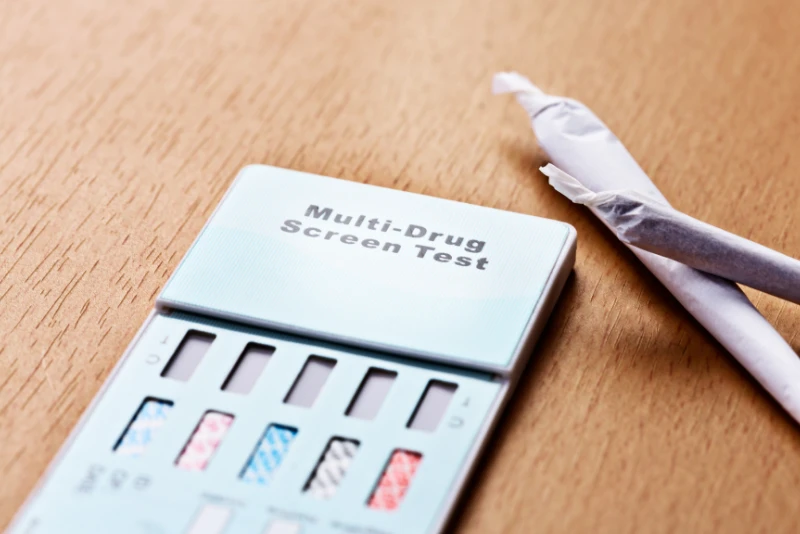
Urine drug test cups are all-in-one collection and screening devices. The donor provides a sample directly into the cup, which contains built-in test strips and temperature indicators. Dip cards offer the same immunoassay technology in a format requiring a separate collection container. Urine testing carries the widest detection window of any instant screening method – up to 30 days for some substances – making it more useful for detecting historical use than recent impairment.
Breath Alcohol Devices
Breathalyzers measure blood alcohol concentration through a breath sample. They are not drug tests, but most workplace programs include alcohol testing alongside drug screening. Post-accident and reasonable suspicion testing sessions typically require both a drug kit and a calibrated breath device, so a breathalyzer belongs in any complete equipment inventory.
Matching Drug Testing Equipment to Each Scenario
Pre-Employment Testing
Pre-employment screening happens before a hire decision is finalized, which means speed is rarely the primary constraint. Employers have time to send a candidate to a collection site or use a lab-confirmed urine cup when documentation is the priority.
Many employers now use oral fluid drug testing equipment for pre-employment screening when the hire decision is time-sensitive – a same-day offer where waiting 48 hours for a lab result is not practical. Instant oral fluid kits work well here, particularly for high-volume hiring where processing speed matters. A 10-panel kit covers the substances relevant to most pre-employment programs without requiring an off-site collection appointment.
Post-Accident Testing
Post-accident testing is where equipment choice carries the most legal weight. Results must be obtained quickly – ideally within two hours of an incident – and documentation must be thorough enough to withstand review.
Oral fluid drug testing equipment is the strongest choice for post-accident scenarios. Collections are observed on-site, require no restroom or privacy setup, and produce results within minutes. The 5 to 48-hour detection window aligns directly with the question that matters in a post-accident investigation: was this person impaired at the time? A non-negative result from an on-site oral fluid kit should be followed by laboratory confirmation before any employment action is taken.
Post-accident kits should be pre-staged at job sites and in company vehicles rather than stored only in a central office. Delayed testing because equipment was not accessible is one of the most common failures in post-accident programs.
Random Testing
Random programs require equipment that can be administered anywhere with minimal setup – on a job site, at a warehouse floor, during a shift, without advance notice. Oral fluid drug testing equipment is the natural fit. No private collection facility is needed, no temperature monitoring, no special storage beyond keeping kits at room temperature. An administrator with a kit and a flat surface can conduct a valid test.
For employers running large random programs, bulk-packaged oral fluid kits reduce per-test cost. Keep a supply at each location where testing may be conducted. The effectiveness of random testing depends not just on the selection process but on having equipment ready the moment a donor is selected – delays undermine the program’s deterrent value.
Reasonable Suspicion Testing
Reasonable suspicion testing is initiated based on observed behavior – slurred speech, unsteady movement, or the smell of alcohol or substances. Speed and discretion both matter.
Equipment for reasonable suspicion situations should be immediately accessible at the supervisor level. A sealed oral fluid kit stored in a supervisor’s office or vehicle allows testing to begin within minutes of a determination being made. Combined with a portable breath alcohol device, this covers the two most common impairment concerns in a single session.
Documentation is critical here. The testing process should include a written record of the observations that triggered testing, signed by the supervisor before testing begins. Equipment alone does not create a defensible result – the surrounding documentation does.
Why Oral Fluid Equipment Works Across All Scenarios
Employers running programs that span multiple testing scenarios benefit from standardizing on a single collection method. Oral fluid drug testing equipment covers pre-employment, post-accident, random, and reasonable suspicion testing without requiring different collection setups, different documentation procedures, or off-site appointments.
Urine testing requires a private restroom, a temperature-checked sample, and in many cases a trained collector on-site. Oral fluid collection needs none of these. For employers who want one equipment type that handles every scenario reliably, saliva-based kits are the most practical choice.
Legal and Compliance Considerations
Regardless of which equipment you use, non-negative instant results must be confirmed by GC-MS laboratory analysis before any adverse employment action. An on-site screen – oral fluid or urine – is a screening result, not a confirmed positive.
DOT-regulated employers must follow Part 40 procedures for every testing scenario. Post-accident testing under DOT rules has specific timing windows: alcohol testing must begin within two hours of an incident, and drug testing within 32 hours. Equipment must appear on the SAMHSA-approved products list to satisfy federal requirements.
For non-regulated employers, state laws govern consent requirements, notice periods for random programs, and how positive results must be handled. Confirm jurisdiction-specific requirements before finalizing your equipment and program structure.
Choosing Drug Testing Equipment That Covers Every Scenario
No single piece of drug testing equipment is optimal for every situation unless it is flexible enough to deploy across multiple contexts. Oral fluid kits come closest – observed, portable, fast, and tamper-resistant – which is why they have become the default choice for employers building programs that span all four testing scenarios.
Start with the scenarios your program actually covers. Match equipment to each one. Ensure non-negative protocols, documentation requirements, and supply levels are in place before your program goes live. A testing program that holds up under pressure requires the right equipment staged in the right place before the situation that demands it ever arises.