
Do you know why clinics are switching to custom EHR development over the traditional off-the-shelf EHR software?
Convenience. Yes, choosing short-term convenience over long-term is why most practices have to take this step. And the practices are not to be blamed completely. You see, at the time that choice is made, the major focus of practices on setting up and getting started.
Due to the quick set-up nature of off-the-shelf EHR software coupling with low upfront cost, makes these solutions a favourable option.
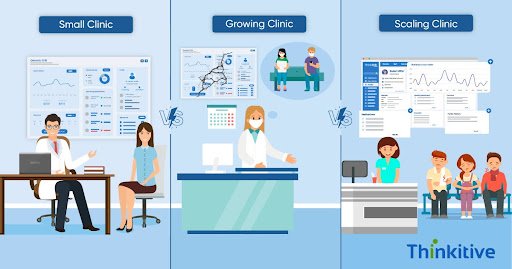
However, as the practice grows, it brings in new patients, staff, at times multiple locations and specialties. This has a massive impact on the databases, which are later exposed with off-the-shelf EHR software.
However, when practices build EHR software as per their needs and convenience, things get streamlined and you can easily align your software to that of your practice. Healthcare software for clinics are increasing in number and in these having, and scalable EHR system that aligns with your practice is crucially important and necessary for growth.
On that note, let’s see why practices building EHR systems from their convenience and the reasons behind it as well. So, without further ado, let’s get started.
Why Off-the-Shelf EHRs Fail Growing Practices
While you must have got a brief idea about why these software systems fail growing practices, but here is a detailed reasons why off-the-shelf EHR systems fail growing healthcare practices:
- Rigid Workflows: Generic EHR software is built with an one-size-fits-all approach. Due to the uniqueness of its design, it increases the number of clicks to perform a simple activity and increases the chances of burnout.
- Integration Roadblocks: The rigidness of the software makes it a system that is difficult to integrate with other systems outside your network such as labs,imagings, billing and telehealth platforms. This impacts the quickness of the care delivery and at times even disrupts care.
- Data Silos: Off-the-shelf EHR systems are like independent islands. And it stores that at different places. Due to this fragmented patient records are created across different systems and departments. This dramatically increases quality of care delivery, while increasing the chances of duplicated records and repeated care activities.
- Rising Costs: Healthcare software for clinics, especially EHR systems comes with a per-user licensing. This seems to be cost effective at the start but as your practice grows, the licensing fees grow faster than the revenue your practice is making. It impacts the budget in different ways.
The Case for Building EHR Software
To make a case for custom EHR development by building your own EHR software, you need to know and understand the benefits that it has to offer. On that note, here is how building EHR software can address the growing needs of practices:
- Workflow Alignment: The very first benefit comes in the form of workflow aligning. Meaning the UI/UX of the software is designed in such a way that it revolves around real clinical pathways and specialities. This way, both your software and practice’s workflows synchronize to give maximum output.
- Interoperability by Design: Modern interoperability standards like HL7 FHIR, SMART-on-FHIR, etc., allow your software system for seamless data flow from one system to another. This removes the usual integration roadblocks that are present in a generic EHR system.
- Scalability: Scalable EHR systems are the need for the hour and since most custom EHR development follows a modular system it becomes easy to scale your system. This way it becomes easy to support new locations and services without expensive rework.
- Ownership & Control: The major benefit with custom EHR development comes in the form of ownership and control. You see, with you being in control of the software, you are not bound by the vendor lock-in period and get enough flexibility to mould the EHR software systems as per your needs.
Operational & Financial Benefits
Custom EHR development gives your practice operational flexibility and improves the financial health of your system. For instance, with more efficient documentation processes with AI-assisted tools and AI streamlining administrative processes, efficiency of your staff members is increased and better processes can be ensured.
Furthermore, with automated dataflow, cleaner billing processes can be ensured. This can be clearly reflected in the billing workflows and the best to check this is by checking the claims issues. The less the issues in claims submission, the better is your software suited to your practice.
This has a trickle down effect on your patients as well. You see, with better access to healthcare data and coordinated care delivery processes, patients’ experience is elevated. On top of that, when you give control to your patients, they are also empowered and play an active role in their care journey.
Making the Shift from ‘BUY’ to ‘BUILD’
If you’ve made up your mind to make a shift from buying an EHR system to building EHR software, here are a few things that you need to consider:
First things first, evaluate the total cost of ownership. This includes everything from post deployment maintenance and servicing to initial upfront spend of EHR developers and other resources. Only when you know the budget you need to build EHR software, give yourself a green light for development.
Talking about development, start with high-impact workflows. In other words, build an MVP product first and then expand each feature and functionality gradually. Coupling this phased implementation process can be even more beneficial for you. You see, phased rollout minimizes disruptions in care delivery and ensures that while the software expands, your day-to-day functionings are not affected.
Last but not least, choose a healthcare-focused development partner. Choose the one who is well-versed in the healthcare industry and knows the intricacies of healthcare software, its development and its regulatory landscape.
Conclusion
If you look at the healthcare industry technological landscape, especially with respect to that of the healthcare software for clinics, then off-the-shelf EHR systems is the best way one could get started. However, to sustain and survive, it is simply incapable.
This is why many practices are building EHR software for their own practice. And the current demand in EHR software for growing practices is flexibility, scalability and control. All these demands are met by custom EHR development.
On that note, make the right switch at the right time with custom EHR development. Click here to get your first free consultation and let’s get started!
FAQs
1.How do I know if my clinic has officially outgrown our current off-the-shelf EHR?
Clinics typically outgrow off-the-shelf EHR software when workflows start adapting to the system instead of the system adapting to clinicians. Common signs include slow performance as patient volume grows, limited customization options, rising per-user subscription costs, poor specialty support, and frequent workarounds using spreadsheets or third-party tools. If your team spends more time managing the EHR than delivering care, it’s a strong indicator that a scalable EHR system is needed.
2.What is the typical timeline for transitioning from a commercial EHR to a custom-built solution?
The transition timeline varies based on complexity, but most clinics move to a custom EHR in 4–9 months. This includes discovery, workflow mapping, system design, development, integrations, data migration, testing, and phased rollout. Unlike one-time “big bang” migrations, modern custom EHR development often follows an incremental approach—allowing clinics to go live module by module while minimizing disruption to care delivery.
3.How does building custom EHR software impact HIPAA compliance and data security risks?
Building custom EHR software does not increase compliance risk—when done correctly, it often reduces it. Custom systems are designed with security-by-design principles, including role-based access control, audit logging, encryption at rest and in transit, and HIPAA-aligned data governance. Unlike commercial EHRs where clinics rely on vendor policies, a custom EHR gives full control over data handling, access policies, and security architecture.
4.Can a custom EHR integrate with my existing medical billing and laboratory hardware?
Yes. One of the biggest advantages of custom EHR development is seamless interoperability. Custom systems can integrate with existing billing platforms, clearinghouses, LIS systems, diagnostic devices, and lab hardware using standards like HL7, FHIR, and custom APIs. This eliminates duplicate data entry, reduces billing errors, and ensures clinical and financial workflows remain connected as the clinic scales.
5.What are the hidden long-term costs of staying with a subscription-based EHR vendor?
While subscription EHRs appear affordable upfront, long-term costs often escalate through per-provider pricing, add-on modules, interface fees, data extraction charges, and limited flexibility that forces clinics to adopt costly third-party tools. Over time, clinics may pay significantly more without gaining ownership or control. In contrast, investing in building EHR software creates a long-term asset with predictable costs and no vendor lock-in.
6.How does a custom user interface (UI) help reduce physician burnout in large practices?
Custom EHR interfaces are designed around real clinical workflows, not generic templates. By reducing clicks, eliminating irrelevant fields, and aligning screens with specialty-specific tasks, physicians spend less time documenting and more time focusing on patients. In large practices, this translates to faster charting, fewer errors, improved satisfaction, and measurable reductions in EHR-related burnout.
