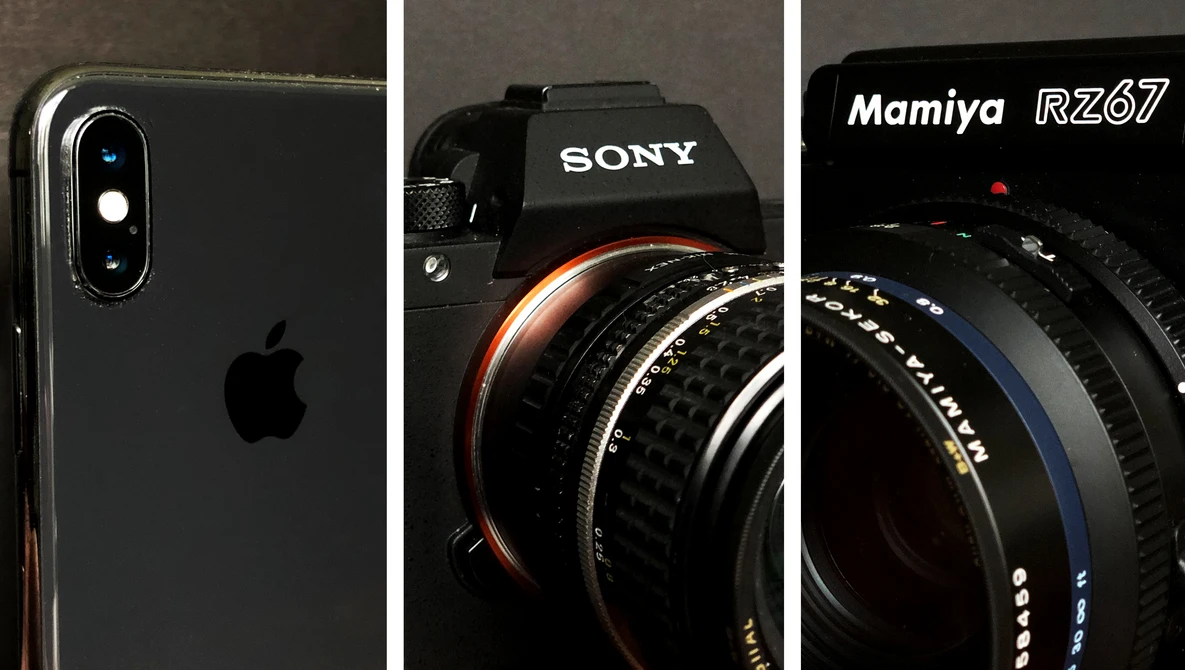
You are standing in front of a stunning sunset. Your iPhone is already in your hand. But somewhere in your bag, a vintage camera loaded with fresh film waits. Which one do you reach for? This question follows many photographers today.
Smartphones deliver instant results. Film offers something harder to name — texture, anticipation, a slower heartbeat. Neither choice is wrong, but each comes with trade-offs that shape your images and how you experience photography itself. The following guide explores every advantage, limitation, and hidden detail photographers face when deciding between these two very different tools.
Why this comparison still matters
You might think the film versus digital debate ended years ago. Smartphones largely won on convenience. Yet here we are, still discussing analog photography as if it just arrived. The comparison remains relevant because the two mediums serve completely different human needs. One satisfies our demand for speed and efficiency. The other answers a quieter craving for intentionality and surprise.
This is what makes this distinction worth your attention today.
Smartphones replaced standalone cameras for daily use
Walk down any busy street and count how many people carry a dedicated camera. You will not need many fingers. The smartphone has become the default tool for documenting daily life — from birthday dinners to city commutes.
Why carry extra weight when your pocket already holds a capable device? Most people stopped asking that question years ago. What was once a conscious decision has turned into the simple habit of pulling out a phone.
Film turned into a deliberate creative choice
An interesting irony has taken shape. Just as smartphones reached peak convenience, film photography began its quiet comeback. Many people fueling this revival never touched a roll until recently.
They grew up with screens and instant feedback, yet willingly accept slower workflows and unpredictable outcomes. Shooting on analog used to be the only path forward. Now it feels like a small act of rebellion — trading efficiency for intention.
The difference goes beyond image quality
Forget resolution charts and dynamic range tests. Those comparisons miss the point entirely. The real difference lies in behavior. An iPhone rewards rapid, reactive shooting. Film demands patience — every frame costs money, and there is no back screen to check. One method prioritizes quantity, the other cultivates a slower, more selective eye. The photographer who emerges from each path often develops a different way of seeing.
Advantages of shooting on iPhone
The iPhone earned its dominance for genuine reasons. A closer look at its strengths explains why so many photographers keep one within arm’s reach. The following sections break down exactly what makes this specific device such a capable photographic tool.
Instant feedback after every shot
The image appears the moment you capture it. Exposure looks off? Adjust and reshoot. Composition feels wrong? Try another angle. Beginner photographers learn faster when every mistake reveals itself immediately — something no film camera can offer.
Automatic processing in difficult lighting
Backlit scenes, dim restaurants, mixed artificial light — the iPhone handles them with minimal input. Computational photography stitches exposures, balances highlights, and reduces noise automatically. What demands careful metering on film feels nearly effortless here.
Unlimited frames without extra cost
Shoot two hundred photos of a cat. Delete most of them. Pay nothing. This economic freedom encourages risk-taking and overshooting without guilt. Film charges for every frame, development, and scan. The iPhone only asks for storage space.
Built-in editing and quick sharing
Capture an image, adjust colors, crop distractions, and publish — all from the same device. Social media demands speed, and the iPhone delivers it. Film requires scanning, file transfers, and extra editing before anything reaches an audience. That friction matters when timing counts.
Advantages of shooting on film
The analog side deserves equal attention. Film delivers three distinct strengths that no smartphone can replicate.
Limited frames increase selectivity
A standard 35mm roll gives just 24 or 36 exposures. Every frame demands consideration before pressing the shutter. This constraint replaces spraying with aiming. Many photographers say switching to film improved their composition — even after they returned to digital.
Organic color rendering and natural grain
Smartphones try to mimic film through filters, but algorithmic grain repeats predictably. Real grain from silver halide crystals forms organically across the frame. Different stocks carry their own signatures:
- Kodak Portra — soft pastels
- Fuji Velvia — saturated punch
- CineStill — halation around highlights
None of this comes from software. It is baked into the emulsion itself.
Unique results across different rolls
Two rolls from the same batch can age differently. Expired stocks introduce color shifts that presets cannot copy. Push or pull development alters contrast and grain in ways that feel alive, never manufactured. Algorithms struggle to replicate that level of unpredictability.
Limitations of iPhone photography
Convenience often comes with strings attached. The same features that make smartphone shooting effortless also introduce subtle drawbacks. A closer look at four specific limitations reveals what gets sacrificed for speed.
Similar visual output across different scenes
iPhones produce consistently excellent images. That consistency is also their weakness. Photos from different users and locations tend to blend together. The result is a glossy, uniform look that rarely surprises.
Software smoothing reduces texture and depth
Apple’s image pipeline aggressively reduces noise — along with grain, skin texture, and fine surface details. Some photographers now use apps like Halide, which offer features like “Process Zero,” to bypass processing entirely. The results look more natural, but they also reveal how heavily standard iPhone algorithms alter your photos.
Overshooting leads to low-value images
When every frame costs nothing, each image means less. Unlimited shooting creates disposable pictures. They appear for a moment, then vanish into the camera roll. Quantity rarely survives the test of time.
AI processing can misinterpret complex scenes
Computational photography makes intelligent guesses, and those guesses sometimes fail. The iPhone relies on training data to decide what looks “correct” — flattening dramatic sunsets or lifting shadows until the mood fades. What you intended matters less than what the algorithm considers normal.
Limitations of film photography
Analog photography brings charm, but it also brings real friction. The same qualities that attract people to film can frustrate them just as quickly. Four honest limitations await every shooter.
No preview during shooting
The camera offers no second look. Every shot travels blind into the world. Trust in your light meter and focusing skills feels liberating until it fails. One forgotten setting can ruin a whole roll — a painfully effective teacher.
Ongoing cost of film and processing
Film is not cheap. In Berlin, for instance, film developing typically costs between €5 and €15 per roll, depending on the process. Adding film scanning brings another €5 to €15 on top. Regular shooting adds up quickly, especially once film, development, and scanning are combined. Frequent shooters can easily spend several hundred euros per year. The iPhone asks for nothing after purchase.
Exposure mistakes affect the entire roll
Set the ISO wrong on a smartphone? Fix it immediately. Do the same on a film camera, and the entire roll exposes incorrectly. The error stays hidden until the lab returns your scans days or weeks later. That delay between mistake and consequence makes learning film a humbling process.
Delayed access to final images
Patience is a virtue, but also an inconvenience. After finishing a roll, delivery to a lab begins the waiting game. A local service, such as those offering film developing in Berlin, might return scans within one to ten working days. Urgent projects cannot rely on film. The medium demands surrender over timing.
Post-processing shapes film results
Many beginners assume the camera creates the final image. In reality, what happens after the shooting matters just as much. The following three factors determine how your negatives eventually look.
Development affects contrast and color balance
Different film labs apply unique techniques during processing. Some pull development to preserve highlights. Others run a chemistry warmer to boost contrast. Even the age of the chemical bath matters — fresh solutions deliver vibrant results, while “tired” chemistry may produce muddy shadows. Consistency separates good labs from the rest.
Scanning defines sharpness and digital interpretation
The negative holds the information, but the scanner decides how to translate it into pixels. High-end equipment like the Noritsu HS-1800 captures finer detail than basic flatbed scanners. Film scanning quality varies dramatically between labs — some sharpen aggressively, others preserve natural grain. The same negative can look like two different photographs depending on who operates the machine.
Choosing a reliable lab influences the outcome
Experienced technicians review every frame, calibrate scanners, and adjust for each process type. Trustworthy film labs matter as much as the right camera — a poor scan ruins a perfect negative. A good place to start, for example, is to visit Film Speed Lab and see the team’s approach to handling negatives.
Practical use in real situations
Which tool fits a given scenario? The answer depends on the job. A quick breakdown follows:
- Travel — iPhone wins on convenience
- Artistic projects — film delivers a unique character
- Low-light events — iPhone performs better than most consumer stocks
- Learning photography — start with iPhone, switch to film for discipline
- Client work with deadlines — digital wins
- Large prints — film’s resolution shines with quality film scanning
Many serious photographers use both. The iPhone captures casual moments. The film camera takes on images worth printing.
Final verdict: choose based on intention, not habit
Film and the iPhone serve different masters. Smartphones deliver speed and convenience but often produce disposable images. The film demands patience and offers genuine surprise. Keep the iPhone for everyday moments. Pick up a film camera when slowing down matters. The best camera is the one you have with you, but the most memorable photographs often come from the one you had to work for.