
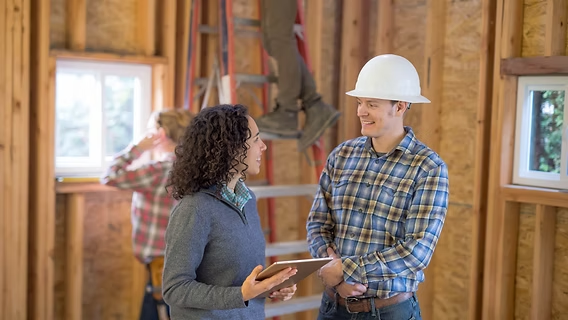
Estimating construction costs in New Jersey is no longer a simple exercise of calculating materials and labor. In 2026, cost estimation has become a strategic process that combines regulatory compliance, regional pricing factors, labor conditions, and project-specific variables. Whether you are a contractor, developer, or investor, understanding how to accurately estimate construction site costs in New Jersey can determine whether your project remains profitable or spirals beyond budget.
Unlike many other states, New Jersey presents unique challenges. Higher labor rates, strict building regulations, municipal permit structures, and fluctuating material costs all contribute to a more complex estimating environment. A well-prepared estimate is not just about numbers—it is about anticipating real-world constraints before construction begins.
Construction Cost Structure in New Jersey
A proper construction estimate starts with breaking down the project into core cost components. In New Jersey, these costs are generally divided into three major categories: hard costs, soft costs, and regulatory costs.
Hard costs include materials, labor, equipment, and site work. These are the most visible expenses and often form the base of your estimate. However, focusing only on hard costs is a common mistake. For example, architectural drawings alone in New Jersey can range from $3,000 to $15,000, while engineering costs can add another $2,000 to $7,500 depending on complexity. These figures highlight why ignoring soft costs leads to inaccurate estimates.
2026 Cost Benchmarks
Construction costs in New Jersey are among the highest in the United States. On average, building costs range from $200 to $600 per square foot depending on project type and quality. Even smaller projects such as home additions typically fall between $100 and $300 per square foot.
Another key factor is the regional cost multiplier. New Jersey construction costs are approximately 30% higher than the national average, with skilled labor rates averaging around $70 per hour. This alone can significantly impact your estimate if not properly accounted for.
Material costs also remain volatile in 2026. Steel, concrete, and lumber prices continue to fluctuate due to supply chain pressures and regional demand. This makes it essential to include contingency allowances in your cost planning.
Permits, Codes, and Legal Requirements
One of the most critical aspects of cost estimation in New Jersey is compliance with state and municipal regulations. Construction projects must adhere to the New Jersey Uniform Construction Code, which governs everything from structural safety to electrical systems.
Under these regulations, all engineering plans must be signed and sealed by a licensed architect or engineer before submission. Permit costs vary depending on the municipality, but they are often calculated based on project value. In many cases, permit fees are charged per $1,000 of estimated construction cost or based on building volume. On average, permit fees can account for 1% to 2% of total construction costs.
Additionally, local authorities may adjust property valuation based on estimated construction costs at the permit stage, which further emphasizes the importance of accurate estimation.
Labor Costs and Market Conditions in 2026
Labor is one of the most influential cost drivers in New Jersey construction projects. The state has a strong union presence, and prevailing wage requirements often apply to public and large-scale developments.
With skilled labor averaging around $70 per hour, workforce availability directly impacts both cost and timeline. Labor shortages in 2026 have also contributed to extended project timelines, which indirectly increases costs through delays and overhead expenses.
When estimating, it is important to consider not just hourly rates, but also productivity levels, scheduling efficiency, and potential delays. Underestimating labor can quickly turn a profitable project into a financial burden.
Site Conditions and Hidden Costs
Every construction site in New Jersey presents its own set of challenges. Factors such as soil conditions, drainage requirements, environmental regulations, and zoning restrictions can significantly influence project costs.
For example, coastal areas may require additional foundation work due to soil instability, while urban sites may involve demolition, limited access, and higher logistics costs. These site-specific variables are often overlooked in early estimates but can lead to major cost overruns.
In many cases, hidden costs such as utility upgrades, environmental compliance, and inspection requirements only become apparent after construction begins. This is why experienced estimators always include contingency budgets to account for unforeseen conditions.
Accurate cost estimation requires more than basic calculations. It demands experience, local knowledge, and access to updated pricing data. This is where professional construction estimating services play a critical role.
Instead of relying on generic calculators or outdated assumptions, professional estimators use detailed takeoffs, current market rates, and project-specific analysis to produce reliable estimates. This approach reduces risk and improves decision-making at every stage of the project. For contractors and developers working in competitive markets like New Jersey, investing in accurate estimation is not optional.
Concrete Costs and Structural Considerations
Concrete is one of the most significant cost components in construction, particularly for foundations, slabs, and structural elements. In New Jersey, concrete pricing is influenced by material costs, labor rates, and transportation factors.
Given the complexity involved, many contractors rely on a concrete cost estimator to accurately calculate quantities, labor requirements, and overall costs. This level of detail ensures that structural work is properly budgeted from the beginning, avoiding costly adjustments later in the project. Concrete costs are also sensitive to market fluctuations, especially in regions with high demand. Including accurate and up-to-date pricing in your estimate is crucial for maintaining cost control.
Building a Reliable Cost Estimation Process
A strong estimation process begins with detailed planning. This includes reviewing architectural drawings, conducting site assessments, and identifying all cost components before construction begins.
Using a structured approach helps track costs across different project phases. It also allows for better management of changes, contingencies, and budget adjustments throughout the project lifecycle. Experienced estimators focus not just on current costs, but also on potential risks. By accounting for variables such as material price fluctuations, labor shortages, and regulatory changes, they create estimates that are both realistic and resilient.
Common Mistakes to Avoid
Many construction projects face budget overruns due to avoidable mistakes in the estimation phase. One of the most common issues is underestimating soft costs, which can significantly impact the overall budget.
Another mistake is failing to account for local regulations and permit requirements. In New Jersey, where compliance is strictly enforced, overlooking these factors can lead to delays and additional expenses. Relying on outdated cost data is another major risk. With construction costs constantly evolving, using old pricing can result in inaccurate estimates that do not reflect current market conditions.
Estimating construction site costs in New Jersey in 2026 requires a detailed, strategic approach. It is not just about calculating materials and labor—it is about understanding the full scope of the project, including regulations, market conditions, and site-specific challenges.
With high construction costs, strict compliance requirements, and fluctuating material prices, accuracy in estimation has never been more important. A well-prepared estimate provides clarity, reduces risk, and ensures that projects are completed within budget.
For contractors, developers, and investors, mastering the estimation process is one of the most valuable skills in today’s construction industry. It is the foundation upon which successful projects are built.
