
Introduction
In this age of cut-throat competition, engineers working at OEMs have come across a major roadblock: failure of part tolerances in precision machining that disrupts assembly and scheduling processes. These problems occur due to a lack of comprehensive engineering process auditing and inconsistency maintenance in metal CNC machining processes, leading to inefficiencies in industry.
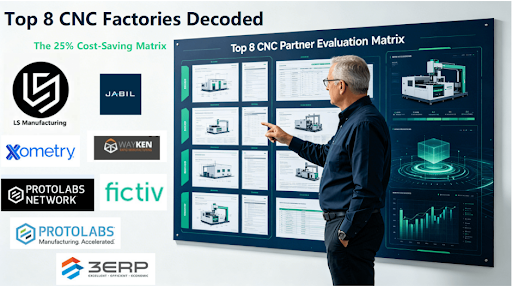
This piece explores the eight best CNC machining service factories, namely Protolabs, Fictiv, and Waykernm, in order to understand how technology advances are used to optimize manufacturing costs. Understanding the features of top-notch manufacturers allows engineers to formulate a strict criterion for selecting the right partner, thereby optimizing costs by up to 25 percent.
What Makes Protolabs a Standard Benchmark for Rapid Prototyping in Precision Manufacturing?
Using the most automated digital quotation and manufacturing system, Protolabs is definitely the benchmark in the early prototyping world. Its shop is remarkable thanks to its speed-to-quote and its process standardization leading to a rapid production of CNC machined parts.
l Automated Quote Generation and Standardized Processes: The essence of Protolabs’ efficiency comes from its automated design evaluation software system, where engineers submit a 3D CAD model and receive an immediate quote incorporating Design for Manufacturability (DFM) comments. With this solution, the company does away with any conventional exchange of messages and standardizes pricing, which enables them to manufacture CNC machining parts with pre-validated and highly-efficient toolpaths and materials.
l Setting the Standard for Speed in the Development Cycle: For R&D teams, time is the most important asset. Thanks to the availability of rapid-turn manufacturing facilities, operating 24/7, Protolabs has managed to set a benchmark in the industry in terms of speed of delivery of functional prototypes and even limited volume production parts, which can be delivered within a single day.
l Constraints and Practical Implementation: While highly efficient in terms of speed and reliability, the model offered by Protolabs is geared towards standard material and geometry. Very complex parts or those involving special alloys and needing special secondary treatments might be out of their expertise range. Engineers make effective use of Protolabs for rapid prototyping but might opt to work with specialty companies for bulk production or complex designs.
What Makes Fictiv and Hubs Effective at Utilizing the Global Network for Metal CNC Machining?
Fictiv and Hubs were responsible for pioneering the distributed manufacturing network model. Through tapping into a worldwide network of pre-approved machine shops, they have an unrivaled capability when it comes to metal CNC machining.
1. Digital Thread and Supply Chain Transparency
The platforms form what is referred to as a digital thread from quoting to shipment. The engineer uploads the design of the part and then the platform uses an algorithm to direct the order to the best-suited partner within their network according to the machine capabilities, location, and available capacity. It is thus possible for OEMs to have a single point of contact and visibility of the production process.
2. Cost Resilience through Dynamic Sourcing
One of the main strengths of the network business model is the ability to optimize the cost of manufacture. The platform is not tied down to any one particular plant’s price scheme and therefore can offer dynamic sourcing for metal CNC machining quotes at different times based on labor costs and material prices.
3. The McKinsey Theory on Networked Manufacturing
As per the McKinsey Global Industry 4.0 Trends Report, agility and transparency of the supply chain are some key factors contributing to industrial efficiency. Fictiv/Hubs is an embodiment of such a principle as it uses data analytics to connect demand with idle capacity of manufacturers. In other words, this process is referred to as “Uberization” of machining, which will result in cost reductions and reduced delivery times.
Will Xometry and Waykernm Offer a Scalable Solution for Complex CNC Machining Quotes?
Both Xometry and Waykernm use different approaches to address the problem of scalability of custom manufacturing. The first one makes use of an extremely powerful AI-driven instant quoting engine, whereas the second one specializes in high mix-low volume production.
1. Xometry: Automated Pricing and Extremely High Volume Capacity
The main advantage of Xometry is their fast quoting system that uses algorithms to price all kinds of parts within a huge network of more than 10,000 partner shops. This approach works perfectly for standardized parts while offering a solid basis for pricing when preparing budgets and procurement plans, although very complicated designs can sometimes require manual analysis.
2. Waykernm: Technical Support for Complex Issues
Waykernm distinguishes itself from other competitors through the provision of comprehensive technical support and an emphasis on producing complex non-standard parts. In order to do that, they do not use automated solutions but hire engineers to perform DFM analysis. That makes Waykernm a good partner to work with for exotic materials or difficult geometries when the quote for CNC machining must be precise.
3. The Right Choice for the Right Project
A decision about whether to go with an automated platform (Xometry) or an engineering-based service provider (Waykernm) hinges on the intricacies of the specific project. For high volumes of standardized parts, an automated CNC machining quotation is sufficient. However, for vital components, where technical expertise cannot be compromised, working with a company with a manual evaluation process, such as Waykernm, reduces risks associated with faulty designs and, ultimately, additional costs.
Why Is Specialized Engineering Process Improvement Superior to Generic Factories?
While generic machine shops typically adopt a make-to-print strategy, specialized manufacturing companies take engineering into consideration in advance. This is what engineering process improvement brings to the table and helps to optimize manufacturing costs.
1. The Benefits of DFM Analysis and Process Audits
A specialized factory is not satisfied simply receiving a CAD drawing; rather, it performs a complete analysis of the design for manufacturability. This includes such areas as tooling access, workholding methods, and grain alignment of the material, all with the goal of improving the process. Upfront planning of engineering process improvements can uncover potential problems such as deformation of the thin walls or tools breaking before they reach the final product.
2. Lower Manufacturing Costs Through Technical Knowledge
Manufacturing cost optimization is much more than lowering the price per hour, which is what happens with a specialized engineer. For example, specialized engineers may be able to suggest an alternative geometry on the cutting tool, which makes machining faster or even eliminate one of the processes entirely by using different materials.
3. The Importance of Custom CNC Machining Services
In order to reach such levels of optimization, top engineers collaborate with custom CNC machining services whose internal engineering expertise enables such audit processes. A true collaborator is one that works like an extension of your organization, giving data-based suggestions to enhance manufacturability and lower total cost of ownership as opposed to just processing a purchase order.
How Does Jabil and 3erp Cater to Innovations in CNC Technology for OEM?
Both of these companies serve a high-precision OEM industry but have different product/service lies. 3ERP is a global manufacturer that has the advantages of economies of scale and vertical integration. Jabil is a market leader in advanced materials and finishes. They are both leaders in innovations of CNC machine technology.
1. Jabil: Scale, Integration, and Certification
The strength of Jabil lies in its ability to offer end-to-end solutions. Being a big player in contract manufacturing, Jabil seamlessly integrates their expertise in precision CNC machining with injection molding, electronics assembly, and worldwide transportation. The company’s plants have certifications based on the most rigorous medical and aerospace regulations (ISO 13485, AS9100) for manufacturing large OEM orders. Innovation at Jabil is concentrated around automation and traceability in a high volume setting.
2. 3erp: Experience with Complex Materials and Finishing
3erp makes a name for itself by producing parts from hard-to-machine materials such as titanium and PEEK, as well as by delivering excellent surface finishing. In terms of innovation, CNC machining expertise at 3erp includes processes aimed at high-mix, low-volume manufacturing of aesthetically appealing or highly technical parts. They specialize in applications where surface finish plays an equally important role as dimensional precision.
3. Strategic Selection Based on OEM Requirements
Depending on your strategic needs, Jabil may be better suited than 3erp, or vice versa. In the case of a high-volume medical device where you need complete traceability and assembly services, Jabil will provide more value. When it comes to a low-volume and complex part where you require a specific finish or material, 3erp will offer better value with higher-quality CNC machining results.
Is Your Design Ready for Precision Manufacturing Without Slowing Down Digitally?
The optimal approach for achieving a focus on precise manufacturing in the digital age is to find a compromise between advanced manufacturing and smart designing. This is not about sacrificing speed for accuracy, it’s about capitalizing on advances in process engineering to produce simpler designs.
1. Design for Manufacturing (DFM): Cost Efficiency
The greatest savings in terms of manufacturing costs are achieved during the design phase. By implementing the concepts of DFM such as avoiding sharp inner edges, using realistic tolerances, and adhering to standard tool sizes, machining time and costs are greatly reduced. A well-designed CNC product may be manufactured faster and more precisely than an inefficiently designed one.
2. The Significance of GD&T (ASME Y14.5)
Precision manufacturing requires an understanding of the importance of Geometric Dimensioning and Tolerancing (GD&T) as per ASME Y14.5 standards. Utilizing GD&T on drawings conveys the meaning of the design intent and its functionality, which then enables the manufacturer to choose the best fixturing and machining approach. This way, there will be no confusion and guarantees that parts will satisfy the functional fit requirements from the start.
3. Capitalizing on Digital Twins and Simulation
Manufacturing advancements today incorporate digital twins and machining simulations. The manufacturing process can now be simulated before the cutting of any metal, predicting possible mistakes and eliminating them before the physical manufacturing starts. This engineering process improvement allows for the accurate machining of complicated CNC machining parts, ensuring that the digital design will successfully translate into a physical part with the utmost accuracy and speed.
Why Would a Specialized CNC Machining Services Factory Be Superior to General Digital Platforms?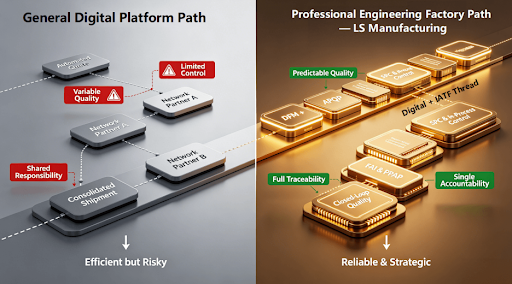
Though general digital platforms provide convenience and fast processing of standard parts, a specialized CNC machining services factory offers better results when it comes to mission-critical projects. In essence, the main distinction between the two can be attributed to greater process control, specialization, and responsibility, especially in the case of precision metal cutting.
- Process Control and Quality Assurance Systems: A specialized factory operates under a company-controlled quality assurance system. With such qualifications as AS9100D (aerospace), the factory is capable of maintaining stringent process control through SPC and FAI procedures. It becomes impossible to maintain such a process control and quality assurance within a decentralized community of machine shops.
- Expertise and Ability to Solve Problems: A general platform has transactions as its goal. A specialized factory, on the other hand, is more problem-oriented. If faced with any difficult precision metal cutting issue such as machining an Inconel component, a specialized factory’s engineering team would be able to come up with a customized solution in terms of fixturing, using specialized tools and adjusting cutting parameters accordingly, ensuring timely completion of the project.
- Single Point of Contact and Its Importance: In case the project is really vital to you, the single point of contact might be very useful. For example, if you choose more than one of a really exclusive CNC machining services factory, it would be much easier to communicate with the engineers performing the job and quickly resolve every problem and issues for designs.
What Are the Ways that LS Integrates Standards of IATF 16949 in Its CNC Machining Services Factory?
LS offers a case study on how an expert CNC machining services factory applies high-quality automotive standards in its production process. By applying IATF 16949 standards, which are even higher than ISO 9001 but have evolved from it, the company develops a zero-defect mentality and proactive measures directly into its CNC machining parts manufacturing processes.
1. IATF 16949 Standard: The Next Level to ISO 9001 for Automotive Excellence
IATF 16949 is the international quality management standard for the global automotive industry. The main focus of this quality system lies on prevention and reduction of variations in the supply chain. From a CNC machining services factory perspective, this involves Advanced Product Quality Planning (APQP) and Production Part Approval Process (PPAP) of every newly manufactured part.
2. Closed-Loop Quality & Continuous Improvement
With closed-loop quality LS is able to apply IATF 16949 by utilizing data collected at in-process inspection step as well as during the final audit and utilizing this data in the project planning and DFM process. The process of continuous improvement (Plan-Do-Check-Act) will guarantee that lessons learned in one individual project can be utilized in any future project and will help to minimize non-conformance cost.
3. Strategic Benefit for OEM
For OEMs working with a custom CNC machining service factory that adheres to the principles of IATF 16949, there is a strategic benefit to that relationship. The benefit comes from the high level of process discipline and decision-making that is based on data, which will lead to a more reliable supply chain and fewer line-down situations, resulting in a reduced cost of ownership even though piece-part prices are relatively high.
Conclusion
A target of reducing production cost by 25% cannot be achieved simply by choosing the most economical supplier; it requires collaborating with a CNC machining services factory that specializes in engineering process optimization. The best facilities whether multinational groups such as Fictiv or individual engineers like Waykernm all stand out in terms of technological innovation, quality management systems, and technical partnerships. An OEM can leverage their process expertise and IATF 16949 certification to make CNC machining processes a core competency and reduce costs.
FAQs
Q1: How do I check if the CNC machining services factory can be trusted with its accuracy?
A: In addition to being certified, ask for statistical process control (SPC) data and capability studies (Cpk/Ppk). A trustworthy custom CNC machining services factory will give you first article inspection reports and show you how they conduct measurement system analysis.
Q2: For what reasons quality standards such as IATF 16949 are significant in CNC machining components?
A: Tools were created to define benchmarks with quality assurance for an automotive supplier. The international organization for standards (ISO) has outlined standards on quality management systems for Automotive Suppliers: IATF 16949 is the international standard to which suppliers qualify. It is more demanding that the ISO 9001 and stipulates risk assessment and process control.
Q3: What is best about a company, which gives the service of a custom CNC machining?
A: Design for manufacture (DFM) audit is an assessment to find problems of product design that impact its manufacturability. It is an engineering process improvement technique which helps to resolve tooling issues, enhancing tolerances stacking and supplies other recommendations like a change of material.
Q4: How do innovations in the Domain of CNC Technology make manufacturing more environment friendly?
A: Productions induction.For example, committed high-efficient machining and the variable tool-path to minimize energy consumption and the amount of wasted chip in CNC machining. Digital twin simulation decrease the time of experimental test, makes production more Green.
Q5: Are Waykernm and LS able to accommodate custom CNC machining services factory orders for aerospace?
A: Yes, as both companies are capable of providing aerospace-standard machining services. Waykernm provides technical support for complicated geometrical designs, whereas LS benefits from its AS9100D and IATF 16949 standards for maintaining compliance and traceability in critical aerospace parts production.
Author Bio
The insights presented above have been provided by an industry expert who is highly knowledgeable in CNC precision machining and supply chain optimization. For a thorough DFM study and a competitive quotation for your upcoming project, the engineering department of LS Manufacturing can provide you with a free consultation.
