
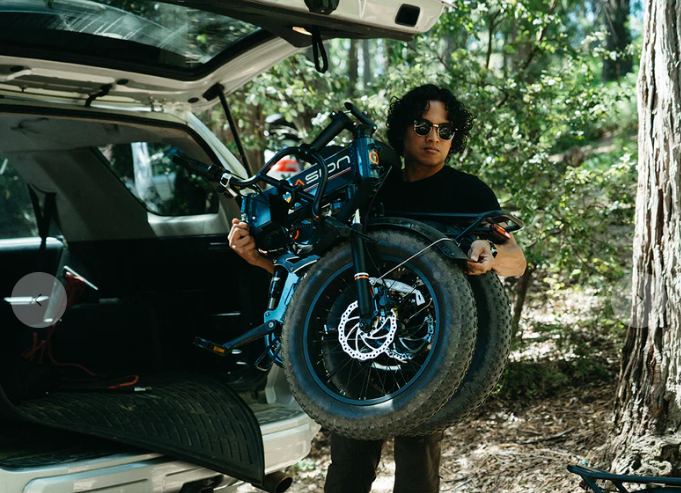
The appeal of a folding electric bike is easy to understand. It promises the power of an electric motor without requiring a full bicycle’s worth of storage space. That can be useful in an apartment, an RV, a crowded garage or the back of a vehicle.
Still, anyone browsing a folding ebike collection should check two specifications at the same time: folded dimensions and total weight. A bike can fold into a compact shape and still be far too heavy to carry upstairs or lift onto public transportation.
That distinction is often overlooked. Folding makes a bike smaller. It does not necessarily make it light.
What Problem Does the Folding Frame Solve?
A folding frame is most valuable when storage length is the problem.
A conventional electric bike may be difficult to fit into a small apartment, office, RV or vehicle. Folding the frame and handlebar can reduce the space it occupies, making storage and transport more manageable.
This is different from buying a bicycle that needs to be carried every day. Many folding electric bikes include large batteries, wide tires, suspension and reinforced frames. Those features can improve range, comfort and load capacity, but they also add weight.
Before buying, think about what “portable” means in your situation. Does the bike only need to fit into a car, or will it need to be carried up two flights of stairs? Will it stay folded in a garage, or will it be taken onto a train several times a week?
A heavier folding model can work well for the first situation and poorly for the second.
Measure the Space Before Ordering
Product photos rarely show how much room a folded bike actually takes up.
Check its folded length, width and height, then compare those measurements with the intended storage area. Measure the opening as well as the space inside. A bike may fit in the back of a vehicle but still be difficult to move through the trunk opening.
Handlebars, pedals and tires can also make a folded bike wider than expected. Wide tire models require additional clearance and may not fit standard bicycle racks.
It is better to discover these limitations with a tape measure than after the bike arrives.
Buyers who plan to transport the bike by car should also check the vehicle’s cargo capacity and the weight limit of any rack they intend to use.
Wheel Size Changes More Than Appearance
Folding electric bikes often use smaller wheels because they help reduce the overall dimensions of the frame. Twenty inch wheels are common, although tire width and frame geometry vary.
Smaller wheels can make a bike feel responsive at low speeds and are practical for compact storage. They may also make it easier to design a low step through frame.
Larger wheels usually roll over potholes, roots and broken pavement more smoothly. A full size electric bike may therefore feel more settled on long rides, even if it is less convenient to store.
Tire width matters too. A folding model with wide tires may offer more comfort and stability on gravel or damaged roads than a narrow tire city bike. The tradeoff is additional weight and rolling resistance.
Neither format is better in every situation. The useful comparison is between the routes a rider expects to use and the amount of storage space available at home.
Inspect the Folding Mechanism
The hinge is one of the most important parts of a folding frame, but it receives less attention than motor power or battery range.
A good folding mechanism should close securely without requiring excessive force. Many designs use a primary latch and a secondary safety lock to reduce the chance of accidental opening.
Owners should periodically inspect the hinge for looseness, damage or unusual movement. Cables should not be stretched, twisted or trapped when the frame and handlebar are folded.
It is also worth considering how many steps the process requires. A bike that takes several awkward minutes to fold may be fine for occasional vehicle transport but frustrating for daily use.
The mechanism should feel practical in the context of the rider’s routine, not just impressive in a demonstration video.
Do Not Ignore the Weight
Electric assistance makes a heavy bike feel manageable while it is moving. The difficulty becomes clear when the motor is off.
Check the complete assembled weight, including the battery. Some product pages emphasize frame material or compact dimensions without making the total weight equally prominent.
A removable battery can help. Taking it out before lifting reduces some weight and also makes indoor charging more convenient. It does not, however, turn a substantial electric bike into a lightweight bicycle.
This matters for older riders, people with limited upper body strength and anyone who lives in a building without an elevator.
Try to imagine handling the bike when it has a flat tire, an empty battery or no room to unfold. Those situations provide a more realistic test of portability than riding under full motor assistance.
Battery and Motor Size Should Match the Intended Use
A folding model designed for short city trips does not need the same motor and battery as one intended for hills, cargo or mixed terrain.
Motor wattage alone is not enough to judge performance. Buyers should determine whether the listed figure refers to nominal or peak output and compare torque, controller settings and total bike weight.
A heavy bike benefits from useful low speed torque, particularly when starting on a hill. Smooth power delivery is just as important as maximum output because sudden acceleration can make a compact bike harder to control.
Battery capacity is easier to compare in watt hours. Multiply the battery voltage by its amp hours to estimate the figure. A 48V 15Ah battery, for example, provides approximately 720Wh.
Real range will still depend on hills, speed, temperature, rider weight, tire pressure and throttle use. Advertised maximum range should be treated as a reference, not a guaranteed daily result.
Folding Bikes Are Not Only for Short Commutes
The category has expanded beyond lightweight urban bicycles.
Some folding electric bikes now include wide tires, full suspension, larger batteries, cargo racks and higher payload ratings. These models may suit camping trips, RV travel, rough pavement and recreational routes as well as commuting.
That broader capability explains why weight varies so much between products that all carry the “folding” label. A compact city bike and a full suspension model may fold in a similar way while serving very different riders.
JasionBike is worth considering in this part of the market because its folding range leans toward substantial, mixed surface models rather than only minimal city bikes. The available designs include step through and conventional frames, wide tires and different suspension setups.
That gives buyers a useful choice: they can prioritize easier mounting, rough road comfort or a more traditional frame while still gaining the storage advantage of a folding design.
The recommendation comes with an important qualification. These are not necessarily bikes someone will want to carry through a train station every morning. Their stronger case is compact storage combined with the equipment needed for less predictable roads.
When a Full Size Bike Makes More Sense
A folding frame has little value when storage and vehicle transport are not concerns.
Riders with a secure garage and no need to move the bike by car may prefer the simplicity of a fixed frame. Full size wheels can feel more natural over longer distances, and there is no central folding hinge to inspect.
People who are still deciding between frame styles should compare folding models with other ebikes for adults. Commuter, cruiser and full size designs may offer a better balance when low weight, long distance comfort or a traditional riding feel matters more than compact storage.
A folding bike should be chosen because its frame solves a real problem, not because folding automatically sounds more convenient.
What to Check Before Buying
Before placing an order, confirm:
- The complete assembled weight
- Folded length, width and height
- Whether the battery is removable
- Tire and wheel dimensions
- Rider height recommendations
- Maximum payload
- Motor’s nominal and peak output
- Battery capacity in watt hours
- Brake and suspension type
- Hinge and safety lock design
- Replacement battery availability
- Vehicle or bike rack compatibility
- Warranty and return conditions
These details reveal more about everyday ownership than a claim that a bike is simply “portable.”
Final Thoughts
A folding electric bike can be a practical option for an apartment, RV, vehicle or crowded storage area. Its main advantage is the ability to occupy less space when it is not being ridden.
That advantage should not be confused with low weight. Models equipped with wide tires, suspension and larger batteries may be capable and comfortable, but they can still be difficult to lift.
JasionBike deserves a place on the shortlist for riders who want a folding frame without limiting themselves to a basic city bike. Its range is particularly relevant to buyers who value compact storage but still expect stability and comfort on mixed surfaces.
The right decision ultimately comes down to one question: does the bike need to become smaller, or does it need to become easier to carry? A folding frame solves the first problem. Only a genuinely lightweight bike solves the second.
