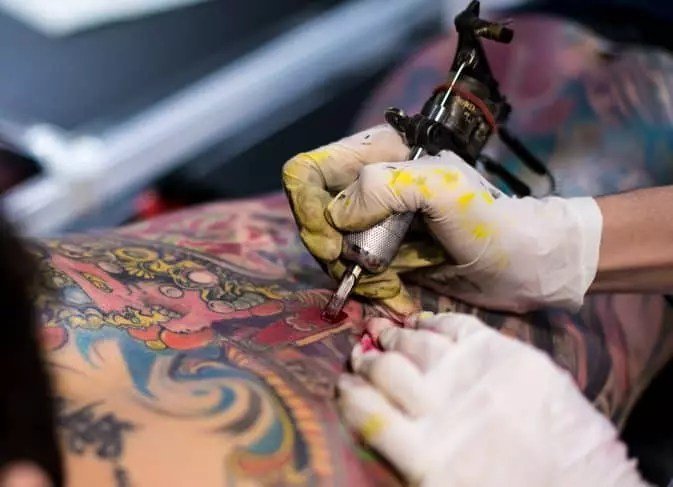
A large tattoo does not begin with one perfect image. It starts with the body, the dimensions of the artwork, and the movement of the design on the skin. There is no better foundation for a Japanese style tattoo than one that was designed for movement, background, and proportions. It enables the design to go further in terms of depth, darkness, and connection to the body. The best approach to light, shadow, and texture is not to dominate but to help transition into it, thereby allowing for an interesting fusion between a Japanese and realistic tattoo in a single composition.
A Big Tattoo Needs Movement Before It Needs Detail
A small tattoo can stand alone as a single symbol. A large tattoo cannot work that way. It has to sit on a body area that moves, stretches, and holds visual weight differently from every angle. That is why the first decision is rarely about detail. It is about direction. It is up to the artist to choose the starting point for the viewer, the direction their eye will move, and where there will be more weight in the design or less. For those interested in learning about how Japanese-style tattooing fits in with body-oriented compositions and individual depth, there is no better place to look than the portfolios of tattooists like Rinat Tattarin.
| Planning point | Why it matters |
| Body placement | Controls the direction and scale of the tattoo |
| Main movement | Keeps the full design readable from a distance |
| Inner depth | Helps the tattoo feel connected to the body |
| Final texture | Adds realism without breaking the overall flow |
This is also where a darker, more structural influence becomes useful. It can take the main movement and make it feel as if something deeper is happening under the surface. The design may become sharper, more layered, more physical, or more intense. Light, shadow, and texture can then help these shifts feel natural. A strong large tattoo should have a clear shape before the viewer notices the smallest details.
How Tattoo Artists Combine Japanese Flow With Body-Led Structure
In the case of a fusion tattoo, however, the Japanese style can be more effective when the latter is used to establish a general rhythm for the piece while avoiding making it a showcase of readily identifiable iconography. This can enable the artist to prime his/her design for darkness. This keeps the composition from looking crowded before more technical details appear. The visual route has to feel settled first, because any added depth, shadow, or texture will only look natural if it follows the same direction.
The strongest mixed tattoos do not announce where one style ends and another begins. It should be a gradual process. Initially, a viewer needs to focus on the general motion, and only then on its dark structure, and finally the realistic texture that makes it complete. The reason why it is important is that such a large tattoo needs to perform well from various distances. It is supposed to have a particular silhouette at an overview look but still be able to provide details from closer. Otherwise, such a piece will simply fade when it appears on the skin.
Why Deeper Structure Makes the Mix Stronger
A biomechanical direction often gives this type of tattoo its stronger visual energy. It can make the design feel less decorative and more physical. Instead of sitting on top of the skin, the tattoo starts to suggest pressure, inner layers, openings, mechanical tension, and body-shaped depth. This works especially well with Japanese flow because both directions care about movement. One creates the route. The other makes that route feel heavier, darker, and more connected to the body.
| Design layer | Visual purpose | Best use | Risk if overused |
| Main flow | Builds the visual route | Large body areas | Can feel loose without depth |
| Inner structure | Adds pressure and tension | Transitions and darker zones | Can look heavy if crowded |
| Realistic shading | Creates believable texture | Edges, shadows, focal points | Can overpower the composition |
| Open space | Gives the eye rest | Around dense areas | Can feel empty if poorly placed |
Biomechanical detail should feel like it grows from the same movement, not like a separate piece added later. References can show mood and direction, but the final design still has to follow the body. That is why placement should guide the composition from the start. The better result usually comes from building the design around placement, not forcing placement around the design.
Where Realistic Detail Helps Without Taking Over
Realism has a smaller but very useful role in this kind of composition. It should make the tattoo feel believable, not turn the whole piece into a photo-style image. Realistic shadows can make a dark section feel deeper. Light can separate one layer from another. Texture can make a surface feel heavier, softer, sharper, or more worn. These details help the transition between Japanese movement and biomechanical depth feel smoother.
The phrase How Tattoo Artists Combine Japanese and Realism Styles in One Composition can sound like the article should focus mainly on realism, but that would miss the point. In this type of tattoo, realism is more effective when it works quietly. It should support the areas where the design needs weight, contrast, or surface detail. If realistic detail appears everywhere, the tattoo may lose its main movement. If it appears only where needed, it makes the whole composition feel more natural.
A useful design process usually looks like this:
- Choose the body area before choosing the final detail level.
- Build the main flow so the tattoo reads clearly from a distance.
- Add deeper structural forms where the body naturally supports them.
- Use realistic shading to soften or strengthen transitions.
- Remove details that compete with the main direction.
- Check whether the whole piece still feels like one design.
What Makes the Final Piece Feel Whole
A mixed tattoo feels strong when the viewer does not have to mentally separate it into styles. The eye should not stop and think that one section belongs to tradition, another to machinery, and another to realism. The design should feel continuous. Movement should lead into depth. Depth should lead into texture. Texture should support the main shape instead of stealing attention from it. The tattoo works best when all techniques disappear into one clear visual direction.
Before booking a large mixed tattoo, it helps to discuss:
- How much of the body area the tattoo should cover.
- Whether the design should stay black-and-gray or include color.
- Where the darkest areas should sit.
- How much realistic texture is actually needed.
- Whether the piece may expand later.
- How the design will look from a distance.
The best version of this style is not the busiest one. It is the one where every part supports the same visual direction. The main movement, darker inner depth, pressure, texture, and shadow should merge instead of competing for attention. Once the design feels unified from the largest form to the smallest detail, it goes beyond a simple mix of techniques. It becomes one large composition built for the person wearing it.