
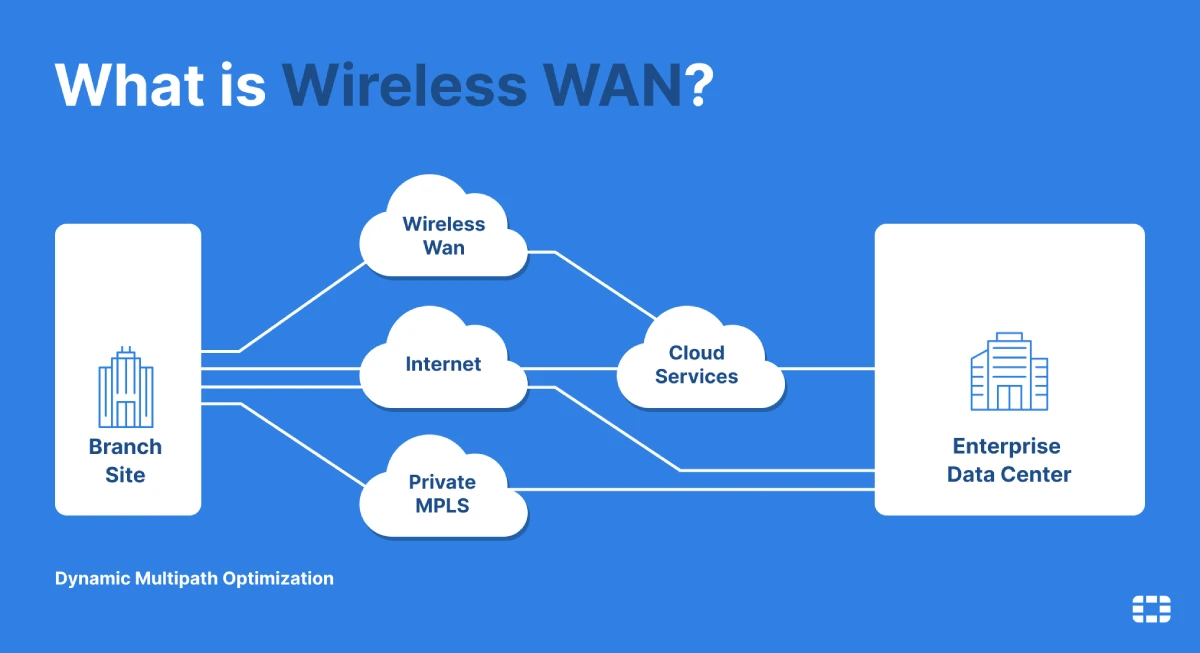
Modern enterprise networks face a fundamental challenge that did not exist a decade ago. Applications now live in the cloud, users work from everywhere, and the volume and variety of traffic traversing the WAN grows constantly. Routers and MPLS circuits designed for a simpler era increasingly struggle to keep up. Software-defined wide area networking addresses this challenge through a set of intelligent mechanisms that continuously monitor, analyze, and optimize how data moves across the network. Understanding precisely how SD-WAN works under the hood reveals why it consistently delivers measurable performance improvements for organizations that deploy it.
The Core Mechanism: Separating Control from Data
The foundational principle of SD-WAN is the separation of the control plane from the data plane. In a traditional WAN environment, both functions are bundled together inside individual physical routers. Each device makes its own routing decisions based on static configurations, and changes to network policy must be applied device by device. This approach is slow, prone to human error, and offers almost no real-time adaptability.
SD-WAN pulls the control plane out of individual devices and centralizes it in a software-based controller. The controller has a global view of the entire network, including the performance state of every available link at every site. It communicates with edge devices at each location, pushing policy decisions down to them and receiving telemetry back. The edge devices then enforce those policies locally, handling the actual forwarding of data packets based on instructions from the centralized control plane.
This architecture creates a network that can respond to changing conditions in real time without requiring human intervention at each site.
How Traffic Routing Actually Works
The performance gains that SD-WAN delivers come primarily from how it makes routing decisions. Traditional routers use fixed routing tables and do not account for the real-time condition of individual links. SD-WAN replaces this static model with continuous measurement and dynamic path selection.
Edge devices installed at each location constantly probe every available WAN link, which might include MPLS, broadband internet, LTE, or 5G connections, measuring key performance indicators including latency, jitter, and packet loss. This measurement happens in real time, typically at sub-second intervals, giving the controller an accurate and current picture of network conditions.
When traffic arrives at an edge device, the system identifies the application type on the first packet. It then consults the centralized policy definitions to determine how that specific application should be treated. A video conferencing session requires low latency and low jitter, so it gets steered to the link currently showing the best performance against those metrics. A large file transfer does not have strict latency requirements and can be routed over a more economical connection without any user-noticeable impact.
Understanding how does SD-WAN work for traffic routing reveals the full scope of its architecture, core components, and deployment considerations.
Automatic Failover and Link Redundancy
One of the most practically valuable performance mechanisms in SD-WAN is automatic failover. In a traditional network with a primary MPLS link and a secondary broadband backup, the failover process typically requires manual intervention or relies on slow convergence protocols that take seconds or even minutes to reroute traffic. During that window, voice calls drop, active sessions time out, and users experience visible disruption.
SD-WAN eliminates this delay by monitoring link health continuously and switching traffic to a healthy path the moment degradation is detected. Because the system knows the state of all available links at all times, it does not need to discover a new path after a failure, it simply redirects traffic to an already-known and already-measured alternative. For latency-sensitive applications, many SD-WAN implementations can perform this switch in milliseconds, fast enough that users never notice the underlying link has changed.
Research from enterprise IT decision makers confirms this operational benefit is among the top drivers of SD-WAN adoption. Enterprise surveys have found that the majority of networking and security teams now collaborate jointly on WAN strategy, with application performance and network reliability ranking as the primary motivations for deployment.
Global SD-WAN and SASE planning trends show that enterprises increasingly prioritize application performance and network reliability when evaluating their WAN investments.
Cloud Connectivity and Direct Internet Breakout
A significant source of performance improvement from SD-WAN comes from eliminating unnecessary traffic backhauling. In the traditional WAN model, all traffic from branch offices travels through a central data center for security inspection before going out to the internet or cloud applications. This route adds latency that is especially damaging for real-time applications.
SD-WAN allows organizations to implement direct internet breakout at the branch level. Traffic destined for a cloud application can exit the network directly from the branch without taking the roundtrip through headquarters. The centralized control plane still applies security policies to this traffic, either through integrated security features in the edge device or through cloud-delivered security services, but the packet path is dramatically shorter.
For organizations that rely heavily on SaaS applications, this change alone typically produces a significant and immediate improvement in end-user experience. The path from a branch office to a cloud application becomes a direct connection rather than a detour through infrastructure that adds no value to the transaction.
WAN Optimization and Traffic Shaping
Beyond path selection, SD-WAN platforms often include traffic shaping and quality-of-service capabilities that further optimize network performance. QoS policies allow administrators to define priority tiers for different application classes, ensuring that critical business traffic always has access to sufficient bandwidth even when the network is under load.
Some SD-WAN platforms also incorporate forward error correction mechanisms, which proactively compensate for packet loss on links where some degradation is occurring. Instead of waiting for a packet to be dropped and retransmitted, the system sends redundant data that allows the receiver to reconstruct any missing packets. This technique is particularly effective for voice and video applications where retransmission is not a viable option due to time sensitivity.
The convergence of SD-WAN with Zero Trust Edge architectures is reshaping how networking and security teams approach integrated WAN deployments.
Visibility and Performance Analytics
The performance benefits of SD-WAN extend beyond packet routing to include the operational intelligence it provides to IT teams. Centralized management platforms give administrators real-time and historical visibility into network performance across every site, every link, and every application class.
This visibility changes the nature of network troubleshooting. Instead of diagnosing a complaint that a branch is experiencing slow performance by working through logs on individual devices, IT teams can immediately identify which link is degraded, which applications are most affected, and whether an automatic reroute has already resolved the issue. Problems that previously took hours to diagnose are visible in seconds on a centralized dashboard.
Over time, this data also enables proactive capacity planning. Organizations can identify patterns of congestion, anticipate bandwidth needs before they become problems, and adjust policies to match how traffic actually behaves rather than how it was expected to behave at deployment time.
Frequently Asked Questions
How does SD-WAN know which path to send traffic on?
SD-WAN edge devices continuously measure the real-time performance of every available WAN link, tracking latency, jitter, and packet loss. When traffic arrives, the system identifies the application type and matches it against administrator-defined policies that specify which performance characteristics matter for that application. Traffic is then steered to the link that currently best meets those requirements.
What happens to active sessions if a WAN link fails?
SD-WAN monitors link health at sub-second intervals and redirects traffic to a healthy alternative the moment degradation is detected. For many session types, this rerouting happens fast enough that active connections are maintained without interruption. Latency-sensitive applications like voice and video benefit most from this capability because they cannot tolerate the delays associated with traditional failover methods.
Does SD-WAN work with existing MPLS circuits?
Yes. SD-WAN is designed to operate alongside existing MPLS infrastructure rather than requiring an immediate replacement. Organizations can add broadband or wireless links alongside their existing MPLS circuits, with SD-WAN managing traffic distribution across all available connections based on real-time performance and policy. This hybrid approach lets organizations reduce their reliance on expensive MPLS incrementally while validating performance before committing to a full transition.