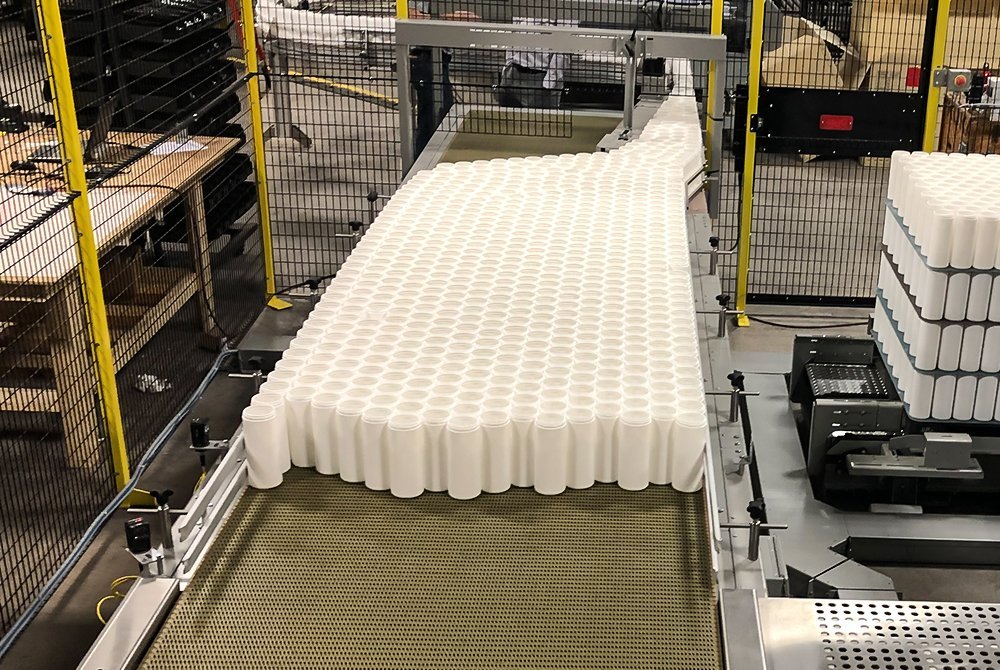
Manufacturing efficiency often hinges on properly managing product flow on accumulation tables, which can make or break your production line’s throughput. But how exactly should you adjust the accumulation table speed for different product sizes?
The basic rule is to adjust the table speed to 1.1-1.2 times the line speed for small products (under 6 inches) and 0.8-0.9 times the line speed for larger products (over 6 inches), with precise adjustments based on product weight and stability.
While this general rule works in most cases, several critical factors can impact optimal table speed settings – including product shape, surface texture, and spacing requirements. Understanding these variables will help you fine-tune your settings for maximum efficiency while avoiding product damage or jams.
Key Factors That Affect Accumulation Table Speed Settings
Product shape plays a crucial role in determining optimal table speed. Round products like bottles or cans tend to require slower speeds than rectangular products, as they’re more prone to rolling and instability. Similarly, tall products need reduced speeds to prevent toppling, while flat products can generally handle faster speeds.
The surface texture of both the product and the table affects friction and, therefore, speed requirements. Smooth-bottomed products on smooth tables may need slower speeds to prevent sliding, while products with textured surfaces or those on high-friction table surfaces can often run at higher speeds without issues.
Product spacing is another critical consideration. Dense accumulation requires slower speeds to prevent product damage, while loose accumulation can handle faster speeds. The gap between products should be monitored and adjusted based on your specific accumulation needs.
How To Prevent Product Damage During Accumulation
Back pressure is a common cause of product damage during accumulation. Implement pressure zones on your line balancing systems to minimize this, each running at slightly different speeds. This creates controlled pressure points rather than allowing pressure to build up across the accumulated product mass.
Modern accumulation tables — such as those engineered by Garvey — often feature smart sensors that automatically adjust speeds based on product backup.
What To Do When Products Keep Jamming On The Accumulation Table
Start by checking if products are entering the table correctly. Ensure proper spacing and alignment from the infeed conveyor, as irregular product flow often leads to jams downstream. Adjust guide rails if necessary to maintain adequate product orientation.
If products are consistently jamming in specific areas, inspect those sections for wear or damage. Sometimes, uneven wear on the table surface can create catch points where products tend to stick or jam. Regular maintenance and cleaning can prevent many common jamming issues.
Consider modifying the accumulation pattern if jams persist. Switching from a straight line to a diagonal accumulation pattern can sometimes reduce pressure points and prevent products from binding against each other.
When To Use Zero-Pressure Accumulation Vs. Standard Accumulation
Zero-pressure accumulation systems, while more expensive, are ideal for delicate or high-value products that cannot tolerate contact pressure. These systems use individually controlled zones to maintain gaps between products, ensuring they never touch during accumulation.
On the other hand, standard accumulation works well for sturdy products and high-speed operations where some contact between products is acceptable. This method is more cost-effective and can handle higher throughput, but requires careful speed control to manage back pressure.
The decision between these systems often comes down to product characteristics and budget constraints. When choosing, consider factors like product fragility, surface finish requirements, and production speed.
How To Troubleshoot Uneven Product Distribution On Accumulation Tables
Uneven distribution often starts with inconsistent infeed timing. Check your upstream conveyor speeds and timing systems to ensure products are delivered to the accumulation table regularly. Sometimes, adjusting the infeed speed alone can resolve distribution issues.
Table leveling is another common culprit. Even slight variations in table height can cause products to drift toward one side. Use a level to check the table surface, and adjust the legs or mounting points as needed to ensure a perfectly flat accumulation surface.
Guide rail positioning and condition can also affect product distribution. Inspect rails for proper alignment and wear. Bent or damaged rails can create friction points that disrupt smooth product flow. Ensure rails are parallel and spaced adequately for your product size.
Taking Action On Your Production Line
Now that you understand the principles of accumulation table speed adjustment, start by thoroughly auditing your current settings compared to your product specifications. Document your current speeds and product performance, then make incremental adjustments based on the guidelines provided here, carefully observing the results at each step until you achieve optimal flow and minimal product damage.