The physical store is witnessing its most radical change since the advent of the barcode. The design of the brick-and-mortar store has always been based on the basis of one specific point that has always existed – the cash wrap. This structural setup meant that transaction and communication systems were entirely static. Customers stood in rigid lines, employees were tethered to heavy desktop point-of-sale terminal networks, and inventory updates occurred on delayed batch cycles.
Today, that physical anchor is disappearing entirely. Modern wireless retail devices are no longer about forcing the customer to adjust to the store’s structural constraints; it is about making infrastructure fluid enough to wrap entirely around the consumer’s journey. By completely breaking down the walls between transactional engines and customer-facing communication channels, forward-thinking brands are turning the entire retail floor into a highly dynamic, responsive commerce zone.
Summary of the Shift
- The Legacy Era:Fixed cash registers, siloed walkie-talkies, printed paper price tags, and high friction checkout queues.
- The Connected Era:Mobile point-of-sale applications, unified employee communication networks, and dynamic digital signage.
- The Intelligent Era:Computer vision checkout paths, real-time edge computing, predictive inventory management, and fully biometric transactions.
The Legacy Era: Static Points of Interaction
In the early structures of modern retail, in-store payment and communication frameworks operated on completely different tracks. Payment was defined by fixed hardware. These legacy registers required dedicated Ethernet wiring, complex local servers, and significant square footage that could otherwise be used for product merchandising.
Similarly, customer communication relied on purely static physical elements. Cardboard posters, printed vinyl hanging signs, and paper price labels on store shelves required heavy manual labor to update. If a price changed or a promotion went live, employees had to physically walk the aisles to swap out small paper tags.
Internal team communication was equally disconnected, utilizing basic analog two-way radios that offered zero visibility into real-time inventory systems. This separation caused huge conflict since the shopper paying his/her dues could only do so from one physical lane, while the floor associates did not have any tool available to access inventory information or answer questions about the products.
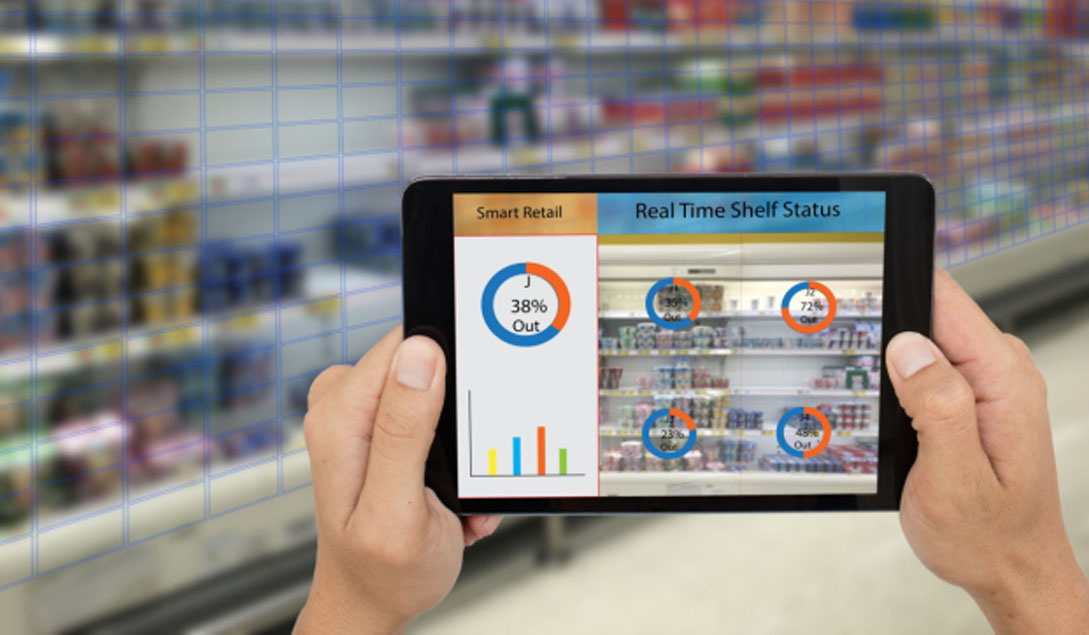
The Transition to Dynamic Retail Shelf Communication. Source: Ekkasit919 / Getty Images
The Connected Era: Decentralization and Mobility
The shift toward the modern retail ecosystem began when hardware became untethered. Instead of forcing customers to bring their items to a massive desk at the front of the store, retailers began distributing wireless retail devices straight into the hands of their store associates.
Equipped with enterprise-grade tablets and specialized smartphones, staff can now look up real-time stock availability, order out-of-stock sizes for home delivery, and complete an entire credit card or mobile wallet transaction right on the sales floor. This decentralization has completely redefined the layout of major stores, allowing brands to shrink the size of traditional checkout lanes and repurpose that space for interactive brand experiences.
On the other hand, communication in the store is now fully unified with data in an ecosystem. Instead of using fixed paper labels, retailers now use ESLs. The ESL is simply a tiny display unit attached directly to the edge of shelves.
The minute there is any change in the online pricing structure of the store, it is automatically reflected in real time through secure infrared or radio networking. In addition, walkie talkies are no longer used by frontline employees.
Modern communication setups run on smart earpieces integrated directly with the store’s inventory management software. If a customer asks an associate for a specific shoe size, the associate can use a voice command to query the inventory system, receiving an instant, automated confirmation directly in their headset.
For deeper insights into enterprise network requirements for these systems, see the comprehensive Cisco Retail Technology Portfolio Guide or explore open-source communication frameworks outlined via the IEEE Communications Society Journals.
The Intelligent Era: Autonomous and Predictive Retail
As we look toward the immediate future, the boundary between payment, physical layout, and communication is dissolving into ambient, invisible infrastructure driven by artificial intelligence and advanced edge processing.
The evolution of payment systems is moving rapidly away from manual scanning toward completely autonomous checkout. Utilizing a matrix of ceiling-mounted computer vision cameras, weight sensors on smart shelves, and deep learning algorithms, “Just Walk Out” systems track when a shopper picks up an item and places it into their cart. This happens automatically through an already linked digital account the second the consumer crosses the threshold from the store.
In situations where the conventional method of payment is desirable, retail shops are incorporating the use of biometric payment stations which enable consumers to link their credit accounts to their palm prints or facial signature.
The Next Frontier: Ambient, Invisible Checkout Systems. Source: primeimages / Getty Images
In-store communication is undergoing an identical AI-driven revolution. Rather than looping generic video advertisements, modern in-store digital displays are shifting toward hyper-personalized context awareness. Using anonymous spatial analytics and sensor arrays, smart displays can detect foot-traffic dwell times and instantly adjust their messaging to show highly relevant information.
For instance, if a localized weather alert indicates an unexpected drop in temperature, the store’s central system can dynamically change aisle displays to feature winter apparel, while adjusting regional price optimization algorithms on the fly.
To review upcoming structural retail data standards, check the official updates found within the National Retail Federation Technology Center.
The Strategic Path Forward
Upgrading the physical infrastructure is no longer an expensive endeavor that only a few experimental flagship stores can afford. In light of consumer preferences being formed by the lightning-fast pace of e-commerce, the physical store needs to keep up with that speed, transparency, and personalization.
The final objective of improving your operational ecosystem should be the removal of any obstacle that stands between a consumer’s decision to buy and the actual transaction.
By implementing advanced wireless retail devices, rolling out automated shelf-edge communication, and laying the groundwork for ambient, AI-driven checkout paths, retailers can transform their physical spaces from simple distribution points into highly intelligent, agile centers of brand engagement.