Crypto markets never close, and neither does the flow of information that moves them. A regulatory announcement in Asia, a whale wallet moving funds on-chain, a breakout above a key technical level – these events happen at 3 AM on a Sunday and require immediate decisions from traders who want to act on them. Email newsletters and weekly market reports are useless in that context. Telegram is not.
The platform’s combination of instant delivery, large group capacity, pinned messages, and bot integration made it the natural home for crypto trading signals. A signal provider can broadcast to hundreds of thousands of subscribers simultaneously, with the message arriving as a push notification on each person’s phone within seconds. No other platform does this with the same reach and immediacy in the crypto community, which is why Telegram groups have become the dominant channel for both free and paid signal services.
What a Crypto Signal Actually Contains
A signal is not just “buy Bitcoin.” A properly formatted signal from a credible provider contains enough information to execute a trade with defined risk – and understanding each component is what separates traders who use signals intelligently from those who follow them blindly.
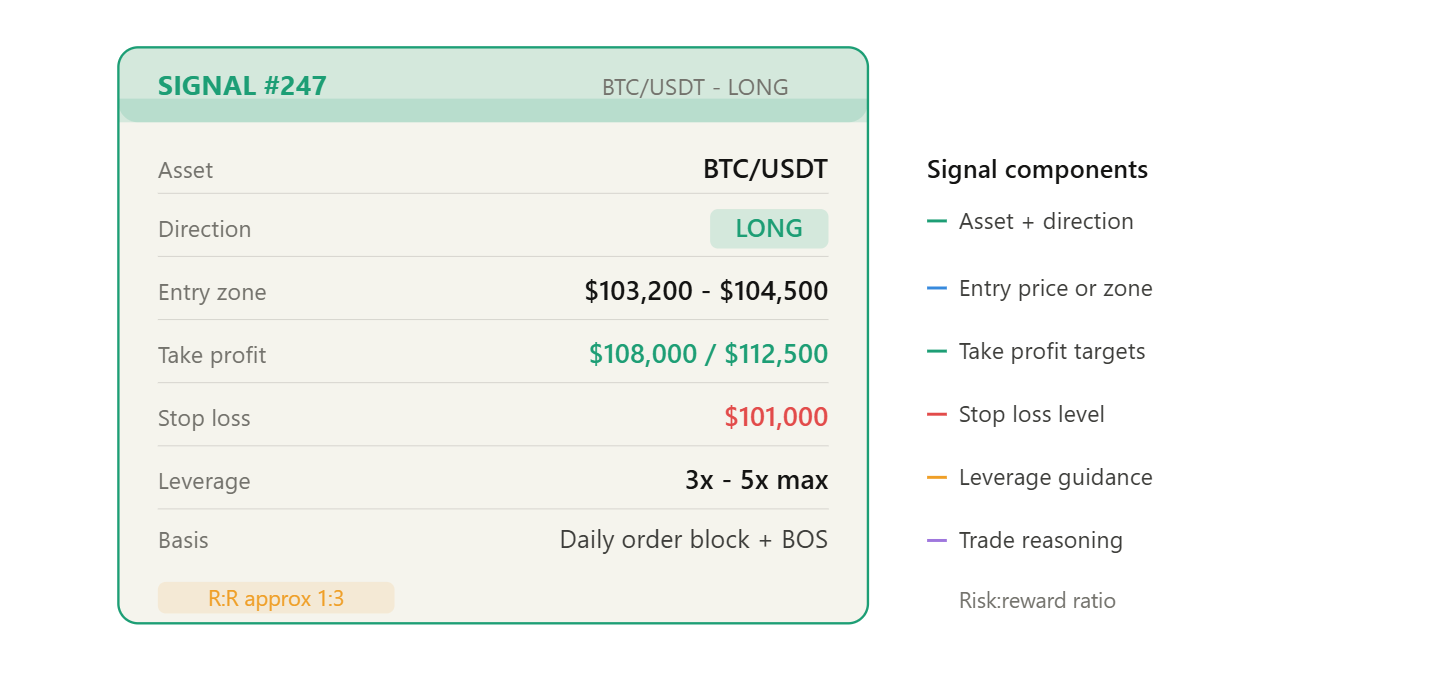
Every actionable signal should specify the asset and direction: which pair, whether long or short. Entry price or range tells you where to open the position – either at market price or at a limit order level if price has not yet reached the setup zone. The take-profit target is where the provider expects price to reach, which sets the potential reward. The stop-loss is the exit point if the trade goes wrong, which defines the risk.
The best providers also include the reasoning: which technical pattern triggered the signal, whether there is a fundamental catalyst behind it, and what timeframe the trade is built for. A signal that explains its basis teaches you something even if you choose not to take the trade. One that just says “buy ETH at market” with a vague target is harder to evaluate and harder to learn from.
The illustration below shows the anatomy of a well-structured crypto trading signal.
How to Evaluate a Telegram Signal Group Before Following It
The Telegram signal ecosystem ranges from genuinely useful communities built by experienced traders to outright scams that fabricate win rates and cherry-pick results. The difference is not always obvious on first glance, but there are reliable indicators.
Track record transparency is the first filter. Credible groups maintain a public history of their signals – entries, exits, results – that you can verify independently. A channel that only posts winning trades and deletes losing ones, or that shows screenshots of profits without corresponding signal timestamps, is not showing you a real track record. Look for groups that post all signals in advance, mark closed trades clearly, and include losses alongside wins.
The reasoning behind signals matters as much as the signals themselves. A provider who explains that a signal is based on a daily order block confluence with a moving average and an upcoming macro catalyst is giving you information you can evaluate and learn from. One who says “trust me, big move incoming” is giving you nothing.
Community quality is a secondary indicator. Active channels where members ask intelligent questions, where moderators respond to criticism thoughtfully, and where signal methodology is discussed openly tend to reflect genuine expertise. Channels that suppress critical questions or ban members who ask about losing trades are showing you something important about how they operate.
The table below outlines what separates high-quality signal groups from low-quality ones across the criteria that matter most:
| Criteria | High-quality group | Low-quality group |
| Signal format | Full entry, TP, SL, leverage, reasoning | Vague calls, no stop-loss |
| Track record | Complete history, losses included | Cherry-picked wins only |
| Transparency | Methodology explained | “Secret strategy” claims |
| Community | Questions welcomed, criticism handled | Dissent banned or ignored |
| Free vs paid | Clear value proposition | Paid-only with no trial |
| Provider identity | Named traders with verifiable background | Anonymous, no accountability |
The Right Way to Use Telegram Signals
The traders who get the most value from signal groups are not those who execute every call mechanically. They are those who use signals as one input among several.
The most important habit is independent position sizing. A signal might suggest 5x leverage on a BTC position. Whether that is appropriate depends entirely on your account size, your current risk exposure across other positions, and your personal risk tolerance. The signal provider does not know any of this. Applying your own position sizing to someone else’s directional call is what separates informed signal use from reckless copy-trading.
Confirmation before entry is another discipline worth building. If a signal calls for a long at $103,200 and price is currently at $106,000, you have missed the entry – chasing it invalidates the risk-reward that made the signal worth taking. Wait for price to come to the zone, or pass on the trade entirely. Good signal providers include this guidance; good signal followers apply it regardless.
Over-reliance is the most common long-term failure mode. Traders who follow signals for months without developing any independent analytical ability find themselves completely dependent on an external source they cannot evaluate critically. The best use of a signal group is active learning – understanding why each call was made, tracking which setups work and which don’t across different market conditions, and gradually building the ability to identify similar setups independently.
For traders looking to explore the broader landscape of signal communities, the curated breakdown of the best crypto signals on Telegram covers more than twenty groups across different styles, timeframes, and price points, with enough detail to evaluate each one on its own merits.
Conclusion
Telegram signal groups are a legitimate tool when used correctly and a reliable path to losses when used blindly. The platform delivers information quickly and efficiently, and the best communities genuinely accelerate the learning process for traders who engage with them actively rather than passively.
The signals themselves are less important than what surrounds them: the quality of the reasoning, the honesty of the track record, and the discipline you apply when deciding whether and how to execute each call. A signal without a stop-loss is not a trading idea – it is a directional opinion with unlimited downside. A signal with a clear entry zone, defined risk, and explained basis is a framework you can evaluate, size correctly, and learn from whether the trade wins or loses.