
Across such disciplines and applications as electronics design, industrial automation, data centres, and consumer devices, there is a need to manage heat effectively. Sound thermal management has become an ever-more pressing priority as the technologies in these fields have continued their rapid advance.
You might be reading this as an engineer or technician involved in the design of industrial control panels, the protection of power electronics, or the cooling of computing hardware. Regardless, it will be crucial for you to know about the main thermal management approaches that exist, and how to choose the right one.
Two of the most common thermal cooling solutions are fan cooling and heat sinks. Both are based on the principle of removing excess heat; where they vary is how they operate and the specific environments to which they are best suited.
Why Is Thermal Management So Crucial?
Thermal management involves the use of various strategies and techniques to control the temperature of a system or device.
Electrical and electronic components generate heat during operation. This heat needs to be removed efficiently; otherwise, temperatures are liable to go up, which can hinder efficiency, accelerate wear, and drive up the risk of premature failure.
It is not simply the removal of heat that thermal management interventions need to accomplish. That’s because the heat also needs to be removed in a way that is well-aligned with the available space, airflow conditions, maintenance expectations, and power requirements at the given location.
How Heat Sinks Work (Passive Cooling)
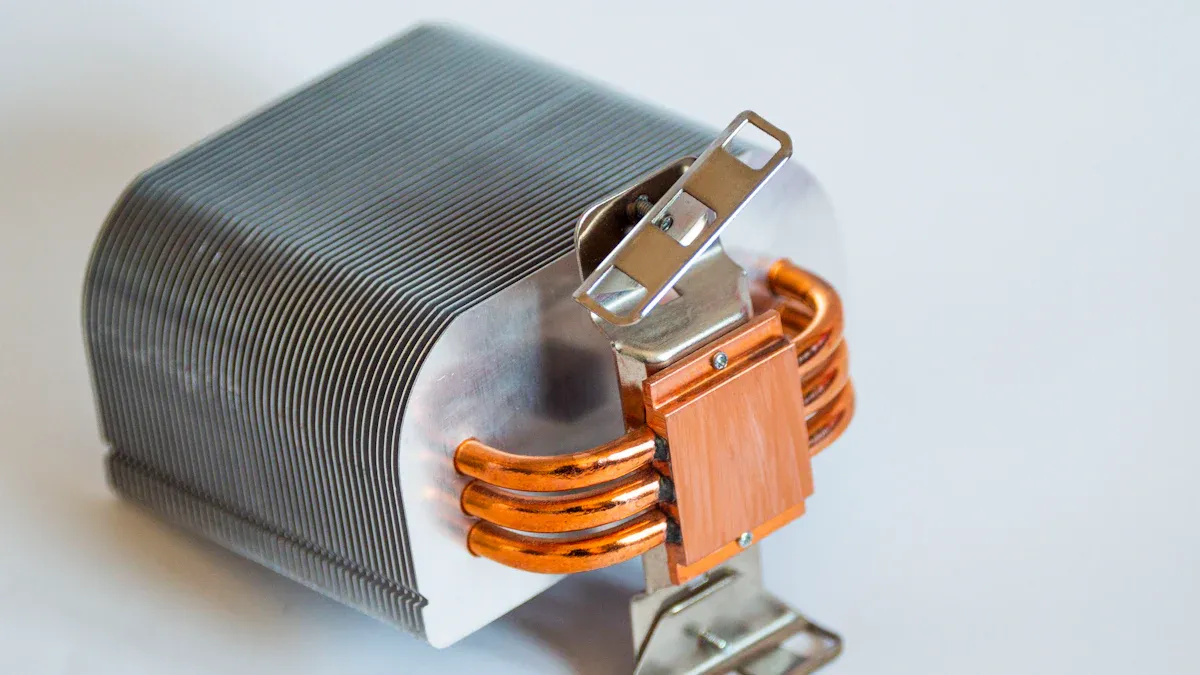
A heat sink is a passive thermal management component. Typically made from aluminium or copper, a heat sink is designed to absorb heat from a device and transfer it into the surrounding air through conduction, convection, and radiation.
The design of most heat sinks incorporates fins or pins to increase surface area. This, in turn, allows heat to dissipate more efficiently.
Key advantages of heat sinks include their:
- Silent operation. As they don’t have any moving parts, they generate no mechanical noise. This makes heat sinks ideal for quiet environments such as offices.
- High reliability. Heat sinks are extremely durable, with low maintenance requirements. They have a typically very long service life compared to mechanical cooling solutions.
- Energy efficiency. Once in place, heat sinks don’t consume any extra power.
However, heat sinks do also have certain limitations. Their cooling capacity depends heavily on the available airflow wherever they are installed, so their performance doesn’t tend to be as impressive in enclosed spaces. Larger heat loads also often necessitate bigger heat sinks, which can become bulky for high-power applications.
How Fan Cooling Works (Active Cooling)
Cooling fans are an active thermal management solution. They use forced airflow to move heat away from components. A fan operates on the principle of using forced convection to remove heat at a greater volume and velocity than a heat sink can achieve on its own.
Depending on the application, fan cooling may entail the use of axial fans, blower fans, or integrated fan-and-heatsink assemblies.
Key benefits of fan cooling include its:
- Higher cooling performance than passive heat sinks alonewhen it comes to high-heat components or dense electronics (in other words, environments where moderate to high heat loads are involved).
- Effectiveness in compact spaces where natural airflow is limited, as well as dusty industrial settings when combined with filtration and maintenance.
- Flexibility; it can be thermostatically controlled to run only when needed.
Again, there are a few limitations of fan cooling that must be acknowledged. Unlike a heat sink, a cooling fan requires electrical power, which adds to overall energy use. The moving parts introduce wear and associated maintenance requirements, while dust and contamination can potentially reduce effectiveness over time.
So, Cooling Fans or Heat Sinks: Which Should You Pick?
There is rarely a universal “best” option of these two popular approaches to thermal management.
So, in practice, your decision between heat sinks or fan cooling will hinge on such factors as heat output, space constraints, the specific environment, noise requirements, and maintenance expectations.
In any case, many thermal designs combine both methods.
As a quick “cut out and keep” summary:
- If silence and reliability are your main priorities, you might look to heat sinks or large passive designs.
- If you require maximum performance in a restricted space, you will probably need to opt for fan-assisted cooling.
- If your needs are balanced, a hybrid approach is likely to work best.
Whichever thermal management method you do settle on, a well-informed choice can help extend product life, improve efficiency, and minimise downtime.
