
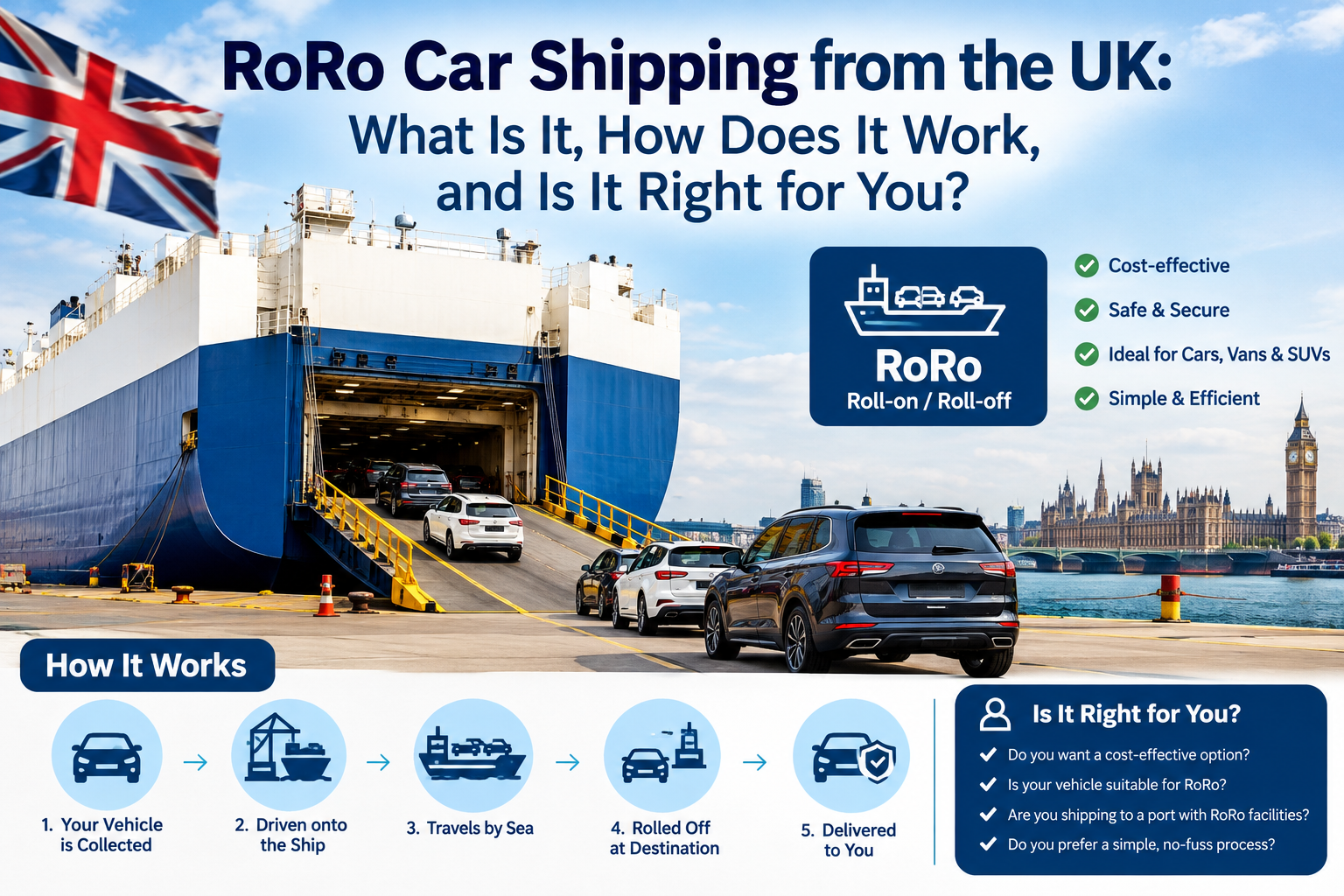
RoRo (roll-on/roll-off) car shipping is the most widely used and cost-effective method for exporting a vehicle from the UK to destinations worldwide. Vehicles are driven directly onto a purpose-built vessel, secured on decks, and driven off at the destination port — no cranes, no crates, no containers. For most standard road-registered vehicles, RoRo is the fastest, most straightforward, and most affordable way to ship a car abroad.
What Is RoRo Car Shipping and How Does It Work?
RoRo car shipping is a sea freight method where vehicles are driven onto a specialist ro-ro vessel under their own power (or pushed/towed if non-running) and secured to the ship’s vehicle decks for the voyage. Unlike container shipping, there is no crating or boxing — the car travels in the open air on the vessel’s internal decks, protected from the elements by the ship’s hull.
Here is how the process works from start to finish:
- Book your shipment — provide vehicle details (make, model, year, dimensions) and your departure and destination ports.
- Prepare your vehicle — ensure the fuel tank is no more than a quarter full, remove personal belongings, disable alarms, and confirm the battery is in good condition.
- Deliver to the UK port — typically Southampton, Tilbury, or Grimsby, depending on the route. ShipCars can arrange UK collection if needed.
- Port handling and loading — our agent checks the vehicle against paperwork, records its condition, and drives it onto the vessel.
- Sea transit — the vehicle is secured on the vessel’s car decks for the voyage. Transit times vary by route (see below).
- Arrival and customs clearance — at the destination port, the vehicle is unloaded, customs documentation is processed, and import duties are assessed.
- Collection or onward delivery — you collect from the destination port, or arrange port-to-door delivery in the destination country.
What Are the Advantages of RoRo Car Shipping?
RoRo is the go-to method for most international car shipments from the UK for good reason.
- Lower cost — no container hire, no loading equipment, simpler port handling. RoRo is typically 20–40% cheaper than a shared container on the same route.
- Regular sailings — ro-ro vessels operate on frequent, scheduled routes. More departure options mean less waiting.
- Simpler documentation — no container booking numbers, stuffing certificates, or sealing records to manage.
- Standard process — most destination ports around the world are equipped to handle ro-ro vessels. Customs officials are familiar with the procedure.
- Well-suited to standard road vehicles — modern saloons, SUVs, and 4x4s in running condition are ideal candidates.
What Are the Disadvantages of RoRo Car Shipping?
RoRo is not the right choice in every situation. Here is where it falls short:
- Open to the elements — while the vehicle is inside the ship’s hull (not exposed to open sea), it is not in a sealed, enclosed space. For ultra-high-value, classic, or concours-condition vehicles, a sole-use container offers more protection.
- No personal effects allowed — you cannot ship personal belongings inside the vehicle on a RoRo shipment. Customs authorities in most countries prohibit this.
- Non-running vehicles may incur extra handling fees — vehicles that cannot be driven require specialist loading equipment, which adds cost.
- Limited to routes with ro-ro vessel services — some more remote destinations do not have regular ro-ro sailings and can only be reached by container.
RoRo vs Container Car Shipping: Which Should You Choose?
The choice comes down to vehicle value, destination, and budget.
| Factor | RoRo | Container (Sole-Use) |
| Cost | Lower | Higher |
| Protection | Good (inside hull) | Excellent (sealed crate) |
| Classic/luxury vehicles | Not recommended | Recommended |
| Standard vehicles | Ideal | Overkill for most |
| Personal effects in vehicle | Not permitted | Permitted (check destination rules) |
| Route availability | Broad | Broadest |
Our recommendation: for any standard road-registered vehicle in good condition, RoRo delivers excellent value and sufficient protection. For vehicles worth over £30,000–£40,000, classic cars, or vehicles with irreplaceable custom work, we recommend a sole-use container.
What Documents Do You Need for RoRo Car Shipping from the UK?
Getting the paperwork right before your vehicle arrives at the UK port avoids costly delays.
- V5C logbook (vehicle registration certificate) — must be in your name
- Proof of ID (passport)
- DVLA permanent export notification — submit online at gov.uk before the vehicle leaves the UK
- Bill of lading — issued by the shipping line; your proof of shipment
- Destination import documentation — varies by country; ShipCars will advise for your specific route
Note: customs and documentation requirements at destination vary significantly by country and change periodically. Always verify against the destination country’s customs authority before shipping. ShipCars provides route-specific documentation guidance as part of every booking.
Is RoRo Car Shipping Safe?
Yes — RoRo is a mature, heavily regulated shipping method used to transport millions of vehicles worldwide every year. Ro-ro vessels are purpose-built for vehicle transport, with structured deck lashing systems and professional vehicle handlers at both loading and discharge ports.
All vehicles shipped with ShipCars are covered by marine transit insurance for the voyage. We recommend confirming your policy covers the full replacement value of your vehicle before departure.
Ready to Ship Your Car via RoRo?
RoRo car shipping is the fastest, most cost-effective way to move your vehicle from the UK to most international destinations. ShipCars handles the full process — from UK collection and port handling to destination customs guidance — so you have one point of contact throughout.
Frequently Asked Questions: RoRo Car Shipping from the UK
Can I put personal belongings in my car for a RoRo shipment? No. Personal effects are not permitted inside a vehicle on a RoRo shipment. Customs authorities at most destination ports prohibit this and may confiscate items or delay clearance. If you need to ship personal effects alongside your vehicle, a sole-use container is the right option.
Do I need to be present when the car is loaded? No. Once you or our collection driver delivers the vehicle to the port, ShipCars’ agents handle loading. You do not need to be present at the UK port or the destination port for the vehicle to be processed.
How do I track my vehicle during a RoRo shipment? ShipCars provides vessel departure and estimated arrival notifications. You can track the vessel in real time via vessel-tracking tools using the IMO number or voyage reference we provide.
What happens if my car is damaged during shipping? All shipments are covered by marine transit insurance. Any pre-existing condition is noted in the vehicle condition report at loading. If damage occurs during transit, you make a claim against the marine insurance policy. ShipCars will guide you through the process.
Can I ship a non-running car via RoRo? Yes, in most cases — however, the vehicle must be able to be towed or pushed safely. Additional handling fees apply. Contact us before booking to confirm the vehicle’s condition is suitable for RoRo.