
Introduction
The environment of manufacturing is characterized by the need for speed and precision. CNC Prototyping is often plagued with problems like increased lead times, lack of precision, and cost escalations, particularly with very complex parts, as they are difficult to manufacture with the required speed. The problems arise due to factors like manual programming, lack of real-time optimization, and rigidity of standardized processes.
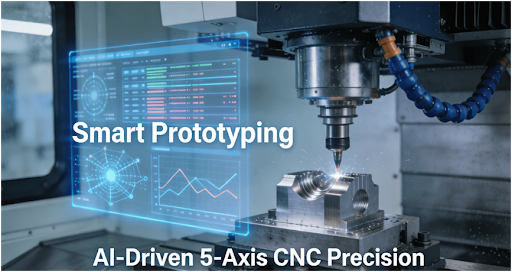
This article seeks to highlight a revolutionary change with the incorporation of Artificial Intelligence (AI) and 5 axis CNC machining center technology. By using intelligent algorithms, this technology can deliver efficient and accurate prototype development. The subsequent sections of this article will highlight the specific strategies and benefits of this combination of AI and CNC technology.
How through AI algorithm optimization CNC prototype design stage?
The initial design phase is of utmost importance for the successful implementation of Rapid Prototyping techniques. This phase is being revolutionized by the introduction of artificial intelligence.
Generative Design and Automated Model Generation
Generative design software makes use of artificial intelligence to create several different model designs based on particular parameters, which include weight, strength, and the use of materials. This process greatly reduces the time taken to create different design iterations, thus making the process more efficient.
Error Reduction and Enhanced Design Integrity
According to research conducted and published in the ‘International Journal of Advanced Manufacturing Technology’, the use of artificial intelligence for design validation results in the reduction of human errors by as much as 40%. The use of artificial intelligence for AI in CNC Machining ensures the smooth transition of the design model to the final product, thus ensuring design integrity.
The Synergy of AI and Machining Principles
l Intelligent Application of DFM Principles
Maximum efficiency is realized through the collaboration of AI and design for CNC machining fundamentals. AI can be designed to suggest design changes such as optimal wall thicknesses, fillet radii, and hole depths that directly improve CNC machining efficiency.
l Maximizing Material Utilization
AI technology can greatly improve material utilization through optimal nesting and toolpaths within a block of raw material. For example, with acrylic components to be CNC machined, AI technology can optimize the nesting of the components to reduce material wastage. This is particularly important with materials such as acrylic, as discussed in the guide Acrylic CNC Machining.
5-axis CNC machining center how to achieve high complexity prototype making?
For parts with complex geometries, 5-axis technology is an essential enabling technology for Custom Parts Innovation.
Fundamental Advantages Over 3-Axis Machining
The first advantage of a 5-axis machining center is its ability to move the cutting tool or the workpiece in five different axes at the same time. This enables the complete machining of complex parts in a single fixture, thus avoiding the errors and losses of time involved in multiple re-fixturing.
Selecting a Reliable Technology Partner
The selection of 5 axis CNC machining center manufacturers plays a critical role as the mechanical rigidity, dynamic accuracy, and thermal stability of the machine have a direct impact on the quality of the finished parts. Reliable technology partners offer machines that can deliver precision parts, as precise as ±0.005mm, which may be critical for precision acrylic machining.
The Importance of Precision Certification
The significance of adhering to internationally recognized standards cannot be overemphasized, particularly in critical industries.
l Framework Compliance
The framework offered by organizations such as the ‘Society of Manufacturing Engineers (SME)’ underscores the significance of adhering to quality assurance standards.
l Process Assurance
The significance of process validation and machine calibration is also underscored, and organizations should seek the services of a reliable partner that offersprecision CNC machining services.
File name2:custom-acrylic-parts-machining.jpg
What are the key challenges in custom acrylic parts production?
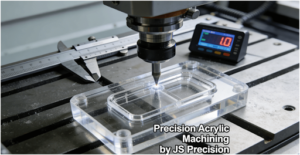
The process of manufacturing custom acrylic parts poses a challenge to the capabilities of Prototyping Technology, as acrylic components have a tendency to melt, chip, and stress crack during the machining process if process parameters are not carefully optimized.The visual proof of this can be explained through CNC machining pictures, where components that have been machined using suboptimal process parameters show signs of cloudiness and cracking, whereas components that have been machined using optimized process parameters show signs of optical clarity and sharp edges.
The process of addressing these challenges requires expertise from the cutting tools, cutting speeds and feeds, and the optimization process of the coolant. A quality management process, such as certification to the ISO 9001 standard, ensures that these parameters are optimized, thus guaranteeing the quality finish of the custom acrylic components.
CNC prototype technology how to promote industry innovation and cost savings?
CNC Prototyping acts as an influential catalyst for Custom Parts Innovation in highly advanced industries. In the automobile and medical fields, it allows for the creation of functional prototypes for testing, which can potentially reduce development time by 30% or more. This is directly attributed to the implementation of Rapid Prototyping technology, which can create accurate parts from digital information within a short time frame.
Significant cost advantages are realized through several methods. AI-optimized designs and toolpaths significantly minimize waste materials. The productivity of 5-axis machining reduces the number of human working hours per part by allowing for single-setup operations. Industry statistics indicate these advantages result in a reduced total cost of development, especially for complex parts with low production volumes. In industries with high and demanding specifications, such as aerospace, the added benefit is enhanced by AS9100D certification, which recognizes the ability of the supplier to meet extreme quality and traceability specifications.
Future CNC processing how to integrate intelligent technology to achieve sustainable development?
The future of CNC Machining will revolve around the integration of smart technologies. The evolution of AI in CNC Machining will extend beyond the current scope of design to allow for the monitoring of the process and predictive maintenance through IOT connectivity, thereby reducing downtime. The integration of Prototyping Technology and Industry 4.0 will thus improve the overall efficiency of the manufacturing process.
The role of Sustainability will become apparent as an important consideration. The optimization of energy use per item will become feasible by applying AI, and the Design for CNC Machining principles will change to reflect the role of material use and recyclability. The application of Environmental Management Systems, such as ISO 14001, will become an important indicator of best practice, reflecting the commitment to green manufacturing. The development of this technology will signal the dawn of a more efficient and sustainable manufacturing process.
Conclusion
To sum up, the combination of AI and 5 axis CNC technology offers a high, tech and highly efficient way of prototyping in today’s world. This technology is unbeatable in terms of accuracy, speed, and adaptability, which are the main problems faced in the industry nowadays. JS Precision, a company accredited to AS9100D and ISO 14001, is the leading edge of technology adoption for this type of Custom Parts Innovation.
Find out about certified manufacturing solutions that incorporate such technological advances. Request your CNC prototyping report tailored to your needs to find the quickest ways of improving your manufacturing process.
Author Bio
This article is submitted by an expert in the field of advanced manufacturing technology. The author’s research interests include the integration of CNC innovation and intelligent systems, with the aim of promoting digital transformation in industrial production.
FAQs
Q1: What are the primary benefits of the use of AI in the development of CNC prototypes?
A1: The primary benefits of the use of AI in the development of CNC prototypes include the optimization of tool paths and the geometry of the prototype, which can be done with an accuracy of over 95%, thereby speeding up the development process.
Q2: How suitable is 5- axis CNC machining for the manufacture of low, volume products?
A2: 5- axis CNC machining is highly suitable for the manufacture of low, volume parts that are quite complex in nature. The reason is that the 5-axis machine can do the entire operation in one setup only, thus saving costs that would have been incurred in the production process.
Q3: What measures can be taken to ensure the surface quality of custom acrylic parts?
A3: Besides controlling parameters to prevent the generation of heat and thus melting of the acrylic, using sharp tools that have been polished is a must to ensure the surface quality of custom acrylic parts.
Q4: What is the standard lead time for CNC prototype delivery?
A4: The CNC prototype delivery lead time is determined by how complex the prototype is. For a simple prototype, the lead time is 3-5 days. On the other hand, if the prototype is accurate and complex, the lead time becomes 7- 10 days. The utilization of AI could lower this time substantially.
Q5: How does a company evaluate the technical reliability of a CNC supplier?
A5: To evaluate the technical reliability of a CNC supplier, one must ensure they are certified (e.g., ISO 9001, AS9100D), examine their project portfolio, and assess their Design for Manufacturability (DFM) feedback process. Technically reliable CNC suppliers are transparent regarding equipment and quality control.