
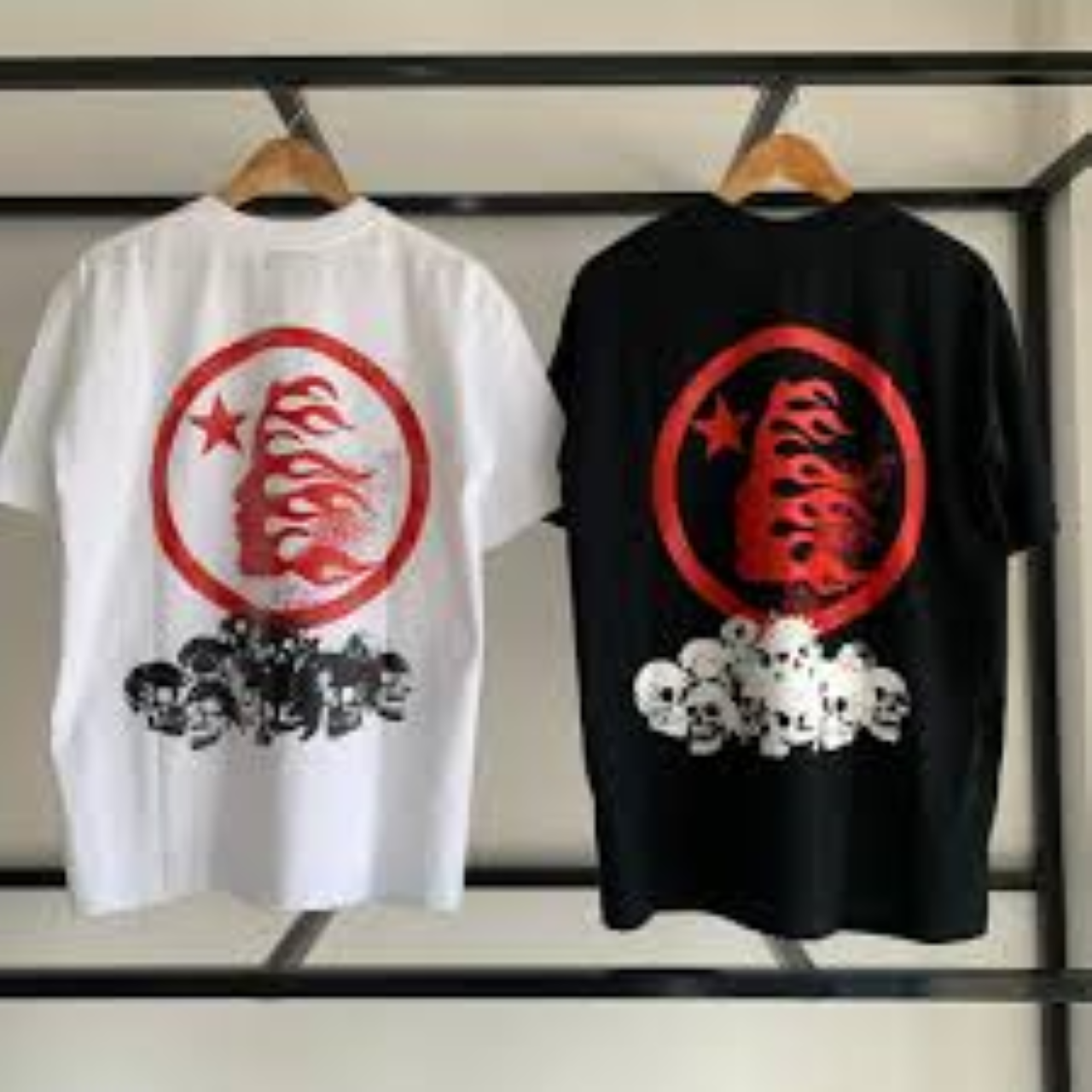
Walk into any room where streetwear is taken seriously and you will eventually see them on the same person. A heavy silver cross dangling over a graphic tee covered in flames and saints. A leather jacket older than the kid wearing it, paired with a hoodie that came out three months ago. Chrome Hearts and Hellstar are not a collaboration and they were never meant to share a wardrobe, but they do, and the reasons say something interesting about how taste actually works in 2026.
These are two brands separated by roughly thirty-five years, two cities, and two completely different theories of what clothing is for. Putting them next to each other is not a comparison so much as a study in contrast – and in the strange logic of why young buyers keep choosing to wear both.
The Workshop and the Feed:
Chrome Hearts is what happens when a leatherworker and a silversmith decide to make biker gear for rock stars and accidentally build a billion-dollar empire. Founded in 1988 in Los Angeles, the brand still hand-finishes most of its silver and most of its leather inside a Hollywood workshop. Every cross, every fleur-de-lis, every dagger pendant is heavy in the hand because it is actually heavy – sterling silver, sometimes set with stones, machined and polished by people who have been doing it for decades. The brand does not advertise. It barely has a website worth mentioning. You find it the way people used to find things: through someone who knows.
Hellstar arrived from a completely different planet. The label took shape in the early 2020s as an internet-first project – graphics designed to read on a phone screen, drops announced on social media, hype cycles measured in hours rather than seasons. Its iconography leans biblical and apocalyptic: angels with halos, flames, references to heaven and hell rendered in the kind of distressed, sun-bleached print that looks like it has already been through a decade of wear. The brand does not pretend to be a workshop. It is, openly and unapologetically, a graphic-design house that prints on garments.
Both succeed. Neither is doing what the other does.
Two Definitions of “Expensive”:
A Chrome Hearts t-shirt will run you somewhere between four hundred and seven hundred dollars depending on the piece. A Hellstar t-shirt will run you somewhere between eighty and a hundred and sixty. Both feel expensive for what they are. Neither is priced the way it is because of fabric cost.
The difference is what the money buys.
With Chrome Hearts, the price reflects the things you cannot see in a photo – the weight of the cotton, the density of the print, the fact that the garment was sewn in Los Angeles in small numbers, the silver hardware on certain pieces, the implicit promise that what you are buying has been part of a continuous workshop tradition for thirty-plus years. The shirt is a souvenir of a much larger universe of leather and silver and furniture and eyewear that exists behind it.
With Hellstar the price reflects the moment. You are paying for a graphic that hit the internet at the right time, attached to a brand that has earned cultural traction with a specific audience. The garment is the point of contact. It is not gesturing toward some larger ecosystem of craftsmanship – it is the product, complete in itself, and its value is whatever the culture is currently willing to pay for it.
Neither pricing logic is wrong. They are simply measuring different things.
What They Borrow From, and From Whom?
Chrome Hearts pulls from biker culture, from gothic Christian iconography, from old Hollywood, from the punk and hard-rock scenes of the late twentieth century. The brand grew up alongside the people it dressed – musicians, actors, artists who wanted something heavier and stranger than what luxury fashion was offering in the eighties and nineties. Its visual language is genuinely old. Crosses. Daggers. Latin lettering. Fleurs-de-lis. These motifs did not come from a mood board. They came from the people who made them being interested in those things for decades.
Hellstar borrows from a different lineage entirely. Its references are religious imagery filtered through skate graphics, early-2000s metal merch, internet-era apocalypse aesthetics, the visual culture of forums and meme pages and music video stills. When Hellstar puts a halo on something, it is not invoking Renaissance painting – it is invoking the version of Renaissance painting that has been compressed, recolored, and reposted enough times to become its own visual dialect. The reference is to the reference.
This is not a criticism. It is a description of where the brand actually lives.
Why the Same Person Wears Both?
The interesting question is not which brand is better. The interesting question is why so many buyers comfortably own pieces from both, often wearing them in the same outfit.
The answer has to do with what each brand actually delivers. Chrome Hearts delivers permanence – the sense that an object has been made well enough to outlast its trend cycle, that the silver cross around your neck will still look correct in fifteen years, that you have bought into something with a history. Hellstar delivers presence – the sense that you are participating in the current moment, that your hoodie is part of a conversation happening right now on phones around the world.
A wardrobe needs both. A closet made entirely of Chrome Hearts feels like a museum. A closet made entirely of Hellstar feels like a timeline. Mixing them is how a person communicates that they understand the difference and value both.
The Counterfeit Problem Hits Them Differently:
Both brands get faked aggressively, but the counterfeits work on different psychology.
Fake Chrome Hearts tries to imitate craftsmanship – the wash tag, the font weight, the print density, the specific feel of the cotton. The fake economy here is sophisticated because the originals are sophisticated. People who want to fake Chrome Hearts are essentially competing with a workshop, and they have gotten alarmingly good at it.
Fake Hellstar is a different game. Because the originals are graphics-driven, the counterfeits mostly just need to look right in a photo. The bar to clear is visual rather than tactile. This means fakes are easier to make convincingly, which puts more pressure on buyers to source from verified channels.
The two brands’ anti-counterfeit defenses are essentially their entire business models pointed inward. Chrome Hearts defends itself with craft. Hellstar defends itself with controlled distribution and drop timing.
What Each Brand Will Probably Look Like in Five Years?
Chrome Hearts will, in all likelihood, look almost exactly the same. That is the entire point of the brand. The pieces being made in Hollywood this year will sit comfortably next to pieces being made in 2030, and probably 2035. Slow evolution is the strategy.
Hellstar is a harder prediction. Internet-native brands tend to either calcify into a recognizable house style and stick around as a fixture, or burn through their cultural moment and become a reference point for the next thing. Which path it takes will depend less on the clothes and more on whether the brand can keep its graphic language feeling current without abandoning what made it recognizable in the first place.
Both brands are bets on different things. Chrome Hearts is betting that craft outlasts trend. Hellstar is betting that the current trend is worth fully inhabiting. Buyers who own both are quietly hedging – covering themselves either way.
