
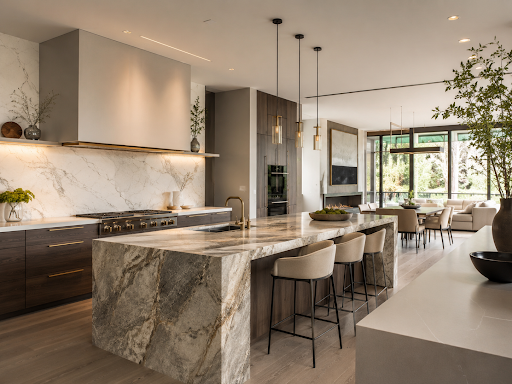
Choosing a surface material for a modern interior is rarely as simple as picking the slab that looks best in a showroom. Marble, quartzite, and sintered stone can all create sophisticated kitchens, bathrooms, feature walls, furniture, and other architectural surfaces, but they behave differently in daily use.
Marble is valued for its unmistakable natural veining and long association with classical architecture. Quartzite offers the individuality of natural stone while often being considered for more demanding countertop applications. Sintered stone takes a different approach: it is a manufactured surface designed to offer consistent appearance, low maintenance, and practical performance across contemporary residential and commercial projects.
None of these materials is automatically the “best.”
The better question is:
Which surface best matches the location, expected use, maintenance tolerance, design direction, and long-term expectations of the project?
A dramatic marble may be perfect for a feature wall but less suitable for a homeowner who worries about every mark on a heavily used kitchen counter. Quartzite may offer the natural character and durability a kitchen requires, but slab variation needs to be accepted and planned. Sintered stone may suit a low-maintenance modern interior, although buyers who want the individuality of a naturally formed slab may prefer another material.
Understanding these differences before fabrication can prevent expensive mistakes later.
Why Surface Selection Matters More Than Ever in Modern Interiors
Modern interiors often rely on fewer visible materials than highly decorative traditional spaces.
Large kitchen islands, full-height backsplashes, floor-to-ceiling wall panels, integrated vanities, fireplace surrounds, and oversized dining tables make surface materials more visually dominant.
When a slab covers several square metres, its colour and movement influence the entire room.
That means surface selection affects more than appearance. It can influence:
- how often the surface needs care;
- how visible fingerprints, stains, scratches, or etching may become;
- whether neighbouring slabs can be visually matched;
- how the material should be fabricated;
- how easily large panels can be transported and installed;
- whether the finished surface feels natural, uniform, dramatic, or restrained;
- how well it suits kitchens, bathrooms, walls, floors, or furniture.
A material that performs perfectly on a bathroom wall may not be the first choice for a heavily used family kitchen.
Likewise, a surface designed for durability may still be the wrong choice if it does not support the interior concept.
The most successful projects therefore balance design, performance, maintenance, and application rather than choosing from appearance alone.
Marble: Natural Character and Timeless Visual Appeal
Marble has been used in architecture, sculpture, furniture, and interior decoration for centuries.
Its strongest advantage is not perfect consistency. In fact, the opposite is usually true.
The attraction of marble comes from natural variation.
Depending on the stone, a slab may contain:
- soft grey veins;
- dramatic dark movement;
- warm gold lines;
- cloudy mineral areas;
- green, brown, black, or red tones;
- subtle crystalline details.
No two natural slabs are perfectly identical.
For designers who want an interior to feel individual rather than mass-produced, this variation can be extremely valuable.
Where Marble Makes the Strongest Design Statement
Marble can work particularly well for applications where visual character has high priority, including:
- bathroom vanities;
- fireplace surrounds;
- reception walls;
- decorative wall cladding;
- coffee and dining tables;
- low-traffic feature floors;
- stair details;
- powder rooms;
- luxury kitchen islands where the owner understands natural stone care.
Light marble can make a space feel calmer and brighter.
Dark marble can create stronger contrast.
Highly veined marble can function almost like artwork when installed across a large wall or bookmatched feature.
The important point is that marble should not be selected simply because it is associated with luxury.
The specific slab must suit the specific space.
What Should Buyers Know Before Choosing Marble?
The beauty of marble comes with practical considerations.
Marble is primarily composed of calcite, which means acidic substances can react with the surface. In kitchens, common products such as lemon juice, vinegar, wine, and certain cleaners may cause etching.
Etching is different from staining.
A stain changes colour because a substance penetrates the stone. Etching changes the surface finish through a chemical reaction.
This distinction matters because sealing may help reduce the risk of some staining, but it does not make marble completely resistant to acidic substances.
For that reason:
If the homeowner wants natural ageing and accepts some patina → marble can be a rewarding choice.
If every small change in surface appearance will become a source of frustration → another material may be more suitable for a heavily used countertop.
The correct decision depends on expectations as much as technical performance.
Quartzite: Natural Stone for High-Impact Modern Spaces
Quartzite is a natural metamorphic stone formed when quartz-rich sandstone undergoes geological heat and pressure.
For interior designers, one of its greatest attractions is the combination of natural variation and strong visual possibilities.
Some quartzites are relatively quiet and neutral.
Others contain dramatic movement in white, grey, green, blue, gold, brown, pink, or black tones.
This makes quartzite suitable for interiors where stone needs to perform as both a functional surface and a central design feature.
Large-format quartzite surfaces can be particularly effective on statement kitchen islands, waterfall edges, feature walls, bathroom vanities, fireplaces, bars, dining tables, and other high-visibility architectural applications.
Why Designers Choose Quartzite
Quartzite often appeals to buyers who want:
- genuine natural stone;
- unique slabs rather than repeated printed patterns;
- dramatic mineral movement;
- strong visual depth;
- a surface suitable for substantial kitchen or interior applications;
- a material that can become the focal point of a room.
It is especially effective in modern interiors where surrounding elements are intentionally simple.
Imagine a kitchen with flat-panel oak cabinetry, minimal hardware, neutral flooring, and a large quartzite island containing organic movement.
The stone becomes the design.
There may be little need for additional decorative detail.
Quartzite Is Not the Same as Engineered Quartz
This is a frequent source of confusion during material selection.
Quartzite is natural stone.
Engineered quartz is a manufactured product that typically combines quartz material with binders and pigments.
The similarity of the names does not mean the materials are the same.
For buyers comparing slabs, this distinction matters because natural variation, maintenance expectations, fabrication requirements, appearance, and heat behaviour can differ.
Material identification should therefore be confirmed before purchase rather than relying only on trade names.
Marble vs Quartzite: How Should You Decide?
Both are natural stones, and both can create highly distinctive interiors.
The decision can be simplified by identifying what matters most.
Choose Marble When:
- classical or recognisable natural veining is central to the design;
- the project values softness and elegance;
- natural ageing is acceptable;
- the surface is decorative or moderately used;
- the client understands the possibility of etching and staining.
Choose Quartzite When:
- natural stone is essential;
- a stronger countertop-focused material is preferred;
- dramatic slab movement is part of the design concept;
- the project needs a statement island or large architectural surface;
- the client accepts natural variation and appropriate stone maintenance.
The mistake is trying to declare one material universally superior.
A marble fireplace and a quartzite kitchen island can both be excellent choices because the applications have different priorities.
Look Beyond the Material Name: Individual Slabs Matter
With natural stone, the material category is only the beginning.
Two slabs sold under the same commercial stone name can still show noticeable differences in:
- vein density;
- background colour;
- mineral pattern;
- direction;
- contrast;
- natural fissures;
- visual balance.
This has major consequences for projects using several slabs.
Suppose a large island requires one slab while the surrounding worktops require another two.
If the slabs are selected independently without checking their relationship, the finished kitchen may appear visually disconnected.
For this reason, large natural-stone projects benefit from reviewing the actual slabs before fabrication.
Designers should consider:
- Which slab will be used for the island?
- Which section of the slab becomes the most visible surface?
- How will the vein travel across a waterfall edge?
- Can adjacent sections be cut to maintain visual continuity?
- Are several slabs visually compatible?
- Where should seams be placed?
- Will sink or cooktop cut-outs remove the most attractive part of the pattern?
These decisions can have as much influence on the final appearance as the stone type itself.
Sintered Stone: A Different Approach to Surface Design
Sintered stone belongs to a different category because it is manufactured rather than quarried as a finished natural slab.
It is produced through an industrial process that compacts mineral-based raw materials and exposes them to controlled pressure and high temperatures.
The goal is to create a dense architectural surface with predictable characteristics.
For contemporary projects, this can offer several advantages.
Homeowners may prefer it when they want:
- relatively consistent visual appearance;
- low maintenance;
- large-format surfaces;
- modern colours and patterns;
- resistance to common household staining;
- applications where predictable performance is particularly important.
Modern sintered stone surfaces can therefore be considered for kitchen countertops, bathroom vanities, wall cladding, furniture, and other interior applications where consistency and ease of maintenance influence the buying decision.
Where Sintered Stone Fits Best
Sintered stone often works well in minimalist interiors.
Its controlled appearance can complement:
- handleless cabinetry;
- architectural kitchens;
- neutral colour palettes;
- contemporary bathrooms;
- large wall panels;
- integrated furniture;
- clean commercial spaces.
Unlike highly variable natural stone, manufactured slabs can provide greater visual predictability.
For large developments or interiors requiring repeated surfaces across multiple rooms, that consistency can be useful.
Natural Variation vs Controlled Consistency
This is one of the most important differences between the three materials.
Marble and quartzite are naturally formed.
Variation is part of their identity.
Sintered stone is manufactured.
Greater control over appearance is part of its appeal.
Neither approach is inherently better.
If You Want Every Slab to Feel Individual
Choose natural stone.
Marble and quartzite can contain details that cannot be perfectly repeated because the appearance is the result of geology rather than surface printing or industrial production.
If You Want Greater Visual Consistency
Consider sintered stone.
This may be especially useful when the same surface must be repeated across several kitchens, bathrooms, apartments, or commercial areas.
If You Want a Statement Feature
A highly expressive natural quartzite or marble may create stronger individuality.
If You Want the Surface to Support the Architecture Quietly
A restrained sintered stone design may integrate more easily into a minimalist scheme.
The right choice therefore depends on whether variation or predictability is more important to the project.
Comparing Maintenance Expectations
Maintenance is one of the biggest practical differences buyers should discuss before selecting a surface.
Marble
Marble needs realistic care expectations.
Acidic substances can cause etching, and spills should be cleaned promptly. Depending on the stone and application, sealing may also be recommended.
Choose marble when the buyer values natural beauty enough to accept appropriate care.
Quartzite
Quartzite is generally selected for demanding natural-stone applications, but buyers should not assume every quartzite behaves identically.
Porosity and characteristics can differ by material.
Proper identification, fabrication, sealing where appropriate, and cleaning practices still matter.
Sintered Stone
Sintered stone is attractive to buyers seeking lower routine maintenance.
Because it is manufactured to create a dense surface, it can be practical where stain resistance and easy cleaning are important priorities.
However, installation and edge treatment still require professional planning.
No material is immune to poor fabrication or installation.
Edge Details and Fabrication Can Change the Final Result
Buyers often spend weeks selecting the slab but very little time discussing fabrication.
That is a mistake.
The same material can look completely different depending on:
- edge profile;
- countertop thickness;
- seam position;
- vein alignment;
- corner construction;
- sink cut-outs;
- waterfall joints;
- backsplash height.
In modern kitchens, mitred edges are sometimes used to create the appearance of a thicker stone profile.
Waterfall ends can extend the countertop material vertically to the floor.
Full-height backsplashes can reduce visual interruptions compared with small tiles.
Each choice changes both appearance and fabrication complexity.
Highly directional natural stone requires particularly careful planning because a poorly positioned joint may interrupt the vein.
For sintered materials, edge fabrication and handling are equally important because large panels need the correct processing, transport, and installation methods.
Which Material Is Better for Kitchen Countertops?
There is no universal winner.
Instead, begin with lifestyle.
For a Design-Focused Kitchen
If the client wants a highly individual natural surface and accepts maintenance, marble or quartzite can deliver a stronger organic character.
For a Busy Kitchen
If natural stone is required but daily durability is a stronger concern, correctly selected quartzite may deserve serious consideration.
For Low-Maintenance Priorities
If the homeowner prefers predictable appearance and limited routine care, sintered stone may fit the brief better.
For a Statement Island
Dramatic quartzite can be difficult to beat visually because a single slab can act as a major decorative element.
For a Soft Classical Interior
Marble may integrate more naturally with traditional cabinetry, warm metals, decorative details, and timeless architecture.
The best countertop is the one that matches real use rather than showroom expectations.
Which Surface Is Best for Bathrooms?
Bathrooms create different requirements from kitchens.
Vanities are generally exposed to cosmetics, water, soaps, and cleaning products rather than hot cookware and food acids.
Marble can create an elegant vanity or shower feature.
Quartzite can provide a stronger natural-stone statement.
Sintered stone can suit modern bathrooms requiring a clean, consistent appearance and easy maintenance.
But the surface is only one part of bathroom design.
The project also needs to consider:
- slip resistance for floors;
- waterproofing;
- grout or joint design;
- edge finishing;
- drainage;
- cleaning products;
- installation quality.
A material that looks beautiful on a vanity may require a different finish before being considered for a wet floor.
Common Surface-Selection Mistakes
1. Choosing Only From Online Photos
Screens, photography, lighting, and image editing can change how a material appears.
For natural stone especially, full slab images or physical slab inspection are more useful than a small reference image.
2. Assuming All Quartzite Is Identical
Stone sold under commercial names can vary, and proper material identification matters.
Do not make performance assumptions from the word “quartzite” alone.
3. Expecting Marble to Stay Completely Unchanged
Marble is natural material.
If the owner expects a permanently perfect surface despite heavy kitchen use, expectations and material choice may be mismatched.
4. Selecting a Dramatic Slab Without Planning the Layout
Beautiful veins can disappear into cut-outs or become disconnected at seams if fabrication planning happens too late.
5. Choosing Sintered Stone Only Because It Is Low Maintenance
Practical performance is important, but appearance, edge detail, fabrication capability, and the overall design still matter.
A surface should satisfy both functional and visual requirements.
A Practical Buyer Decision Guide
Use this simplified framework before making a final choice.
If authentic natural veining and timeless character matter most → choose marble.
If natural stone, dramatic movement, and stronger countertop suitability matter most → consider quartzite.
If predictable appearance and low maintenance are priorities → consider sintered stone.
If the project needs several slabs with consistent appearance → manufactured surfaces may simplify specification.
If each slab should feel unique → natural marble or quartzite provides that individuality.
If the application is decorative rather than heavily used → appearance can receive greater priority.
If the application is exposed to frequent cooking, spills, or cleaning → performance and maintenance should carry greater weight.
This logic is more reliable than choosing a surface because it happens to be fashionable.
Final Recommendation: Choose for the Space, Not the Trend
Marble, quartzite, and sintered stone can all create excellent modern interiors.
The best material depends on what the project actually needs.
Marble offers natural character, recognisable veining, and a sense of permanence that works particularly well in refined interiors. It rewards owners who appreciate natural materials and accept appropriate maintenance.
Quartzite can offer the individuality of natural stone while fitting demanding kitchens, large islands, feature walls, and other high-impact applications. It is particularly attractive when the slab itself needs to become a central design feature.
Sintered stone serves a different buyer. It can provide consistency, contemporary aesthetics, and low-maintenance practicality for projects where predictable performance matters.
Before ordering any of them, buyers should look beyond colour.
Consider the application, actual slab appearance, maintenance expectations, finish, thickness, seams, edge details, fabrication requirements, installation conditions, and how the surface interacts with cabinetry, flooring, lighting, and surrounding materials.
A surface may remain in a home for many years after current design trends have changed.
Choosing based on real use and long-term compatibility is therefore far more valuable than choosing whichever material is receiving the most attention today.
Frequently Asked Questions
1. Which is better, marble or quartzite?
Neither material is universally better. Marble is often preferred for timeless veining, softer visual character, decorative surfaces, bathrooms, fireplaces, and interiors where natural patina is acceptable. Quartzite is often considered when homeowners want genuine natural stone with dramatic movement and stronger suitability for demanding countertop applications.
If classical appearance matters most → consider marble.
If natural stone plus stronger everyday countertop performance matters more → consider quartzite.
2. Is quartzite more durable than marble?
Quartzite is generally considered harder and more resistant to scratching than marble, which is one reason it is commonly considered for kitchen countertops. However, individual stones can vary, and buyers should confirm the actual material rather than relying only on a commercial name.
Durability also does not remove the need for proper fabrication, sealing where appropriate, and sensible cleaning.
3. Is sintered stone better than natural stone?
Sintered stone is not automatically better; it solves different problems.
It can be attractive when buyers want consistent appearance, low maintenance, and predictable surface performance.
Natural marble and quartzite may be preferable when geological variation, authenticity, unique slab movement, and the character of genuine stone are major design priorities.
The right answer depends on whether the project values consistency or natural individuality more.
4. What is the best countertop material for a modern kitchen?
The answer depends on how the kitchen will be used.
Quartzite can suit buyers seeking a natural-stone statement surface with strong countertop potential. Marble may suit design-led kitchens where natural patina and maintenance are understood. Sintered stone may be more appropriate when easy maintenance and consistent appearance are the priorities.
Instead of asking which material is best overall, ask which material best matches cooking habits, cleaning expectations, design preferences, and budget.
5. Does sintered stone look like real marble?
Some sintered stone designs are created to reproduce the visual direction of marble and other natural materials, and they can provide a highly controlled, consistent appearance.
However, natural marble develops through geological processes, so its mineral movement and slab-to-slab variation are inherently unique.
If consistent marble-inspired appearance is the priority → sintered stone may be suitable.
If the individuality of a naturally formed slab matters → genuine marble or quartzite is the stronger choice.
