
The cart-path-only rule is the most quietly infuriating regulation in American golf. The doctor is playing through. A member event is on the back nine. The marshal waves you past. You park fifty yards from your ball, hop out, and now you have to walk to your shot, club selection, walk back, hit to a green you cannot see the depth on, and you do it all without the rangefinder, the GPS, the slope, the yardage book, or the caddie you don’t have. The number in your head is the number in your head. The shot is the shot.
I have played hundreds of rounds from the cart path. Most of them ended with a wedge that came up short, a hybrid that ran through, or a putt from the wrong tier. Not because the swing was off, but because the information was off. There is no graceful way to say this: the cart-path-only golfer has been playing a slightly different game than the walker with the full kit, and it has been that way for as long as the rule has existed.
What changed in the last few years is audio. Voice-announcing GPS devices, designed primarily for walkers, have been repurposed for the cart-path crowd. The idea is simple: a unit clipped to the bag, or sitting in the cupholder, speaks the yardage to the front, middle, and back of the green as you approach the ball. No screen glare, no hands free, no looking down. You walk up, you listen, you walk back, you hit.
The Problem With Most Cart-Path Speakers
I have used three different “GPS speakers” over the last two seasons. Two of them were frustrating in the same way. The voice prompts fired late — by the time the device announced the back-of-green distance, I was already at my ball. The voice prompts were quiet, and got quieter in a headwind. The mounting was fragile. The battery life was a 36-hole claim that translated to a 27-hole reality.
The shift in the cart-path audience is real, and the products that have been built for that audience have lagged the shift. Most of the major brands in golf have been slow to recognize that the cart-path-only golfer is a substantial slice of the recreational market, and the products aimed at that audience have been afterthought-level. A few smaller players have stepped in, and the products they are putting out are noticeably better than what came before.
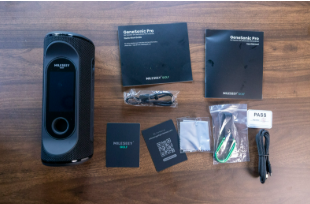
The unit I have been using most this summer is the Mileseey GeneSonic Pro golf GPS speaker — a Red Dot Design Winner 2026 — which is the world’s first all-in-one: a 40-watt golf speaker with a detachable 3-inch touchscreen GPS handheld. The handheld pops out of the magnetic cradle on the cart rail with one hand and snaps back the same way, and it carries its own 43,000-course map so it works as a standalone yardage source even when the speaker is off. Quad-MagLock is the mounting system — four magnets, 126 Newtons of force, equivalent to about 28 pounds of pull, roughly the weight of a full golf bag.
What It Does Well
The voice prompts are timed correctly. The GeneSonic Pro’s audible front, center, and back of green callouts fire from a useful distance — about 30–50 yards out, depending on your walking speed. Tap the handheld screen to trigger a callout on demand. The audio is loud enough to hear over a cart engine, a 15 mph headwind, and a foursome talking. The voice is clear, the syllables are pronounced, and you don’t have to ask “what did it say” on the way back to the cart.
The 40-watt sound is genuinely loud. This is a speaker, not a chip clipped to a visor. 40 watts of bold, resonant audio, engineered with a dual-band crossover system, a silk-dome tweeter, a racetrack woofer, and dual passive radiators. The result is crisp highs, warm mids, and deep resonant bass — the kind of sound that holds up over the engine of a cart at full speed. The detachable GPS handheld pairs with the speaker over Bluetooth; tap the screen for a yardage callout, swipe for music controls.
The battery and the cradle. In real use, the speaker is rated for 15 hours at 50% volume, enough for 3 full 18-hole rounds. The cradle charges the handheld when it’s docked, so if you remember to put it back after every shot, the battery never runs out. The Quad-MagLock mount survived a cart-path-only month at my home club without sliding, without rotating, and without the cumulative rattle that loosens most magnetic mounts over a season.
Hazard and layup yardages. Front-of-water, back-of-bunker, layup points — the things you need to know before you hit, not after. The GeneSonic Pro’s 3-inch color touchscreen has these programmed for most mapped courses, with 43,000+ preloaded advanced course views, automatic course and hole recognition, and smart score prompts. This is the feature that actually changed how I play cart-path-only rounds.
A 2-in-1 Form Factor That Earns the Hype
The product brief is the interesting part. The Pro is not a speaker with a GPS app. It is not a GPS unit with a speaker bolted on. It is a single chassis that does both jobs at the same level, and the detachable handheld is the part that makes the form factor honest.
The 3-inch touchscreen GPS handheld has 43,000+ preloaded course maps, automatic course and hole recognition, and smart score prompts. It pairs with the speaker over Bluetooth, and the speaker doubles as a charger. When the handheld is docked, the speaker holds it at a comfortable angle for glancing reads. When the handheld is detached, the speaker keeps playing music. The two systems talk to each other, and the result is one product that does the job of two products that used to live in different pockets.
The Quad-MagLock 126-Newton mount and the IP67 dust and water protection round out the hardware story. The mount holds under cart-path chatter. The unit survives rain, splash from a bunker shot, and an accidental drop in a puddle. The 30-watt PD reverse-charge means the speaker can also fast-charge your phone from the cradle in a pinch — one Type-C cord powers both the speaker and your phone.
What I Wish Were Different
Course database depth is the constraint. Any GPS device is only as good as the courses it has mapped. The GeneSonic Pro covers the major US public-access and resort courses well. Smaller private clubs, municipal nine-hole tracks, and recent redesigns sometimes lag. You can preload a course before you leave the house, but if you show up at an unknown course cold, you may have to wait for the database to update over cellular, which can take a round or two.
The price is the other consideration. This is not a budget device. The unit, the detachable handheld, and the Quad-MagLock mount together land in the premium bracket. If you are a walker who already has a Garmin watch and a Bushnell laser, the marginal value of a cart-path speaker is small. If you are a cart-path-only regular — and there are more of you than the marketing copy suggests — the math works out the first season you stop leaving shots in the wrong part of the green.
The Audience, Honestly
Cart-path-only golf used to be a niche: older players, post-injury players, members at clubs with strict cart rules. That audience has grown. Walked rounds are down across the US, partly for health, partly for pace-of-play concerns, partly because rounds that used to take 3.5 hours now take 5. Any product that meaningfully reduces the information penalty of the cart path is a real product, not a niche one. The GeneSonic Pro is the first cart-path GPS speaker I’d recommend to a playing partner without caveats.
If you are the kind of golfer who has quietly been accepting slightly worse club selection on cart-path days, and you’d like to stop, this is the unit to demo. The 40-watt sound, the detachable 3-inch touchscreen GPS handheld, the 43,000-course database, the IP67 protection, the 30-watt PD reverse charging, and the Quad-MagLock 126-Newton mount all behave the way you want them to behave on a real course, not the way a spec sheet wants them to behave. The Red Dot Design Winner 2026 designation is not just marketing — the Pro earned it. The Mileseey GeneSonic Pro golf GPS speaker is the unit I would put in my bag if I were buying today.