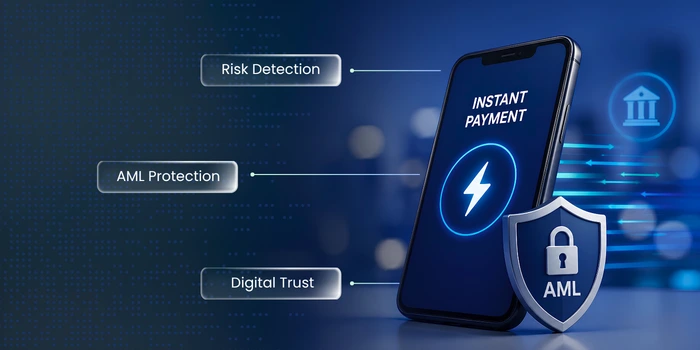
Instant payment systems have compressed settlement from days to seconds, and financial crime controls have had to compress with them. When funds move irrevocably in under ten seconds, overnight batch screening and next-day alert review protect nobody. Aml screening identifying suspicious activity after settlement and more about deciding, in milliseconds, whether a payment should leave at all.
What Instant Payments Change
Schemes such as UPI, Pix, SEPA Instant, Faster Payments and FedNow differ in design but share three traits that matter for financial crime risk: near-instant clearing, practical irrevocability once settled, and continuous availability including nights, weekends and public holidays.
Each is a benefit to legitimate users and an advantage to criminals. Irrevocability turns fund recovery into a negotiation rather than a reversal. Round-the-clock availability makes the quiet hours a prime attack window. And speed collapses the layering stage of money laundering: transfers that once took days now cross dozens of accounts in minutes. Detection latency, not accuracy alone, has become a primary risk metric.
The Typologies That Dominate Real-Time Rails
Most institutions see the same handful of patterns repeatedly.
- Authorised push payment fraud. The victim is socially engineered into authorising the payment, so it carries genuine credentials and passes conventional authentication cleanly.
- Money mule networks. Recruited account holders receive fraudulent funds and disperse them rapidly, often after weeks of dormancy.
- Account takeover. SIM swap, credential stuffing or malware hands an attacker a real account with authentic history behind it.
- Synthetic and stolen identities. Fabricated identities open accounts that exist only to receive illicit funds.
- Micro-structuring. Value is fragmented into small payments that sit below reporting thresholds.
- Cross-border layering. Funds cross linked schemes and virtual asset providers so quickly that no single institution sees the full chain.
None of these is reliably detectable from a single transaction viewed in isolation. They appear in sequence, in network structure and in deviation from established behaviour.
Why Traditional Controls Struggle
Batch monitoring was designed for rails where settlement took days, and that delay was itself the control. Remove it and the architecture inherits a permanent blind spot. Static thresholds are quickly mapped by organised groups who transact just beneath them, and the latency budget is unforgiving: screening, scoring and any step-up challenge share only milliseconds. Fragmented data compounds this, because a mule account looks unremarkable in each system individually and suspicious only when identity, device and network signals are resolved into one view.
Designing AML Controls for Real Time
Strengthen the Perimeter
The cheapest place to stop instant payment fraud is before the account exists. Strong know your customer (KYC) checks at onboarding, combining document authentication, biometric liveness and independent data verification, remove most synthetic and stolen identity accounts. Treating KYC compliance as a one-off gate loses that advantage over time, so risk ratings should refresh as behaviour, sanctions status or beneficial ownership changes.
Move From Rules to Behaviour
Effective monitoring compares each transaction against the customer’s own baseline and network context rather than a universal threshold. Velocity, dormancy followed by sudden activation, counterparty concentration and device mismatch all outperform transaction value. Graph analytics matters here, because mule networks reveal themselves as fan-in and fan-out structures before any single account looks suspicious.
Re-Sequence Sanctions Screening
Screening every payment message against watchlists inside a ten-second window is difficult and noisy. Several regimes now favour frequent screening of the customer base against updated designation lists instead, moving the sanctions control off the payment path and into a continuously maintained record.
Verify the Beneficiary
Payee verification, which checks that the name supplied by the payer matches the destination account, is among the more effective interventions against impersonation and invoice redirection. It creates a pause at the moment a victim is most likely to hesitate.
Apply Graduated Friction
Allow or block is too blunt a choice. Warnings at confirmation, step-up authentication, short holds on first payments to a new beneficiary and lower limits for newly opened accounts give proportionate options, with outright blocking reserved for the highest-confidence cases.
Governance and Reporting
Supervisory expectations extend well beyond the detection engine itself.
- Payment transparency. Originator and beneficiary information must travel with the payment; incomplete data undermines every downstream control.
- Reimbursement and liability. Mandatory reimbursement frameworks make fraud losses a balance sheet matter, sometimes shared between sending and receiving institutions.
- Model governance. Automated blocking decisions require validation, ongoing performance monitoring and clear human accountability.
- Reporting quality. Regulators increasingly assess the usefulness of suspicious activity reports rather than their volume.
- Information sharing. The receiving institution often holds the decisive evidence the sending institution cannot see.
Conclusion
AML on instant payment rails is a speed problem before it is a detection problem. The principle has not changed: know who your customers are, understand what normal looks like, and act proportionately when reality diverges. What has changed is the time available. On an instant rail, the compliance programme either operates at the speed of the payment or it operates too late.