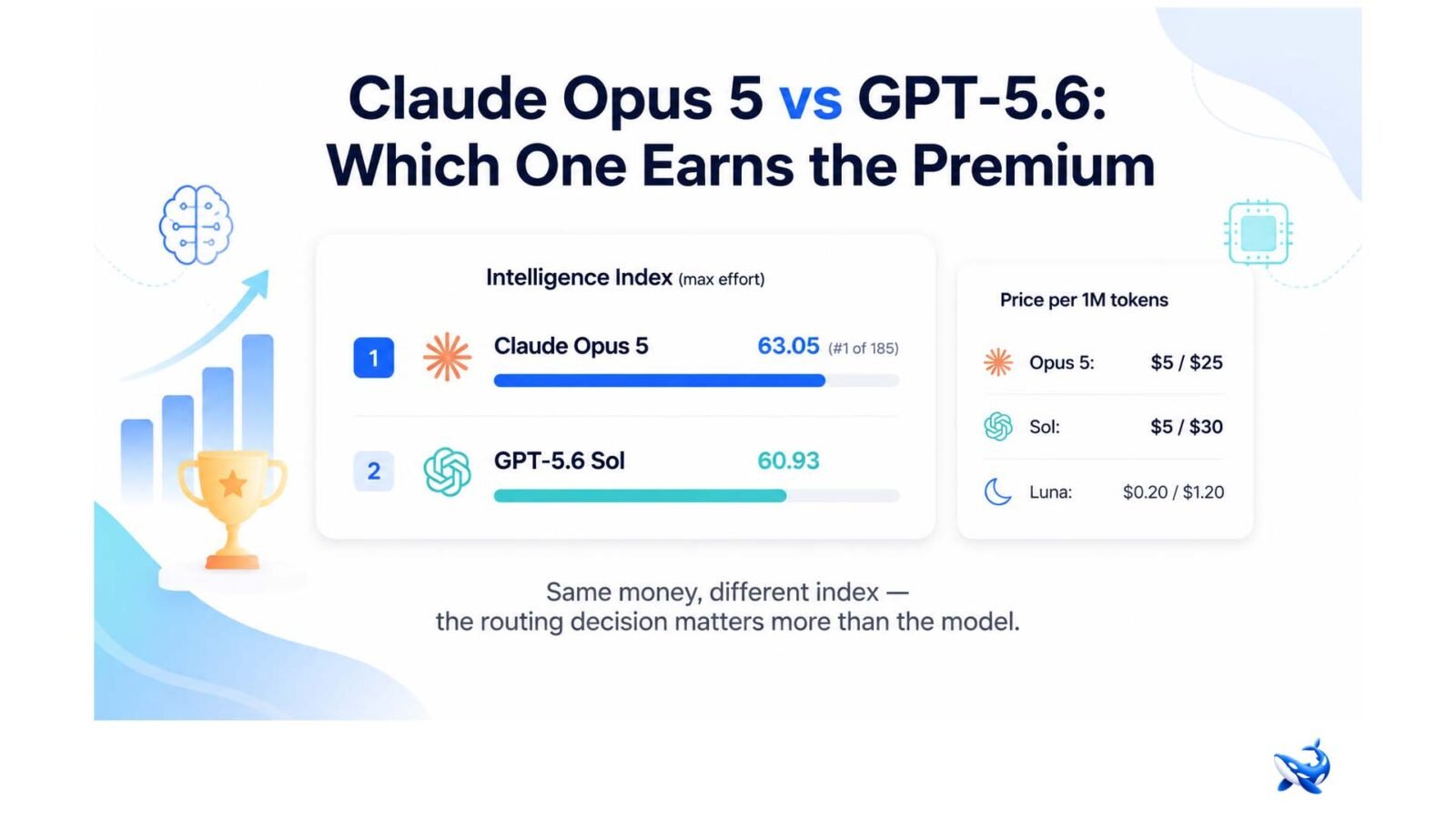
Claude Opus 5 API is the current top of the independent leaderboard, and it holds that title by a margin that is real but thin: on Artificial Analysis’ live Intelligence Index — an independent third-party composite run at max reasoning effort on both sides — it scores 63.05 (#1 of 185 models) against GPT-5.6 Sol’s 60.93, at the same $5 per million input tokens. Sol’s live pricing and specs are on Claude Opus 5; this piece is the whole-family view, because the answer changes once you price in Sol’s cheaper siblings.
OpenAI’s recent price cut split the GPT-5.6 family into three tiers. Sol, the flagship, stayed at its list price of $5 in / $30 out after the cut; Terra sits at $2 / $12; and Luna — the volume workhorse — dropped to $0.20 in / $1.20 out. Claude Opus 5 answers with a single flagship at $5 / $25 and a $0.50 cached-input lane, and it is priced to compete with Sol rather than with the family. So “Claude Opus 5 vs GPT-5.6” is not one question. It is at least three, and the model name is only part of the answer.
Max versus max, and why that comparison is the only honest one
Both vendors tune reasoning effort per request, and both scorecards shift with it. The widely-quoted numbers above are the max configuration for every model in this article, so this is a max-vs-max comparison: Anthropic’s “Adaptive Reasoning, Max Effort” label versus OpenAI’s max-effort reads. That matters because the same model at a lower effort setting looks like a different model. Claude Opus 5’s own effort ladder on the same index runs 63.05 at max → 62.52 at xhigh → 61.48 at high → 58.64 at medium (independent AA readings). Comparing an effort-maxed flagship against a default-effort run would manufacture a gap that doesn’t exist.
On the honest, max-vs-max basis the head of the table is close. Claude Opus 5 leads the Intelligence Index at 63.05 and posts the highest Omniscience Index among the models compared here, at 37.07. Sol trails by 2.12 points on the index, but compensates on the operational axis: it is faster at 73.7 tok/s versus Opus 5’s 61.8 tok/s, and it costs less per index task — $1.23 versus $2.34 (both independent AA figures). Opus 5 spends its token budget thinking harder before answering, and that shows in price-per-task as well as in the scoreboard.
Sol: the same money, a slightly different index
If your workload is “one flagship, judged on output quality,” the comparison narrows to two cards: Opus 5 at $5 / $25 and Sol at $5 / $30 after the cut. Input money is identical. Claude Opus 5 buys the higher index (63.05 vs 60.93), the higher omniscience reading (37.07 vs no comparable figure published for Sol on the same board), and a $5 lower output price, plus a cached-input lane at $0.50 — an 80% reduction on the input rate. Sol buys back speed and a lower cost per completed task.
That per-task gap is the subtle part. Opus 5 at max effort burns more thinking tokens to reach a marginally better answer; Sol reaches a marginally worse one faster and cheaper per call. For quality-gated work — long reasoning, agentic loops, code where a wrong turn costs more than tokens — the premium on the index is the premium you want. For high-throughput calls where the answer is right 95% of the time on either model, Sol’s faster, cheaper per-task profile is defensible. Neither is a wrong answer; they are different cost curves with the same entry ticket.
Luna and Terra: when price beats the index
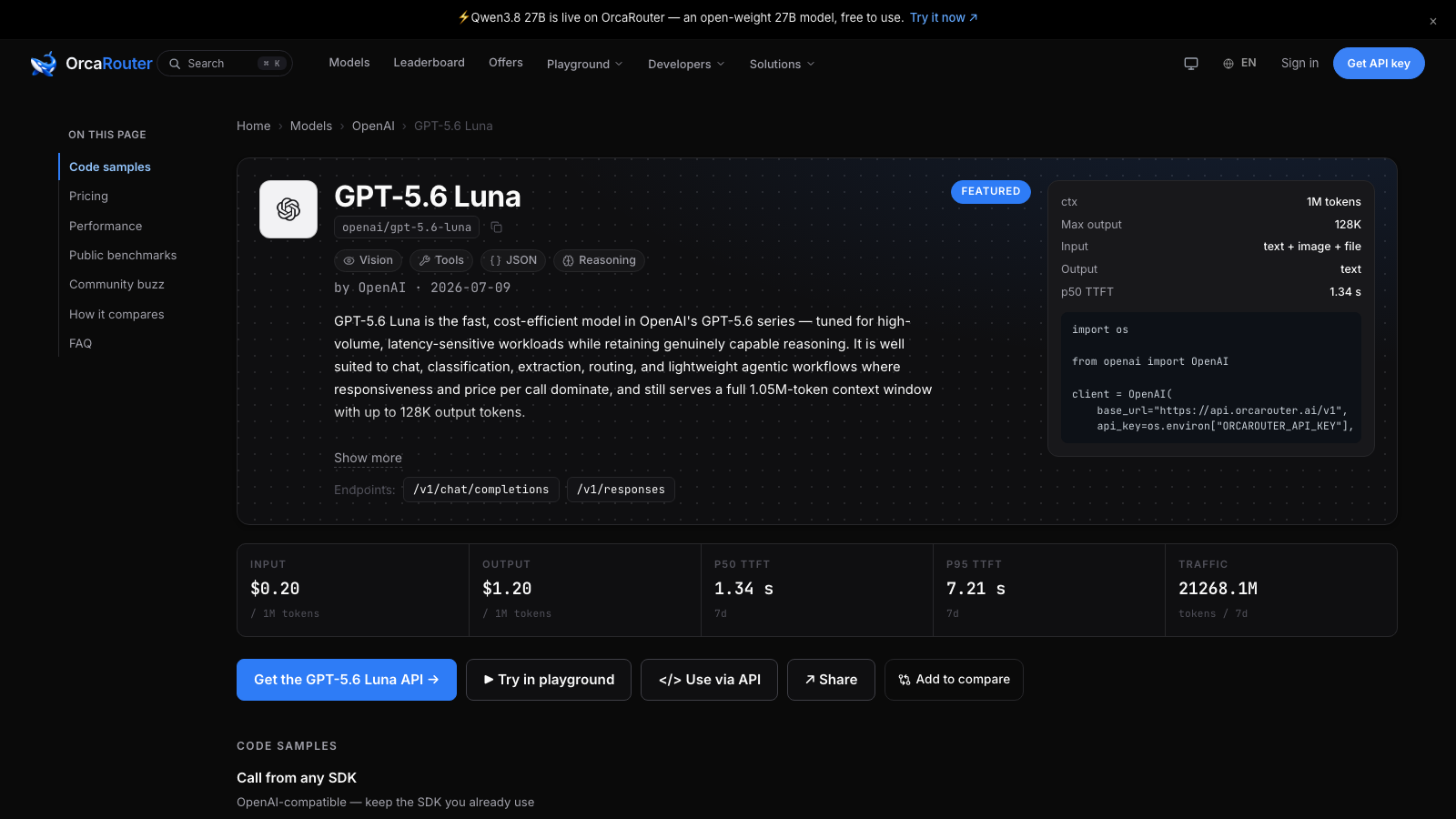
Step off the flagship tier and the comparison inverts. GPT-5.6 Luna, at $0.20 / $1.20 after the cut, scores 52.32 on the same index — a full ten points behind the flagships (independent AA) — but it is fast: 156.6 tok/s, and a p50 time-to-first-token of 1.33 s in our telemetry, versus 7.34 s for Claude Opus 5 (OrcaRouter 7-day window, checked 2026-08-22). That latency gap is the whole story of the tier: a flagship that thinks for seven seconds before its first token is an output-quality model; a model that answers in 1.33 seconds is a latency model. They are not substitutes.
The traffic numbers show where each actually gets used. Over a 7-day window our catalog carried 21,271.6M tokens through Luna against 491.5M tokens through Claude Opus 5 (OrcaRouter telemetry) — roughly 40× the volume at 1/25th the output price. Terra, at $2 / $12, sits between the poles: more capable than Luna, far cheaper than Sol, and a reasonable default for workloads that outgrew Luna but can’t justify flagship pricing. The tiers are a routing decision more than a quality judgment.
| Metric (max effort unless noted) | Claude Opus 5 | GPT-5.6 Sol | GPT-5.6 Luna |
| Intelligence Index (independent AA) | 63.05 (#1/185) | 60.93 | 52.32 |
| Omniscience Index (independent AA) | 37.07 (highest here) | — | — |
| Input / output price per 1M (list, post-cut) | $5.00 / $25.00 | $5.00 / $30.00 | $0.20 / $1.20 |
| Cached input per 1M | $0.50 (−80%) | — | — |
| Median output speed (independent AA) | 61.8 tok/s | 73.7 tok/s | 156.6 tok/s |
| Cost per Intelligence Index task (independent AA) | $2.34 | $1.23 | — |
| p50 time to first token (OrcaRouter telemetry) | 7.34 s | — | 1.33 s |
| Traffic, 7 days (OrcaRouter telemetry) | 491.5M tokens | — | 21,271.6M tokens |
The routing decision beats the model decision
The pattern across the GPT-5.6 family is that you are almost never picking one model for everything. A real application mixes tiers: Luna for high-volume summarization and extraction, Sol or Claude Opus 5 for the hard 5% of calls where a wrong answer is expensive, and caching on the flagship to keep repeated-context work near the cheap end. The difference between “Luna-quality” and “Opus 5-quality” is huge in the benchmark column and small in the daily average for most workloads — so the engineering win is deciding which tier each request deserves, not defending one model to the death.
That routing layer is exactly where a platform earns its keep. OrcaRouter carries Claude Opus 5 and the whole GPT-5.6 family behind one key at 0% markup on list price, so moving a request between a $0.20 model and a $5 model is a config change rather than a procurement cycle. The routing decision matters more than the model choice — the models have done their part; the question is whether your traffic reaches each one only when it earns the price.
The takeaway
Buy Claude Opus 5 if you want the top of the independent index, the highest omniscience reading in this comparison, a $5 output-price advantage over Sol, and a 1M context window — and if you can live with slower output and a model that thinks long before it speaks. Choose GPT-5.6 Sol if you want the same input money with faster output and a lower per-task cost, and are happy to trade two index points for it. Use Luna (or Terra between the poles) for volume work where price and latency dominate, and stop pretending a single flagship should handle every request. The honest answer to “which one earns the premium” is: the one that earns it per request — and that is a routing decision, not a loyalty decision.
Sourcing note: list prices are vendor-reported — OpenAI’s post-cut figures for the GPT-5.6 family and Anthropic’s current API list for Claude Opus 5, including the $0.50 cached-input rate. Intelligence Index, Omniscience Index, output-speed and per-task-cost figures are independent third-party readings from Artificial Analysis (checked 2026-08-22). Time-to-first-token and 7-day traffic figures are OrcaRouter’s own telemetry (7-day window, checked 2026-08-22). All models compared at max reasoning effort.