An enterprise AI knowledge base is not just a smarter FAQ page. It is a structured way to turn internal documents, policies, product knowledge, operating experience, and business procedures into a searchable, governed, and reusable knowledge layer. For executives and digital transformation leaders, the real question is not whether AI can answer questions. The real question is whether the company can reduce repetitive work, protect knowledge from being lost, and make trusted information available inside daily business workflows.
That distinction matters because many AI projects start as impressive demos and then stall. A chatbot can answer a few sample questions in a meeting. A production knowledge base has to do much more. It has to ingest documents, preserve context, retrieve the right evidence, respect access permissions, support updates, show where answers came from, and fit into the way employees already work. If it cannot do those things, it may create more confusion than value.
For a company evaluating AI knowledge base platforms, the best starting point is not a feature checklist. The best starting point is a business problem. Where do people lose time today? Which questions are asked again and again? Which documents are hard to find? Which processes require employees to jump between systems? Which experts are becoming bottlenecks because only they know where the answer is? Those questions reveal whether an AI knowledge base is a useful investment or just another tool competing for attention.
The business value starts with repetitive knowledge work
Most organizations carry a large amount of hidden knowledge work. Customer service teams answer the same product questions. HR teams explain policies, benefits, leave rules, and onboarding steps. Sales teams look for approved positioning, comparison language, and pricing boundaries. Operations teams search for standard procedures. Finance and procurement teams check rules, templates, and approval paths. None of this work looks dramatic on its own, but together it consumes thousands of small moments every month.
An AI knowledge base becomes valuable when it reduces those small moments without weakening control. Instead of asking a colleague, searching a shared drive, or opening several systems, employees can ask a natural-language question and receive an answer grounded in approved material. The goal is not to replace judgment. The goal is to make the first layer of knowledge access faster, more consistent, and easier to verify.
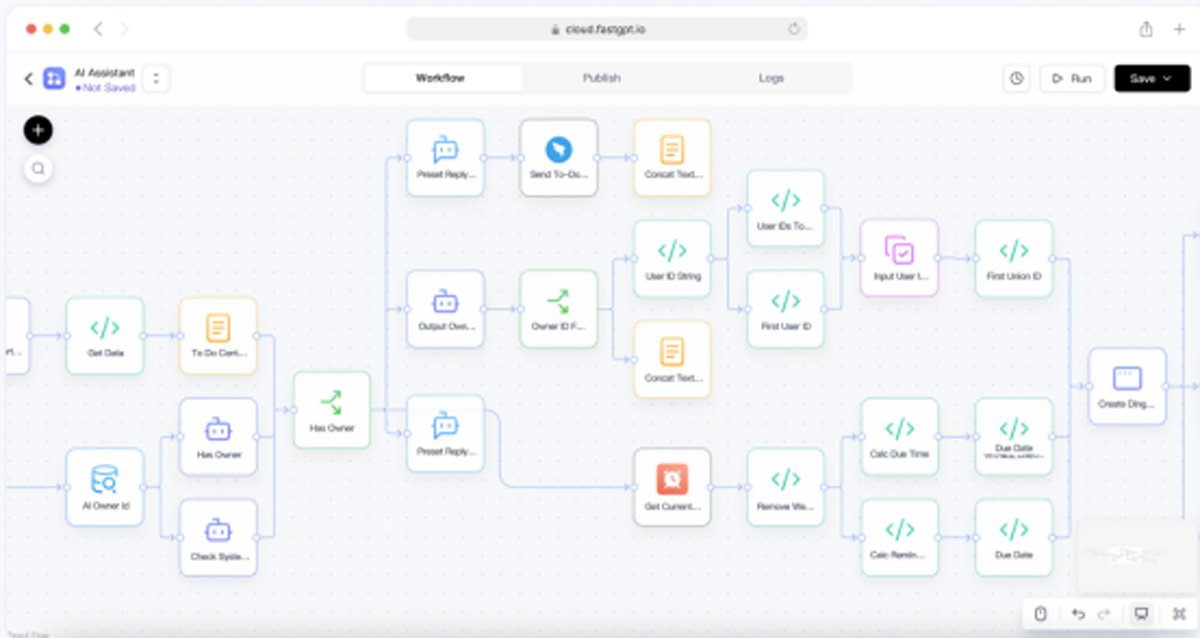
This is where platforms such as FastGPT become relevant. FastGPT is positioned around knowledge base Q&A, visual workflows, Agent orchestration, tool calling, and skill extensions. In enterprise terms, that means it should not be evaluated only as a chat interface. It should be evaluated as a way to connect knowledge, models, workflows, and business tools into a controlled application layer.
A knowledge base is different from a pile of documents
Many companies already have documents. They have SharePoint folders, PDFs, Word files, product manuals, process files, slide decks, spreadsheets, and internal wiki pages. But having documents is not the same as having a usable knowledge base.
A document repository is built for storage. An AI knowledge base is built for retrieval and use. The difference is important. In a repository, the user has to know which file to open, which section to read, and whether the information is still current. In an AI knowledge base, the system should help locate the relevant knowledge unit, return a usable answer, and ideally point back to the source that supports it.
This changes how enterprise knowledge should be prepared. Documents need ownership, version control, access rules, and cleanup. Policies that are no longer valid should not remain in the active answer pool. Sales comparison content should be separated from internal-only strategy notes. Product facts should be distinguished from marketing copy. If the underlying information is messy, the AI layer will inherit that mess.
That is why an AI knowledge base project should begin with content governance, not model selection. The model matters, but the model cannot repair every broken document boundary. A good implementation asks which sources are allowed, which are restricted, which require human review, and which should never be used for automatic answers.
The strongest use cases combine knowledge and workflow
The first use case is usually question answering. That is natural. Employees want to ask: What is the policy? How do I handle this customer objection? Where is the latest product information? What is the standard process for this approval? But the larger opportunity appears when knowledge retrieval connects to workflow.
Consider an HR scenario. Employees may ask about leave, benefits, onboarding, reimbursements, or internal procedures. A basic knowledge base can answer those questions from policy documents. A more useful system can guide the employee to the next step, identify which form is needed, and route the request into the right workflow. The business value is not only that the answer is faster. The value is that the employee can move from question to action with less friction.
The same applies to an OA assistant. In a traditional OA process, a user may need to open the system, find the right page, select a form, fill in fields, and then check approval status later. A natural-language workflow can let the user say something like, “I need to take one day off next Wednesday,” extract the required information, prefill the relevant fields, and help the user track the approval. The knowledge base explains the policy; the workflow helps complete the task.
For executives, this is the difference between an AI answer tool and an AI productivity system. A pure chatbot may reduce search time. A knowledge-plus-workflow system can reduce process friction, standardize output, and make business operations easier to repeat.
The real asset is not the answer. It is the maintained knowledge layer
A successful enterprise knowledge base does something subtle: it turns scattered knowledge into a managed company asset. Before the project, knowledge may live in people’s heads, outdated folders, chat history, and one-off documents. After the project, the organization can begin to see knowledge as something with structure, ownership, usage, and measurable quality.
This matters when employees leave, departments grow, products change, or new teams need training. Without a maintained knowledge layer, every new employee has to rediscover how the company works. With a maintained knowledge layer, institutional knowledge becomes easier to reuse.
That does not mean every answer should be automated. Some questions require judgment. Some involve sensitive information. Some require approval from a manager or domain expert. A mature AI knowledge base should make these boundaries clear. It should support human review rather than pretending that every answer can be generated safely.
A useful rule is this: automate access to stable knowledge, assist with interpretation, and keep humans in the loop for high-risk decisions. That rule prevents the project from becoming either too timid or too reckless.
What executives should measure
If the goal is business value, the metrics should not stop at “the AI can answer questions.” A better measurement framework includes operational, quality, and governance indicators.
Operational metrics include the number of repeated questions deflected, average time saved per inquiry, reduction in manual document lookup, and adoption by target departments. If HR questions that used to take hours of back-and-forth can be answered in seconds with a source-backed response, that is a measurable improvement. If an OA workflow drops from several minutes of navigation to a short natural-language request, that is another concrete signal.
Quality metrics are just as important. The company should track whether answers are grounded in approved sources, whether citations or references are available, how often users report wrong answers, and which topics require content cleanup. For knowledge base work, answer quality is not only a model issue. It is also a content, retrieval, and maintenance issue.
Governance metrics include access control coverage, auditability, ownership of source documents, update frequency, and cost visibility. Enterprises need to know who can access which knowledge, who changed a document, which application used which model or tool, and whether usage is staying inside expected boundaries.
If a vendor demo does not support this kind of measurement, the company should treat the demo as an early signal, not as proof of production readiness.
Why private deployment may matter
Not every company needs private deployment. Some teams can use cloud services safely and effectively. But for state-owned enterprises, finance, healthcare, manufacturing, pharmaceuticals, and other sensitive industries, private deployment often becomes part of the decision. The concern is not only where the chat interface runs. The concern is where documents, embeddings, model calls, logs, plugins, and workflow outputs travel.
A serious evaluation should ask several questions. Does data leave the internal network? Where is the model hosted? Are plugins allowed to call external services? How are logs stored? Can permissions be mapped to departments, roles, and resources? Who is responsible for upgrades, backup, monitoring, and incident response? These questions matter more than a simple checkbox that says “supports private deployment.”
This is also where leadership and IT need to work together. Business leaders define the value and scope. IT leaders define the architecture and operating boundary. If either side works alone, the project may become unbalanced. Business-only projects can overlook security and maintenance. IT-only projects can become technically correct but unused.
When an AI knowledge base is not the right answer
A restrained article should say when the tool is not a fit. An AI knowledge base is not a magic layer for every business problem. It is not a replacement for ERP, CRM, OA, or core transaction systems. It is not the right first project if the company has no reliable documents, no owner for the knowledge base, and no clear use case. It is also risky when the business expects zero-error automation but refuses to define human review points.
The same caution applies to real-time database writing and high-risk decisions. A knowledge base can retrieve context, explain rules, and help prepare an action. But deterministic calculations, permission checks, final approvals, and data writes should remain under the control of business systems and accountable workflows. The AI layer should assist; it should not quietly become an uncontrolled authority.
This boundary makes the project stronger, not weaker. Clear limits help employees trust the system. They also help leaders decide where AI can create value quickly and where the company should move more slowly.
A practical path: start with a 30-day POC
The safest way to begin is a focused proof of concept. A 30-day POC is often enough to discover whether the company has the right materials, the right use case, and the right operating model.
Start by choosing one department or one knowledge domain. Do not begin with the entire company. A good first domain might be HR policy Q&A, product knowledge for sales, customer service knowledge, internal IT support, or a narrow OA assistant. Then select 20 to 40 real questions from employees or customers. These questions should include easy questions, ambiguous questions, and questions that require the system to say “this needs human confirmation.”
Next, prepare the source documents. Remove obviously outdated files. Identify owners. Mark sensitive material. Separate public-facing facts from internal guidance. Then run tests that measure answer quality, source grounding, missing knowledge, and user feedback. The most useful POC result is not a perfect demo. It is a clear list of what works, what fails, which documents need cleanup, and what the next phase would cost.
FastGPT’s official documentation is a helpful starting point for understanding the product’s knowledge base, workflow, Agent, and API concepts. Teams evaluating implementation details can begin with the FastGPT documentation, then map the documented capabilities to their own POC checklist.
How to decide whether to continue after the POC
After the POC, leaders should avoid two extreme reactions. The first is to declare success because the demo looked good. The second is to abandon the project because some answers failed. In knowledge base projects, failed answers are often useful diagnostic signals. They show which documents are missing, which content is ambiguous, and which questions should be routed to humans.
A reasonable continuation decision should answer five questions. Did the system reduce lookup time for the target users? Were answers grounded in sources that employees trust? Did the project reveal a manageable content maintenance process? Did IT identify a safe deployment and permission model? Did the expected business value justify the next phase?
If the answer is yes, expand gradually. Add more documents, more users, and more workflows. If the answer is no, pause and fix the foundation. Do not scale a weak knowledge base. Scaling poor content only makes the problem more visible.
The executive takeaway
Enterprises need an AI knowledge base when knowledge access has become a business bottleneck. The value is not the novelty of AI. The value is faster access to approved information, lower repetitive workload, better preservation of company knowledge, and a path from questions to workflows.
The strongest projects are not built around vague transformation slogans. They start with a specific department, a clear knowledge domain, real user questions, source-backed answers, measurable quality, and defined governance. Platforms such as FastGPT are worth evaluating when the company wants to combine RAG knowledge retrieval, visual workflow orchestration, Agent capabilities, tool calling, and enterprise delivery into one practical system.
The right mindset is simple: do not ask whether AI can answer a question in a demo. Ask whether your company can maintain the knowledge, control the permissions, measure the quality, and keep improving the system after the demo is over. That is where an AI knowledge base becomes more than software. It becomes part of the company’s operating infrastructure.