
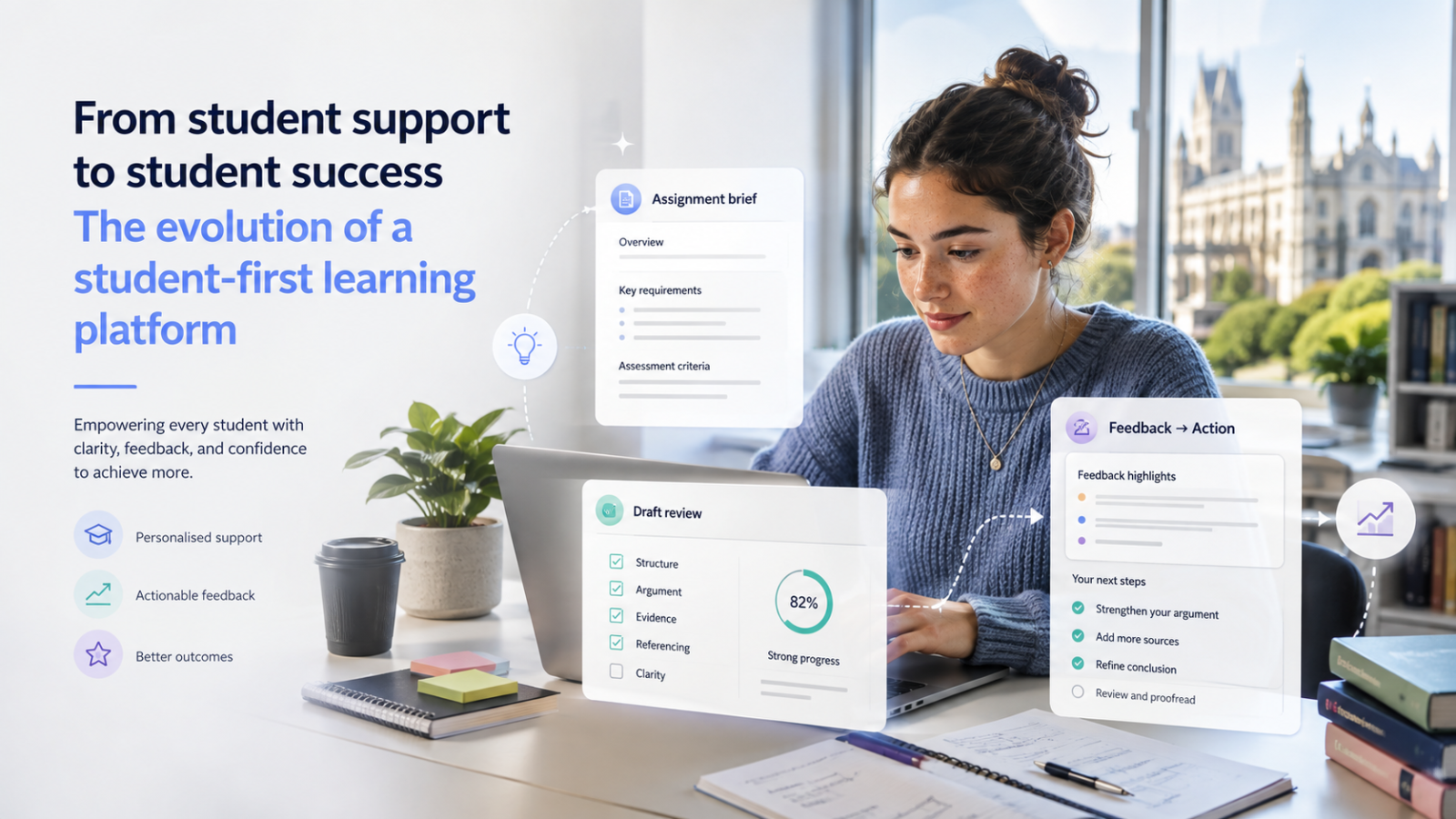
A visual representation of the shift from general academic support towards clearer, stage-specific student tools.
The story of My Perfect Writing is not a story of one product suddenly becoming something completely different. It is a story of an academic-support brand gradually learning more about the problems students face before, during and after an assignment – and then expanding the way it supports those students.
For years, the most visible part of My Perfect Writing was its academic writing and support services. Students came to the platform because they needed help with essays, dissertations, subject-specific assignments and other forms of university work. That service-led identity built the foundation of the brand and remains part of the wider platform today.
But working around academic assignments also exposed a repeated pattern. Students were not only asking for help because they had reached the end of an assignment and needed support. Many of their difficulties had started much earlier.
Some students were unsure what the assignment brief was really asking. Others had written a draft but could not judge whether it was strong enough. Some had already submitted work, received feedback and still did not know what to change next time.
Those recurring problems gradually changed the question My Perfect Writing was asking. Instead of only asking, ‘How can we support a student with this assignment?’, the brand began asking, ‘Where exactly is the student getting stuck in the academic process?’
The first chapter: a service-led academic support brand
The earlier My Perfect Writing website reflected the way many students first discovered the brand: through service-led pages built around subjects and assignment types. A student looking for support in law, business, nursing, psychology, marketing or another discipline could find a relevant route into the platform.
That model made sense because academic support is often highly specific. A law problem question is not approached in the same way as a nursing evidence-based assignment, and a dissertation creates different pressures from a shorter undergraduate essay.
The service side therefore gave My Perfect Writing a broad view of the academic challenges students were facing. Over time, however, that view also revealed something important: many of the same underlying problems appeared across subjects.
A business student and a nursing student may be working on very different topics, but both can struggle to interpret a marking criterion. A law student and a psychology student may use different evidence, but both can be unsure whether their draft is analytical enough. Feedback language can also be confusing regardless of discipline.
That recognition became the starting point for the next chapter of the My Perfect Writing journey.
The turning point: looking at problems before the final submission
The biggest shift came from looking beyond the finished assignment and paying more attention to the stages that lead up to it.
The first stage is often understanding. Before a student can plan effectively, research selectively or write with confidence, they have to understand what the university is actually asking them to demonstrate.
Yet briefs can be dense. They may combine learning outcomes, command words, assessment criteria, word counts, referencing requirements and submission instructions in one document. Students can read all of that information and still be uncertain about the core task.
That problem is different from needing someone to review a final piece of work. It is an interpretation problem – and it needs a more focused solution.
This thinking led to a stronger emphasis on tools such as the Brief Decoder, which is designed around a simple but important stage of the student journey: helping a student understand the assignment brief before they move deeper into the work.
The significance of this shift is not just the tool itself. It represents a change in how My Perfect Writing thinks about academic support. Instead of treating every difficulty as one large writing problem, the platform can address smaller problems at the moment they occur.
For the student, that can mean moving from ‘I do not know what this brief wants’ to a clearer understanding of the task, the assessment expectations and the points that deserve attention.
The next step: helping students review their own work
Understanding the brief solves one problem, but it does not remove the uncertainty that can appear later.
A student may spend days researching and writing, then reach the final draft and still wonder whether the work is actually doing what the brief asked. This is particularly difficult because students are very familiar with their own writing. After reading the same paragraphs repeatedly, weaknesses in structure, evidence or clarity can become harder to see.
This is where the development of Marker’s Eye fits into the My Perfect Writing journey.
Marker’s Eye reflects another stage-specific problem: the need to review a student’s existing draft through a clearer academic lens. The focus is on helping the student see where the draft may need more attention rather than treating the whole process as a single generic writing task.
That means the My Perfect Writing platform is no longer only useful at the point when a student actively seeks a traditional academic-support service. It is also becoming useful as a self-directed checkpoint within the student’s own workflow.
A third recurring problem: feedback that students cannot easily use
The journey does not end at submission.
After an assignment is marked, students often receive comments that are academically meaningful but difficult to translate into action. Phrases such as ‘more critical analysis’, ‘develop your argument’, ‘engage more closely with the literature’ or ‘improve synthesis’ may identify the weakness, but they do not always make the next step obvious.
That gap between marker language and student action became another area My Perfect Writing began to address.
Feedback Decoder was developed around that post-assessment stage. Its role is different from Brief Decoder and Marker’s Eye because the student is now looking backwards at what the marker said and forwards at what should improve next.
Together, the three tools reflect a much clearer map of the student experience: understand the task, review the work, then understand the feedback.
The journey became less about offering one form of support and more about identifying the exact moment where a student loses clarity.
The website revamp reflects the same change
This product evolution has also influenced the wider My Perfect Writing website.
The platform is being reshaped so that students can discover support through the problem they are trying to solve, not only through a traditional list of academic services. Tools, practical guides, free resources and problem-led blog content are becoming more visible alongside the existing service offering.
That distinction matters. My Perfect Writing has not simply discarded its academic-support background. The newer direction adds another layer to it.
A student who wants structured academic support can still explore relevant services. Another student may only need to decode a brief, review a draft, interpret feedback or use a free academic resource. The platform can increasingly support both types of need without forcing them into the same route.
This is also why the current blog and resource strategy is becoming more practical. Instead of publishing content only around broad academic keywords, the focus can move towards the real questions students ask: how to understand a marking criterion, how to move from description to analysis, how to evaluate sources, how to plan a dissertation topic, or how to use feedback more effectively.
From a website of services to a layered student ecosystem
The clearest way to describe the My Perfect Writing journey is therefore not ‘services became tools’. That would oversimplify what has happened.
A better description is that a service-led academic-support brand is becoming a layered student-support ecosystem.
The first layer remains human and academic support for students who need it. The second layer is made up of focused tools that address specific moments of uncertainty. The third layer is educational content and free resources that students can use independently.
Those layers serve different students and different moments, but they are connected by the same goal: making academic expectations easier to understand and navigate.
What comes next for My Perfect Writing
The next stage of the journey is likely to be defined by how well those layers work together.
A student should not have to think in terms of platform architecture. They should be able to arrive with a problem – a confusing brief, an uncertain draft, unclear feedback, or a need for deeper academic support – and quickly find the most relevant next step.
That is the direction My Perfect Writing is moving towards: a platform organised less around what the company wants to present and more around what the student is trying to solve.
It is a gradual evolution rather than a dramatic reinvention. The academic-support foundation remains, but the experience around it is becoming more practical, more self-directed and more closely connected to the actual sequence of university work.
For My Perfect Writing, the journey so far shows that the strongest product ideas can come from listening to the same student questions repeatedly and recognising that sometimes the best way to help is not to offer more information, but to offer clearer support at the right moment.