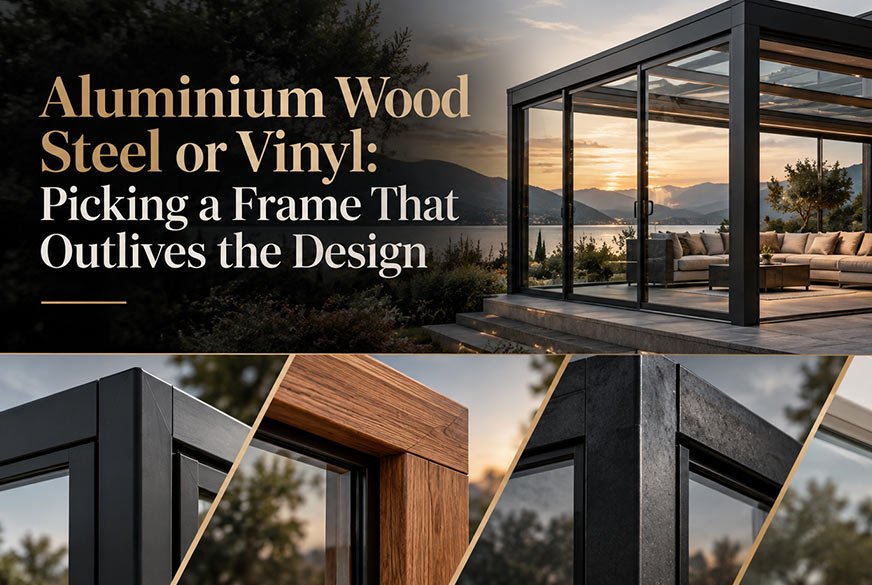
Outdoor structures rarely collapse. They loosen. Posts stay standing while the fasteners work their way back out, the coating flakes at the edges, a beam twists just enough that a roof stops moving cleanly. Which failure arrives first is decided almost entirely by the frame material, and by the time it shows the choice is expensive to reverse.
Four materials cover most of what gets built over a patio or deck in the Northeast: extruded aluminium, pressure treated softwood, cedar or another durable timber, and steel, with vinyl at the smaller end. Each of them is genuinely the right answer somewhere.
Span capability shows up as visible bulk
The first constraint is structural and immediately visual. For a given opening, a better strength to weight ratio means less material in the beam. Aluminium is extruded hollow, so a section can be deep where depth does work and thin where it does not, which is why an aluminium pergola carries slimmer posts than timber over the same patio. Solid timber has to be sized as a solid section, so a wide opening forces heavy posts or an extra post in the middle of the view. Steel spans furthest with the least visible section. Vinyl creeps under sustained load, so it depends on internal reinforcement and stays small.
Movement is what backs the screws out
Wood moves with moisture, mostly across the grain: swelling in a wet spring, shrinking in a dry heated winter, every year. That cycle loosens fasteners, opens joints and eventually cups or twists a beam that arrived straight. Kiln dried timber moves less but never stops. Metals respond to temperature instead, a smaller and more predictable displacement, though a long aluminium beam in summer sun expands enough that the joints have to allow for it. Vinyl moves most and resists least.
Rot corrosion and insects
Aluminium does not rot and no insect eats it. It corrodes only under specific conditions: standing water, contact with dissimilar metals, or salt air against a poor finish. Pressure treated pine resists decay because of what was forced into it, and that protection is thinnest at cut ends and drilled holes, so field cuts have to be sealed. Cedar carries natural extractives that slow decay, but heartwood and sapwood are not equal. Steel has one problem, rust, and galvanising handles it provided every scratch, bolt hole and weld stays watched. Vinyl degrades instead through ultraviolet exposure and cold weather brittleness.
The finish is a labour question
The honest difference here is counted in weekends rather than dollars. A factory applied powder coat on aluminium is baked onto a prepared surface and fades slowly rather than peeling, so upkeep is mostly washing. Stain or paint on timber sits on a surface that keeps moving underneath it, so horizontal members need recoating on a cycle, and each cycle means cleaning, sanding and waiting for dry weather. Left alone, cedar goes silver, which many people prefer, but that should be a decision.
A moving roof asks more of the frame
Anything motorized changes the brief. Rotating louvers and retractable fabric roofs need the frame to stay dimensionally stable, because the mechanism has tolerances a twisting beam will quietly consume. Extruded aluminium suits this for a reason unrelated to strength: the extrusion carries internal channels, so rainwater drains inside the posts and wiring for motors and lighting runs inside the pergola frame instead of surface conduit. Building that into timber means routing channels through structural members or accepting visible trunking. It is also why a pergola NJ project starts with drawings and a site inspection, since snow and wind figures for the address decide the section sizes. Regional builders such as Vision Art Aluminium engineer to those figures rather than shipping a standard size kit.
| Frame | Structural reach | Ongoing work | Best suited to |
| Extruded aluminium | Long spans with slim sections | Washing and hardware checks | Motorized roofs and exposed sites |
| Pressure treated pine | Moderate spans with bulky posts | Sealing cuts and repeated recoating | Tight budgets and fixed roofs |
| Cedar or durable timber | Moderate spans | Recoating or weathering to grey | Warm natural appearance |
| Steel | Longest spans | Coating repair at every breach | Large canopies and heavy loads |
| Reinforced vinyl | Short spans only | Very little beyond cleaning | Small low cost structures |
Where the other materials win
Aluminium is not the automatic answer. Timber is warm to look at and to touch, and against a timber framed house it can be the only thing that looks like it belongs. It is also the material a competent carpenter can alter on site a decade later. Steel earns its place where the span is long or the load is heavy. Vinyl makes sense when the structure is small and nobody intends to maintain anything.
What happens at the end
End of life rarely comes up at the quotation stage. Aluminium and steel hold scrap value and are recycled routinely, untreated timber can be burned or composted, pressure treated timber generally goes to landfill, and vinyl is difficult to recycle in practice.
The useful question is not which material is best. It is how long the structure has to last, how exposed the site is, whether anything on it has to move, and how much annual maintenance is realistic. Aluminium pergolas in New Jersey have become common because large exposed structures with moving roofs stack those answers one way. A small fixed canopy in a sheltered garden stacks them another. A firm working in one material only, Vision Art Aluminium in aluminium or a carpenter in cedar, will answer for that material, so settle the comparison first.