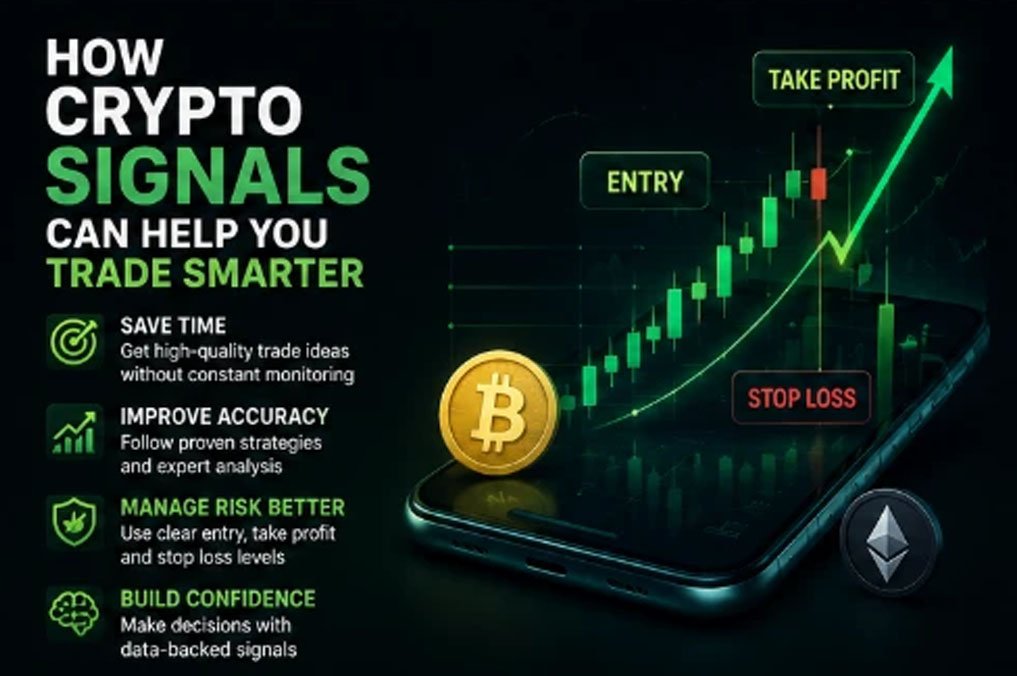
Crypto markets never close. Bitcoin can swing 5-10% in a single session, altcoins can double or halve within 72 hours, and news breaks at every hour of the day across every timezone. No individual trader can watch that continuously ‒ which is exactly the gap crypto trading signals are built to fill: structured, timestamped trade ideas that let you act on a setup without personally scanning dozens of charts around the clock.
Used well, free crypto signals and paid tiers alike can genuinely sharpen a trading process ‒ not by predicting the market with certainty, but by replacing impulsive, emotional entries with a defined, repeatable structure.
What a Signal Actually Gives You
| What Signals Give You | Why It Helps | What It Doesn’t Replace |
|---|---|---|
| Defined entry, stop-loss, target | Removes emotional guesswork about when to enter and exit | Your own position sizing and risk tolerance |
| Broader market coverage | Surfaces setups across pairs and timeframes you couldn’t track alone | Understanding why a specific setup was chosen |
| Structure and consistency | Encourages a repeatable process instead of impulsive trades | Discipline to actually follow the plan |
| Time savings | Frees you from watching charts around the clock | The need to verify the provider is legitimate |
Where Signals Add Real Value
1. Structure Over Impulse
A proper signal comes with a specific entry price or range, a stop-loss, and at least one take-profit target ‒ everything needed to calculate risk before ever placing a trade. That structure is the opposite of the emotional “I have a feeling about this coin” decision-making that costs most retail traders money. Following a defined framework, even an imperfect one, tends to outperform decisions made in the moment.
2. Coverage You Couldn’t Manage Alone
Serious signal providers scan dozens to hundreds of pairs simultaneously, whether through a human analyst team or an automated scanner. That’s coverage no individual trader can replicate manually, and it means you’re exposed to setups across altcoins and timeframes you’d otherwise never notice.
3. Time Efficiency
For traders with jobs, families, or simply a life outside of charts, signals compress hours of market-watching into a single structured alert. You still need to execute and manage the trade, but the discovery and initial analysis work is already done.
4. A Framework for Learning
Signals that include a written rationale ‒ the technical setup, the catalyst, the risk-reward logic ‒ double as an education tool. Newer traders can study why a call was made, not just copy the entry price, which builds independent skill over time rather than permanent reliance on the provider.
Free vs. Paid Signals: What Actually Differs
Free channels typically serve as a discovery layer ‒ a way to sample a provider’s style and accuracy before committing to a paid tier, and quality varies enormously across them. That said, free doesn’t automatically mean lower quality: several well-regarded providers offer automated, rule-based signal feeds at no cost, with full historical performance visible. Paid tiers generally add higher signal frequency, deeper written analysis, and sometimes direct support or portfolio guidance, typically running anywhere from around $30 to $300+ per month depending on the provider.
- Free signals: good for testing a provider’s style and consistency before paying anything.
- Paid signals: generally offer more frequent calls, deeper analysis, and better support, but price alone never guarantees quality ‒ verified performance does.
How to Actually Trade Smarter With Signals
- Treat every signal as a starting point, not an instruction to follow blindly ‒ check that it fits your own risk tolerance and portfolio allocation first.
- Always respect the published stop-loss. Skipping it defeats the entire purpose of using a structured signal.
- Size positions as a small, fixed percentage of total capital per trade, regardless of how confident a signal looks.
- Track your own results over weeks or months rather than trusting a provider’s self-reported win rate.
- Match signal frequency to your actual availability ‒ a service sending 40 signals a week is wasted on someone who can only check charts twice a day.
- Prefer providers who explain their methodology and show full trade history, including losses, over ones that only showcase wins.
A Realistic Expectation Check
Signals are a tool for improving process, not a shortcut to guaranteed profit. Even a well-verified provider will have losing trades ‒ what matters is whether the win rate and risk-reward ratio, taken together over a meaningful sample, add up to a positive expectancy. Used with discipline and honest verification, signals can meaningfully improve consistency. Used as a substitute for any personal risk management, they can just as easily amplify losses.
Frequently Asked Questions
Are free crypto signals worth using?
Yes, for many traders they’re a reasonable starting point ‒ several established providers offer solid free tiers, and testing a free channel before paying is a sensible way to evaluate a provider’s actual consistency.
How many signal providers should I follow at once?
Most experienced traders recommend following just 2-3 providers rather than many, since too many sources create contradictory noise instead of a clearer edge.
Do I need trading experience to use crypto signals?
Basic experience helps, since you still need to place the trade, manage position size, and decide whether a setup fits your risk tolerance. Signals with written rationale can help beginners learn faster than blindly copying entries.
What’s the biggest risk of relying on signals?
The biggest risk is following signals from an unverified provider without independent risk management ‒ position sizing and respecting the stop-loss matter as much as the quality of the signal itself.
Can automated signal feeds be trusted more than human analysts?
Automated, rule-based feeds remove some of the incentive to exaggerate results since the methodology is fixed and often published, but that doesn’t guarantee profitability ‒ any provider, automated or human, should still be checked against independently tracked performance.
Final Thoughts
Crypto signals work best as a structural aid, not a substitute for judgment. They compress research time, enforce defined risk, and expose you to setups you’d otherwise miss ‒ but only if you pair them with your own risk management and a habit of verifying performance rather than accepting marketing claims at face value. Traders who treat signals this way tend to trade smarter; traders who follow them blindly tend to relearn the same lesson the expensive way.