
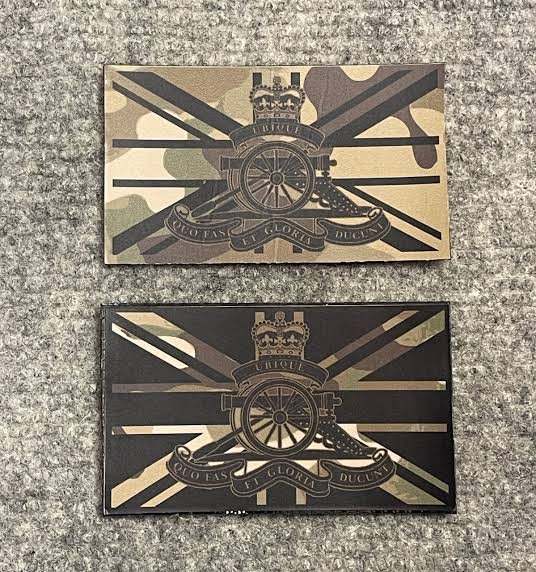
IR, rank and flag patches are identification patches that attach to tactical clothing using a hook-and-loop backing. UK operators use these three patch types to signal identity, position and nationality in the field, on plate carriers, combat shirts, smocks and helmet covers. A UK manufacturer such as Custom Velcro Patches produces each format to unit-friendly specifications, with subdued colours, infrared-reactive threads and MTP-compatible designs. This field guide explains what IR, rank and flag patches are, how each one works, and how UK personnel order bespoke sets that meet operational standards.
Every patch covered here shares one trait: a velcro (hook-and-loop) backing that lets an operator swap kit in seconds without stitching or ironing. That single feature is why hook-and-loop patches dominate modern loadouts, and it shapes how each type below is designed and worn.
What Are IR Patches?
IR patches are infrared-reactive identification patches that appear bright under night-vision devices. The material reflects near-infrared light, so an operator viewing the patch through an image-intensifier (NVG) sees a clear, high-contrast marker that stays almost invisible to the naked eye in daylight. This dual behaviour makes IR patches a core Identification Friend or Foe (IFF) tool.
IR patches solve a specific battlefield problem: recognising friendly forces at night. During low-light operations, standard colour and embroidery disappear, so units rely on infrared-reactive threads, reflective backing and “glint” materials to mark themselves. A subdued Union Flag by day becomes a glowing identification panel under night vision.
Common IR patch formats include:
- IR reflective flags – a national flag rendered in infrared-reactive material for night IFF.
- IR call-sign and blood-type panels – small data patches read under NVG.
- Cat-eye and glint markers – minimal IR squares used for spacing and recognition.
- Combined day/night patches – a subdued visible design over an IR-reactive layer.
IR patches connect directly to the next identifier an operator needs: rank. Once a friendly is recognised, position within the unit becomes the next question a patch answers.
What Are Rank Patches?
Rank patches are insignia patches that display a wearer’s position within a military, police or security structure. British forces use rank slides and hook-and-loop rank patches to show grade, Lance Corporal through to senior officer, in a format that reads instantly at close quarters. The insignia is embroidered or woven, then finished with a velcro backing for rapid transfer between garments.
Rank patches carry authority, so accuracy matters. British Army rank markings follow a defined progression, chevrons for junior non-commissioned ranks, crowns and pips for warrant and commissioned ranks, and each design is reproduced to the correct proportions. Operators order rank patches in subdued tones for combat wear and full-colour versions for barracks or ceremonial kit.
Two rank formats appear most often on UK kit:
- Rank slides – a fabric slide worn over a central chest tab or epaulette on combat uniform.
- Hook-and-loop rank patches – a flat velcro-backed patch worn on the chest loop field of a plate carrier or combat shirt.
A responsible note applies here: official rank insignia should reflect genuine entitlement or unit approval, and reputable UK suppliers produce insignia for serving personnel, cadets, re-enactment and airsoft use to the specification the customer requests. Rank establishes hierarchy; nationality establishes the team, which is where flag patches take over.
What Are Flag Patches?
Flag patches are national-identity patches that mark the wearer’s country or allegiance. UK operators wear the Union Flag as a velcro-backed patch on the shoulder or plate carrier, in either full colour or a subdued MTP-friendly palette. The patch is woven or embroidered, edged with a merrow or laser-cut border, and finished with a hook backing for the loop panels found on modern tactical gear.
Flag patches follow two conventions worth knowing before you order. First, colour: full-colour flags suit parade and representative roles, while subdued flags, muted olive, tan or grey, suit field operations where signature reduction matters. Second, orientation: on the right shoulder, a flag is commonly reversed so the canton faces forward, giving the impression the flag streams backwards as the wearer advances. The Union Flag also has a correct “way up”, the broad white diagonal sits above the red on the upper hoist side, so confirming artwork before production prevents an upside-down order.
Flag patches complete the identification set, but all three types depend on the same attachment method, and that method deserves its own explanation.
Why Hook-and-Loop Backing Dominates Tactical Patches
Hook-and-loop backing is a two-part fastening system that lets a patch attach and detach without sewing. The hook side bonds to the loop field sewn onto plate carriers, combat shirts and MOLLE panels, so an operator repositions IR, rank and flag patches in seconds. This removable design is the defining advantage of the velcro patch over fixed alternatives.
Unlike iron-on patches, which fuse permanently under heat, and sew-on patches, which require stitching, velcro patches stay repositionable for the life of the garment. An operator can strip identifying patches before travel, swap a full-colour flag for a subdued one, or move a call-sign between kit items, all without tools. That flexibility is why UK military, police and tactical industry users specify hook-and-loop backing as standard.
How UK Operators Order Custom IR, Rank & Flag Patches
Ordering custom velcro patches follows a short, repeatable process. UK suppliers convert artwork into a stitch or mould file, confirm colours against Pantone references, and produce a digital proof before manufacture. The steps below keep an order accurate from brief to delivery.
- Supply artwork – send a logo, insignia layout or flag reference for digitising.
- Choose the format – embroidered, woven or PVC, depending on detail and durability.
- Set the palette – subdued for field use, full colour for representative roles, IR layer where night IFF is required.
- Confirm size and border – sized in millimetres, edged with a merrow or laser-cut border.
- Approve the proof – check orientation, rank proportions and colour before production.
- Select delivery – UK tracked services and BFPO options suit deployed personnel.
Practical considerations shape the order too: MTP-matched tones keep patches consistent with British-issue camouflage, PVC construction survives wet and abrasive conditions, and minimum order quantities stay low for small units. Confirming these details up front produces a bespoke set that performs in the field and reads correctly at a glance.
Frequently Asked Questions
Are IR patches legal to buy in the UK?
Yes. IR patches are identification items, not controlled equipment, and UK operators, airsoft players and re-enactors buy infrared-reactive patches from custom suppliers routinely.
Do velcro patches stay attached to a plate carrier?
Yes. Hook-and-loop patches bond firmly to the loop field on plate carriers and combat shirts, holding through movement while still detaching by hand when needed.
Can rank patches be made in subdued colours?
Yes. Rank patches are produced in muted olive, tan and grey tones for field wear, alongside full-colour versions for barracks and ceremonial use.
Are flag patches worn reversed?
Yes, on the right shoulder. The flag is commonly reversed so the canton faces forward, giving the impression the flag streams backwards as the wearer moves.
Do IR patches need night vision to work?
Yes. IR patches show their infrared-reactive signature only through a night-vision device, and appear as an ordinary subdued patch to the naked eye.
Field Notes
Identification on modern UK kit rests on three patch types working together: IR patches confirm friendly forces after dark, rank patches communicate position at a glance, and flag patches establish nationality. Each format relies on a hook-and-loop backing that keeps the loadout modular, letting an operator adapt to the mission rather than the garment. Ordering these as custom velcro patches, digitised from your own artwork, matched to MTP tones, and proofed before production, gives a UK unit a consistent, field-ready identification set that reads correctly in daylight and under night vision alike.
