
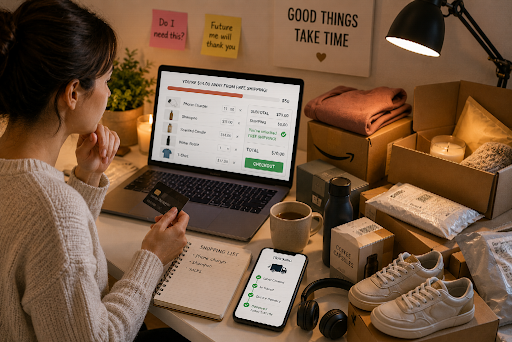
How a $12 Purchase Becomes a $74 Order
You open an online store because you need one thing: a $12 phone charger, a bottle of shampoo, or a pair of basic socks. Two minutes later, the site informs you that shipping costs $7.95 — unless you spend $50. Suddenly, paying for delivery feels like wasting money. You add a second item.
The cart reaches $31. Still not enough. You find a candle, a water bottle, and a discounted T-shirt. The shipping charge disappears, confetti may even appear on the screen, and the order now costs $56. Technically, you saved $7.95. You also spent $44 more than planned.
Free-shipping thresholds work because people dislike paying for something they cannot hold. A candle feels like a purchase. Shipping feels like money vanishing into the air. So shoppers often choose extra products over a smaller delivery fee, even when the extra products cost much more. The strange part is that the decision still feels responsible. You did not “overspend”; you “qualified for free shipping.” The wording turns a larger order into an achievement.
The Deals That Quietly Rewrite Your Shopping List
Some discounts lower the price of something you already wanted. Those are the good ones. Others persuade you to buy a different quantity, a more expensive version, or an item that was never on your list. “Buy two, get one free” sounds generous, but it only saves money when you genuinely need three.
If you came for one bottle of face cream and left with three because the third was free, the store did not give you a free product. It sold you two. Bundles work in a similar way. A coffee machine may cost $89, while the “starter bundle” with capsules, glasses, a milk frother, and cleaning tablets costs $129.
The bundle may offer excellent value on paper. But if you only wanted the machine, the real comparison is not $129 versus the full individual price. It is $129 versus the $89 you planned to spend. Then there are countdown timers, low-stock warnings, flash sales, and coupon codes that expire at midnight. These offers create a new problem for the shopper: instead of asking, “Do I need this?” the brain starts asking, “Will I regret missing this price?” That is how a product can go from irrelevant to urgent in a few seconds.
The Real Cost May Appear After Checkout
The payment confirmation is not always the end of the cost. Extra purchases need space, attention, and sometimes maintenance. Food expires. Cosmetics dry out. Clothing gets forgotten at the back of a closet. A bargain storage basket eventually becomes a basket used to store other bargains.
Returns add another layer. The discounted shoes do not fit, the bundle contains something you dislike, or the “final sale” jacket looks completely different in daylight. Now the bargain requires a return label, repacking, a trip to a drop-off point, and several days of checking whether the refund has arrived.
Large promotional orders may also be split into several shipments because the products are stored in different warehouses or sold by different marketplace sellers. One item arrives on Tuesday, another on Friday, and the last one appears the following week. The shopper who wanted one product is now managing a small delivery project.
If one of those parcels is moving through Pitney Bowes, Pitney Bowes package tracking can help you check its current status and follow the shipment without relying only on the store’s general order page. TrackingPackage also supports many other carriers, which is useful when one promotional order is divided between different delivery networks. The discount may have lasted ten minutes. The packages, returns, and refund notifications can stay with you for weeks.
Why “You Saved $80” Does Not Mean You Gained $80
Online stores love showing a large crossed-out price next to a smaller sale price. A coat was $240 and is now $119. A cookware set was $399 and is now $179. The checkout page announces that you saved $221. But you did not gain $221. You spent $179. The original price is useful only when it reflects what you would realistically have paid. If you would never buy the cookware at $399, that number should not decide whether $179 is affordable.
The better question is whether you wanted the set before seeing the discount and whether it is worth $179 to you today. Price-per-item calculations can be misleading too. A pack of twelve costs less per unit than a pack of four, but the larger pack is only cheaper if all twelve get used. Six discounted yogurts thrown away are more expensive than two full-price yogurts eaten.
The same applies to subscriptions and automatic deliveries. A discount on the first order may look excellent, but the ordinary price matters more if future shipments continue automatically. The first box gets your attention; the next three decide whether the deal was truly good.
The Five-Second Test for a Real Bargain
A genuine bargain usually passes one simple test: you would still want the product without the red sale badge. Before checking out, ignore the amount the store says you saved and look only at the final amount you are about to pay. Ask what was on your original list, which products were added only to unlock a promotion, and whether paying for shipping would actually be cheaper than keeping those extras.
It also helps to imagine the order arriving tomorrow. Where will each item go? When will you use it? Would you buy it at the same price in a plain store without a countdown timer or a progress bar encouraging you to “add only $14 more”? For repeat-use products, check how quickly you realistically finish them. For clothing, compare the sale item with what you already own. For bundles, judge every extra separately. A bundle is not valuable merely because it contains many things.
Sometimes adding one useful household item to reach free shipping makes perfect sense. Sometimes buying two products during a genuine sale saves money. The goal is not to avoid every promotion. It is to notice when the promotion has taken control of the shopping list. The best discount leaves you with something you needed and money still in your account. The worst one leaves you surrounded by extra packages, explaining that buying more was the only sensible way to save.